How to Make the World's Simplest Motor: SciShow Experiments
TL;DR
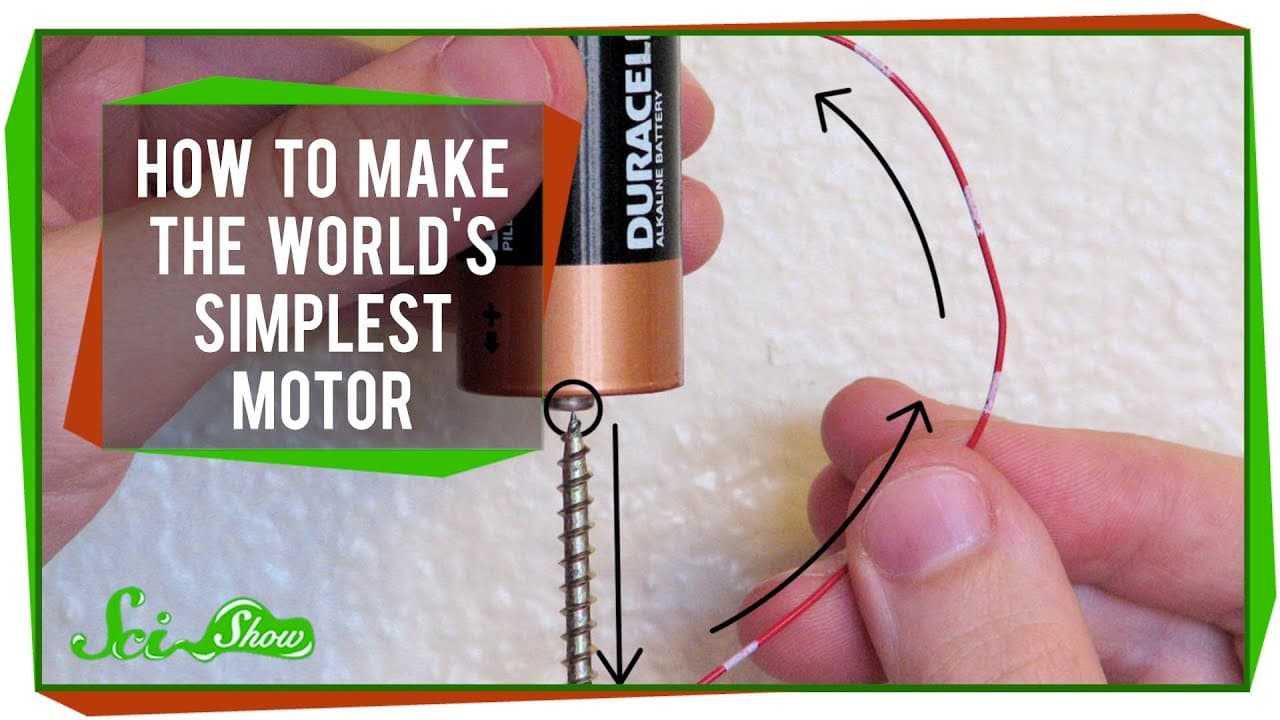
Build a simple electric motor using a magnet, a battery, copper wire, and a screw to demonstrate electromagnetic principles.
Transcript
hello this is Hank green and welcome to another scishow experiment I have in my hand a small disc magnet a D battery a piece of copper wire and a drywall screw for those four objects I'm going to build an electric motor just powerful enough to make this screw spin but also strong enough to blow your mind start with a magnet I'm using a new dim iam ... Read More
Key Insights
- 🧑🦼 Building a DIY electric motor using basic components demonstrates the fundamental principles of electromagnetism.
- 🧑🏭 The Lorentz force, acting on charged particles in the wire, generates the rotational motion of the screw.
- 😒 Commercial electric motors use coils to amplify magnetic fields, unlike the DIY motor's reliance on a permanent magnet.
- 🥵 While simple and cool, the DIY motor is inefficient due to continuous current flow and heat generation.
- 🧑🦼 Understanding the Lorentz force's role in electric motors is essential for grasping their operation and design principles.
- 🛣️ The experiment serves as a hands-on way to explore electromagnetism and basic motor functionality.
- 🦾 By completing an electric circuit with a battery, wire, and magnet, the DIY motor demonstrates the conversion of energy from electrical to mechanical.
Install to Summarize YouTube Videos and Get Transcripts
Explore YouTube Video Summarizer or Get YouTube Transcript Extractor
Questions & Answers
Q: What components are needed to build the DIY electric motor?
You will need a magnet, a D battery, copper wire, and a drywall screw. By assembling these parts correctly, you can create a simple electric motor.
Q: How does the Lorentz force contribute to the motor's motion?
The Lorentz force, generated by the interaction of magnetic fields from the magnet and electric current, acts on charged particles in the wire, causing the screw to spin.
Q: Why is the DIY electric motor not efficient?
The motor runs on a continuous flow of current from the battery, draining it quickly and producing heat. Commercial motors use coils for efficiency.
Q: What key concept does the DIY electric motor experiment illustrate?
The experiment showcases how electric motors convert electrical energy into mechanical energy through the interaction of magnetic fields and electric current.
Summary & Key Takeaways
-
Create a basic electric motor using a magnet, battery, copper wire, and screw to showcase the conversion of electrical energy into mechanical energy.
-
Understand how electromagnetic principles, specifically the Lorentz force, interact to create rotational motion in the motor.
-
While not practical due to inefficiency, the experiment highlights the fundamental concepts behind electric motors.
Read in Other Languages (beta)
Share This Summary 📚
Summarize YouTube Videos and Get Video Transcripts with 1-Click
Try YouTube Summary with ChatGPT & Claude or YouTube Transcript Generator
Explore More Summaries from SciShow 📚


Summarize YouTube Videos and Get Video Transcripts with 1-Click
Try YouTube Summary with ChatGPT & Claude or YouTube Transcript Generator