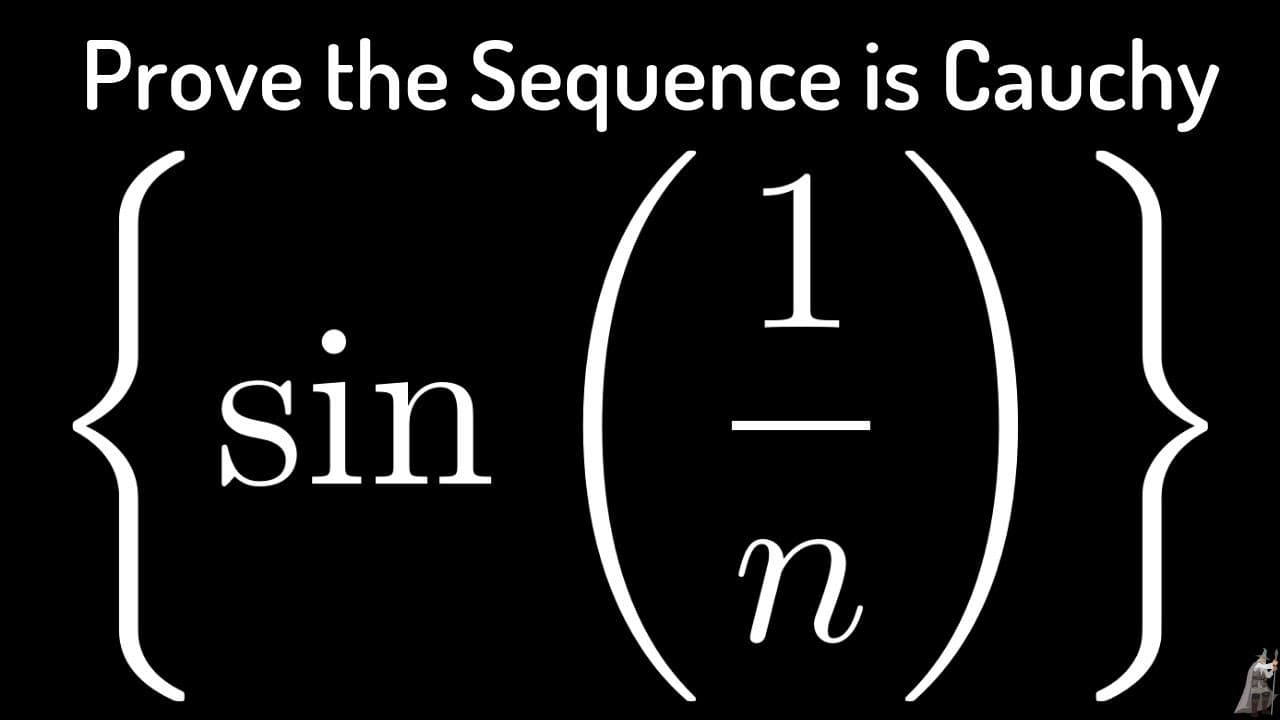
Proof that the Sequence {sin(1/n)} is a Cauchy Sequence
TL;DR
Proving the sequence sine of 1 over N is a Cauchy sequence using mathematical properties and the Archimedean property.
Transcript
hi YouTube in this video we're going to prove that the sequence sine of 1 over N is a Cauchy sequence is a Cauchy sequence so before we do the proof let me recall what it means for a sequence to be Koshi we say a sequence a sub n is Koshi if for all epsilon greater than 0 we can find some positive integer say capital n such that for all little N an... Read More
Key Insights
- ❓ Understanding the concept of Cauchy sequences is fundamental in mathematical analysis.
- 🖐️ Trigonometric identities play a crucial role in simplifying calculations during proofs.
- 👻 The Archimedean property allows for the selection of appropriate values in mathematical proofs.
- 🍉 Utilizing inequalities like the triangle inequality can help establish relationships between terms in a sequence.
- 💐 The sequential logical flow of a proof is crucial in ensuring clarity and understanding.
- ❓ Justifying choices made in a proof enhances the credibility and rigor of the argument.
- ❓ Mathematical proofs often involve manipulating equations and properties to demonstrate specific results.
Install to Summarize YouTube Videos and Get Transcripts
Explore YouTube Video Summarizer or Get YouTube Transcript Extractor
Questions & Answers
Q: What is the definition of a Cauchy sequence?
A sequence is considered Cauchy if for any small margin of error (epsilon), there exists a point in the sequence where all elements beyond that point are within that margin of error from each other.
Q: How does the proof utilize trigonometric identities?
The proof utilizes trigonometric identities like the absolute value of sin(X) being less than or equal to the absolute value of X to simplify calculations and comparisons between terms in the sequence.
Q: Why is the Archimedean property important in this proof?
The Archimedean property allows for the selection of a natural number greater than a real number, facilitating the choice of an appropriate N in the proof to demonstrate the Cauchy nature of the sequence.
Q: How does the use of the triangle inequality contribute to the proof?
The triangle inequality is used to find an upper bound for the absolute value of the difference between terms in the sequence, aiding in determining the closeness of terms required for the sequence to be Cauchy.
Summary & Key Takeaways
-
Explanation of what it means for a sequence to be Cauchy.
-
Utilization of trigonometric identities and the triangle inequality in the proof.
-
Utilization of the Archimedean property to choose a natural number for the proof.
Read in Other Languages (beta)
Share This Summary 📚
Summarize YouTube Videos and Get Video Transcripts with 1-Click
Try YouTube Summary with ChatGPT & Claude or YouTube Transcript Generator
Explore More Summaries from The Math Sorcerer 📚



Summarize YouTube Videos and Get Video Transcripts with 1-Click
Try YouTube Summary with ChatGPT & Claude or YouTube Transcript Generator