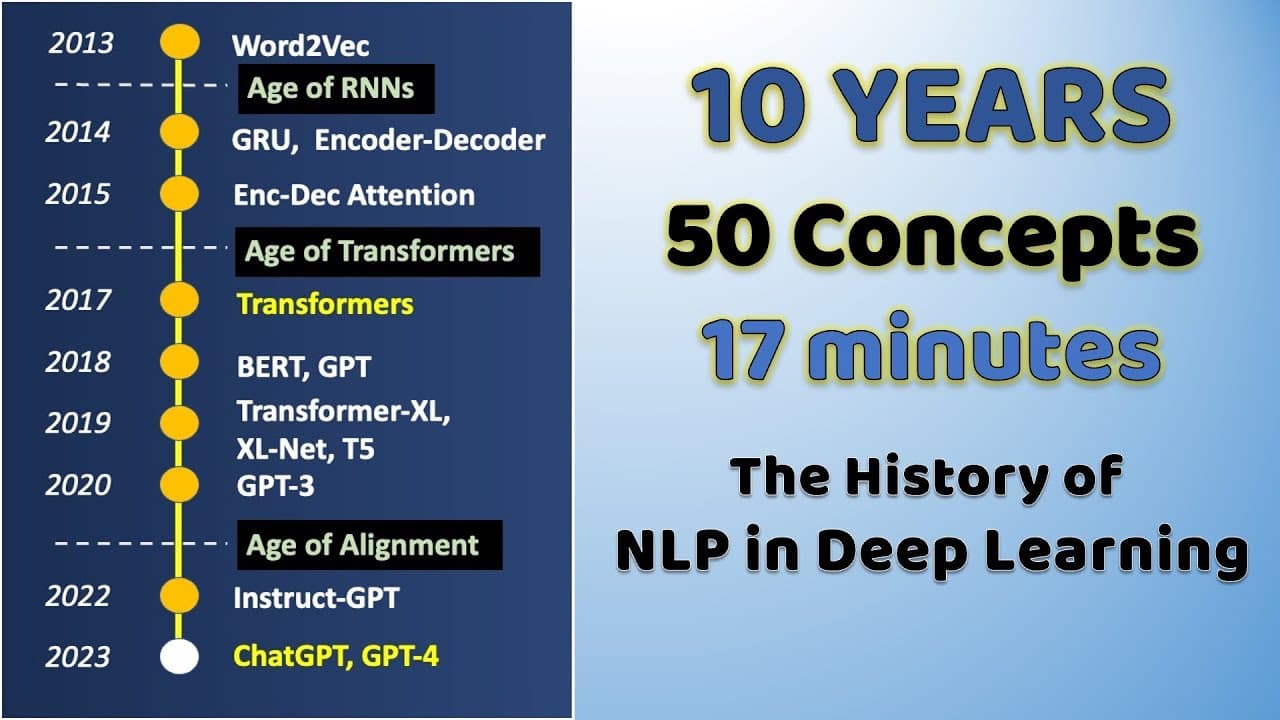
10 years of NLP history explained in 50 concepts | From Word2Vec, RNNs to GPT
TL;DR
An analysis of the advancements in natural language processing (NLP) and the emergence of language models (LLMs) with improved capabilities and safety measures.
Transcript
2023 has been a key year in the space of artificial intelligence chat GPT rocked the World by introducing many people about the potential of AI to not only be great generative text models but also exhibit intelligence creativity and reliability in this episode of neural breakdown I'm going to talk about the last 10 or so years of deep learning rese... Read More
Key Insights
- 🖐️ RNNs, such as LSTMs and GRUs, played a crucial role in NLP research by preserving token order and improving long-term dependency issues.
- 👻 The encoder-decoder architecture revolutionized sequence-to-sequence tasks in NLP, allowing for the generation of target output sequences from input sequences.
- 🔠 The attention mechanism improved the performance of the encoder-decoder architecture by selectively focusing on specific tokens in the input sequence.
- 👻 Transformers further advanced NLP research by allowing parallel processing of input sequences and introducing self-attention and multi-headed attention mechanisms.
Install to Summarize YouTube Videos and Get Transcripts
Explore YouTube Video Summarizer or Get YouTube Transcript Extractor
Questions & Answers
Q: What are language models and how do they work?
Language models are machine learning models that predict the likelihood of a sequence of tokens in a language. They work by using embeddings and recurrent neural networks (RNNs), such as GRUs and LSTMs, to preserve the order of tokens and generate coherent text.
Q: How does the encoder-decoder architecture contribute to sequence-to-sequence tasks in NLP?
The encoder-decoder architecture takes an input sequence and generates an output sequence. The encoder uses an RNN to create embeddings of the input sequence, which are then passed to the decoder. The decoder uses another RNN to generate the target output sequence based on the encoder's embeddings.
Q: What is the attention mechanism in NLP and how does it improve the encoder-decoder architecture?
The attention mechanism allows the decoder to selectively focus on specific tokens in the encoder sequence, instead of relying on a single encoder output. This improves the ability to generate target sequences by combining relevant hidden states from the input sequence.
Q: How do Transformers differ from RNN-based models in NLP?
Transformers are encoder-decoder architectures that use self-attention and multi-headed attention mechanisms. They can process entire input sequences in parallel, which significantly speeds up training. Transformers also introduce positional encodings to retain sequential information.
Summary & Key Takeaways
-
Language models are machine learning models that predict the likelihood of a sequence of tokens in a language.
-
RNNs, such as GRUs and LSTMs, are used to create embeddings and preserve the order of tokens in a sequence.
-
The encoder-decoder architecture, attention mechanism, and Transformers have revolutionized NLP research and improved the ability to generate coherent text.
Read in Other Languages (beta)
Share This Summary 📚
Summarize YouTube Videos and Get Video Transcripts with 1-Click
Try YouTube Summary with ChatGPT & Claude or YouTube Transcript Generator
Explore More Summaries from Neural Breakdown with AVB 📚


Summarize YouTube Videos and Get Video Transcripts with 1-Click
Try YouTube Summary with ChatGPT & Claude or YouTube Transcript Generator