Caselet DI | Students studying in classes | DI | Reasoning | Part - 04 | Bharath Kumar
TL;DR
Comprehensive guidance on interpreting student data across classes.
Transcript
hi everyone welcome to this session in this session I am continuing caselit data interpretation first of all uh we need to read the information carefully which is provided in this passage after that based on that passage we need to give some conclusions according to the given information once you got this entire information which is provided in thi... Read More
Key Insights
- 😫 A clear understanding of class-specific data is crucial for accurate interpretation and problem-solving in data sets related to education.
- 😥 Establishing relationships among data points, such as the total count of students and gender distribution, forms the foundation for deeper analytical queries.
- 🥳 Percentages, differences, and ratios are significant metrics in assessing male versus female student ratios in educational contexts.
- 👣 Each calculation or interpretation step should be meticulously tracked to ensure results are reflective of the original data and relationships established.
- 🪛 The example-driven approach illustrates practical applications of interpreting educational data dynamics in a structured setting, enhancing comprehension.
- 👻 Engaging with problems step-by-step allows for a better grasp of data analysis methodologies and the ability to apply them in varied contexts.
- 🤔 The final analysis highlights the importance of reasoning and logical thinking in interpreting data, especially when discrepancies in expected results are encountered.
Install to Summarize YouTube Videos and Get Transcripts
Explore YouTube Video Summarizer or Get YouTube Transcript Extractor
Questions & Answers
Q: What key information is necessary for data interpretation in this session?
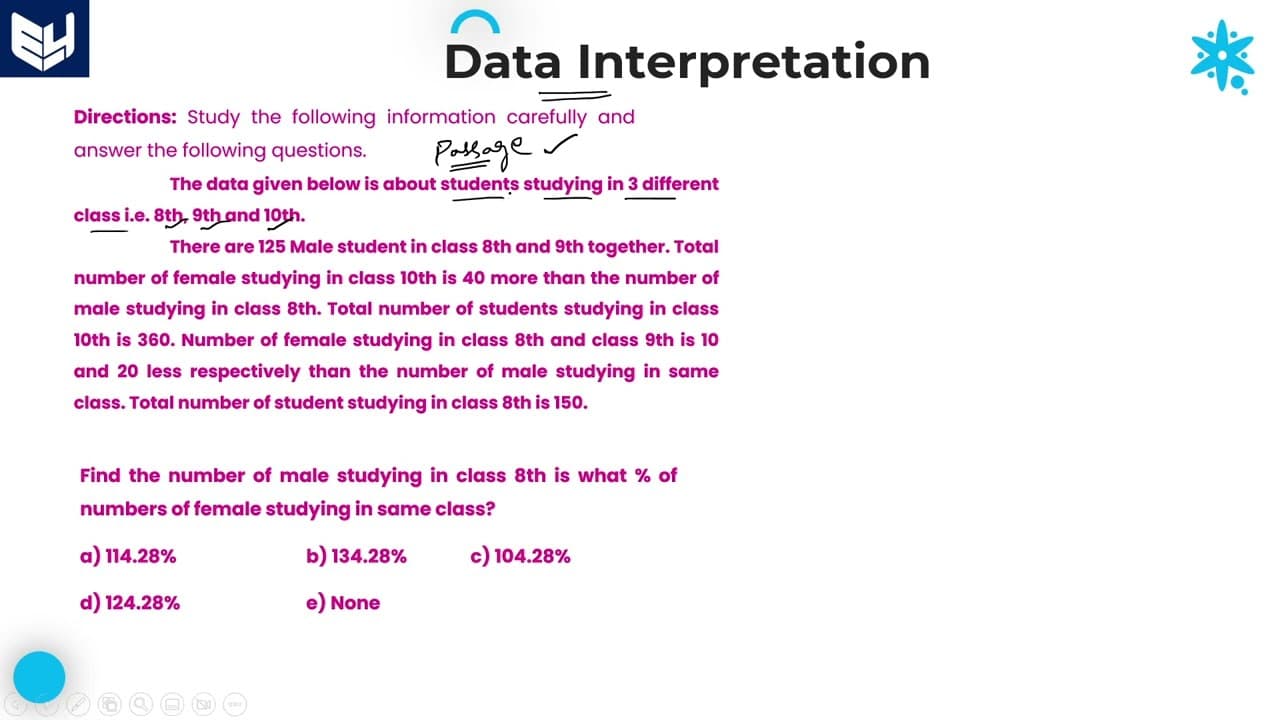
The critical information includes the number of male and female students in each grade, particularly focusing on the total male students in classes 8 and 9, female students in class 10, and important relationships such as how many more females are present in class 10 compared to the males in class 8. Understanding these parameters is essential to solve the accompanying questions.
Q: How are the number of male students distributed among the classes?
The distribution involves 80 male students in class 8, 45 in class 9, and 240 in class 10. Each figure is derived from the total provided for each class and should be tracked carefully as the calculations progress. The total male count is crucial for understanding gender dynamics in the classes addressed.
Q: What calculations are required to determine the percentage of male students versus female students in a class?
To find the percentage, you divide the number of male students by the number of female students in the same class, multiply by 100, and present it as a percentage. For example, for class 8, with 80 male and 70 female students, the calculation would be (80/70)*100, leading to a specific percentage that indicates the male-to-female ratio in that class.
Q: How do you calculate the difference between total male and female students from all classes?
To find this difference, sum the total males and females from all classes (80 males from class 8, 45 from class 9, and 240 from class 10 for males; and 70, 25, and 120 for females respectively) and then subtract the total number of females from the total number of males to determine the net difference.
Summary & Key Takeaways
-
The session focuses on interpreting data related to the student population in 8th, 9th, and 10th grades, emphasizing careful reading and calculation based on provided statistics.
-
Key statistical relationships are established, such as the total number of male and female students, and the calculations necessary to derive information from class-specific data.
-
Various problems are presented, encompassing percentages, differences, and ratios of male and female student populations, showcasing methods for solving data interpretation questions effectively.
Read in Other Languages (beta)
Share This Summary 📚
Summarize YouTube Videos and Get Video Transcripts with 1-Click
Try YouTube Summary with ChatGPT & Claude or YouTube Transcript Generator