What Is Euler's Method and How Does It Work?
TL;DR
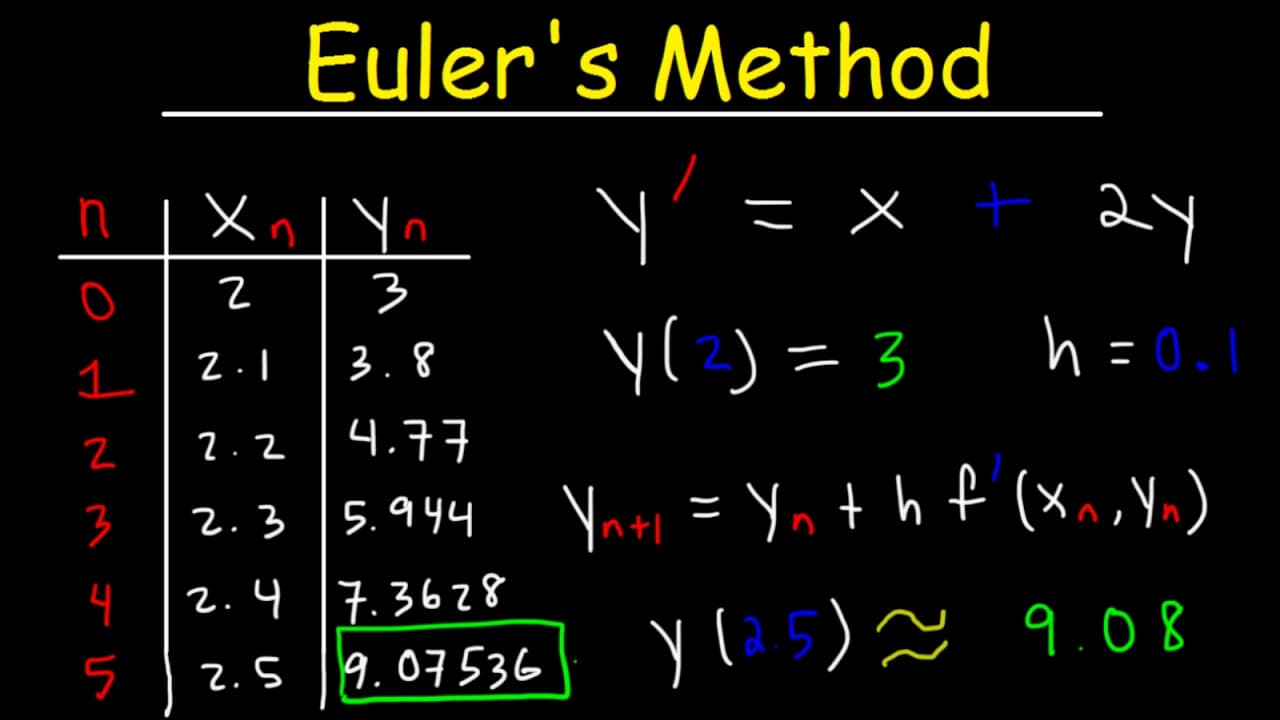
Euler's method is a numerical technique used to approximate solutions to differential equations by employing tangent line approximations with course corrections. By selecting a step size and initial conditions, this method iteratively updates values to estimate the function at specific points, improving accuracy as the step size decreases.
Transcript
in this video we're going to use euler's method to approximate the solution of a differential equation let's say we're going to use a simple function let's say y is equal to x squared the differential equation dydx is equal to 2x and now let's say if we want to estimate y of 0.5 actually uh 1.5 now there's different ways we can do that we can use t... Read More
Key Insights
- 🔨 Euler's method is a useful tool for approximating differential equations.
- 🖐️ The step size plays a crucial role in determining the accuracy of the approximation.
- 🫥 Euler's method is based on tangent line approximations but incorporates course correction.
- 😥 The formula for Euler's method involves updating the function values using the slope at each point.
- ❓ As the step size decreases, the accuracy of the approximation improves.
- 😥 Euler's method can be used to estimate the value of a differential equation at any specific point.
- ❓ The method can be used with different initial conditions and step sizes for different equations.
Install to Summarize YouTube Videos and Get Transcripts
Explore YouTube Video Summarizer or Get YouTube Transcript Extractor
Questions & Answers
Q: What is Euler's method and how does it work?
Euler's method is a numerical technique used to estimate the solution of a differential equation. It involves using tangent line approximations to predict the function values at different points. The method works by iteratively updating the function values using the slope at each point until the desired point is reached.
Q: How is Euler's method different from tangent line approximation?
Euler's method is an extension of tangent line approximation with course correction. While tangent line approximation only considers the slope at one point, Euler's method adjusts the slope at each step size, resulting in a more accurate approximation.
Q: What is the significance of the step size in Euler's method?
The step size in Euler's method determines the distance between each point along the x-axis. Choosing a smaller step size will increase the accuracy of the approximation, but will also require more computations.
Q: How can Euler's method be used to estimate the value of a differential equation at a specific point?
By specifying the initial conditions, such as the function value and the step size, we can calculate the function values at each subsequent point using the formula provided in Euler's method. This allows us to approximate the function value at the desired point.
Summary & Key Takeaways
-
Euler's method is a technique used to approximate the solution of a differential equation.
-
It involves using tangent line approximations with course correction.
-
By choosing a step size and initial conditions, we can estimate the function value at a specific point.
Read in Other Languages (beta)
Share This Summary 📚
Summarize YouTube Videos and Get Video Transcripts with 1-Click
Try YouTube Summary with ChatGPT & Claude or YouTube Transcript Generator
Explore More Summaries from The Organic Chemistry Tutor 📚



Summarize YouTube Videos and Get Video Transcripts with 1-Click
Try YouTube Summary with ChatGPT & Claude or YouTube Transcript Generator