Planning and Learning - Reinforcement Learning Chapter 8
TL;DR
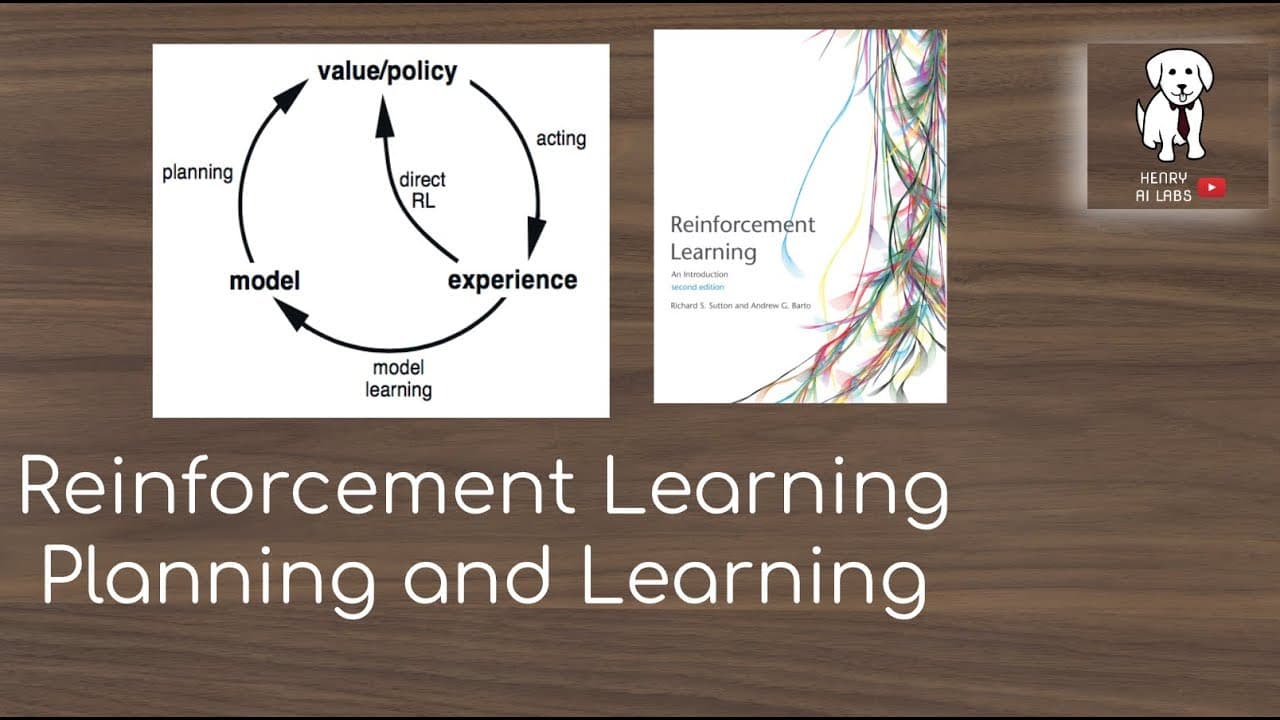
This video discusses the differences between planning and learning in reinforcement learning.
Transcript
this video will explain planning and learning with tabular methods chapter 8 in an introduction reinforced and learning by Richard Sutton and Andrew Bartow this video is a part of the series going through this book chapter by chapter explaining some of the key concepts and ideas so if you're new to the series please check out chapter 1 linked in de... Read More
Key Insights
- ⚾ Planning and learning are interrelated concepts in reinforcement learning, with model-based approaches enhancing learning via simulation.
- 🥶 Model-free learning relies exclusively on empirical data without utilizing predefined environmental models, typically leading to longer convergence times.
- 💱 Efficient reinforcement learning requires structuring updates around significant value changes to avoid unnecessary computations.
- 🪡 The Dyna Q agent exemplifies the need for rewarding under-explored states to promote exploration and learning.
- ⌛ Decision time planning is critical for real-time applications, allowing quick decision-making without altering long-term strategies.
- ❓ Update algorithms, such as prioritized sweeping, improve resource allocation during learning by focusing on impactful states.
- 👾 Monte Carlo tree search provides an effective method for exploring future outcomes in complex environments, especially beneficial for strategic games like chess.
Install to Summarize YouTube Videos and Get Transcripts
Explore YouTube Video Summarizer or Get YouTube Transcript Extractor
Questions & Answers
Q: What is the primary focus of Chapter 8 in the video?
Chapter 8 primarily focuses on understanding the differences between planning and learning within reinforcement learning, specifically distinguishing between model-based and model-free methods. It emphasizes how these concepts interact and can be unified to improve learning efficiency through simulated experiences versus direct trial-and-error learning.
Q: How does model-based learning differ from model-free learning?
Model-based learning utilizes a predefined model of the environment to simulate experiences, whereas model-free learning relies solely on trial and error to gather experiential data. This chapter illustrates how model-based approaches can optimize learning by anticipating outcomes using the environment's transition probabilities.
Q: What is prioritized sweeping, and why is it useful?
Prioritized sweeping is a technique where updates to state values are made based on significant changes observed in recent experiences. This method helps in focusing on states that are more likely to influence other states, thereby improving learning efficiency and accelerating convergence by efficiently navigating the state space.
Q: Can the model of the environment be incorrect? What implications does this have?
Yes, the model of the environment can become outdated or incorrect as real-world conditions change. This can lead to inefficiencies in learning since the agent may continue to rely on a flawed model, delaying adaptation to new optimal paths and strategies within the environment.
Q: How does decision time planning differ from background planning?
Decision time planning involves simulating experiences only for immediate decision-making, using current state information without updating overall value functions or policies. In contrast, background planning integrates simulated experiences to update these functions and refine strategies over time.
Q: What role does Monte Carlo tree search play in reinforcement learning?
Monte Carlo tree search is essential in decision-making processes for complex environments, allowing an agent to explore possible future states by constructing a comprehensive game tree. It facilitates searching through potential actions more efficiently, saving computational resources while optimizing decision-making.
Q: Why might it be advantageous to have more planning steps between experiences?
More planning steps can provide a more thorough exploration of the state space, enabling the agent to make better-informed updates to its value functions. This enhances the learning process by allowing the agent to simulate various outcomes and learn from them, leading to quicker convergence towards optimal behavior.
Q: What is the trade-off between expected and sample updates in reinforcement learning?
Expected updates involve summing probabilities of rewards for all possible next states, which becomes computationally intensive as the branching factor increases. In contrast, sample updates require only generating a single next state, thus significantly reducing computational overhead and making them more efficient in practice.
Summary & Key Takeaways
-
The video covers Chapter 8 of "An Introduction to Reinforcement Learning," highlighting the distinction between model-based and model-free learning approaches.
-
Key concepts include the impact of planning steps on learning efficiency and comparisons between updating value functions via simulated experiences versus direct experiences.
-
Decision time planning, including Monte Carlo tree search, is introduced as a method for making immediate decisions during reinforcement learning tasks.
Read in Other Languages (beta)
Share This Summary 📚
Summarize YouTube Videos and Get Video Transcripts with 1-Click
Try YouTube Summary with ChatGPT & Claude or YouTube Transcript Generator
Explore More Summaries from Connor Shorten 📚
Summarize YouTube Videos and Get Video Transcripts with 1-Click
Try YouTube Summary with ChatGPT & Claude or YouTube Transcript Generator