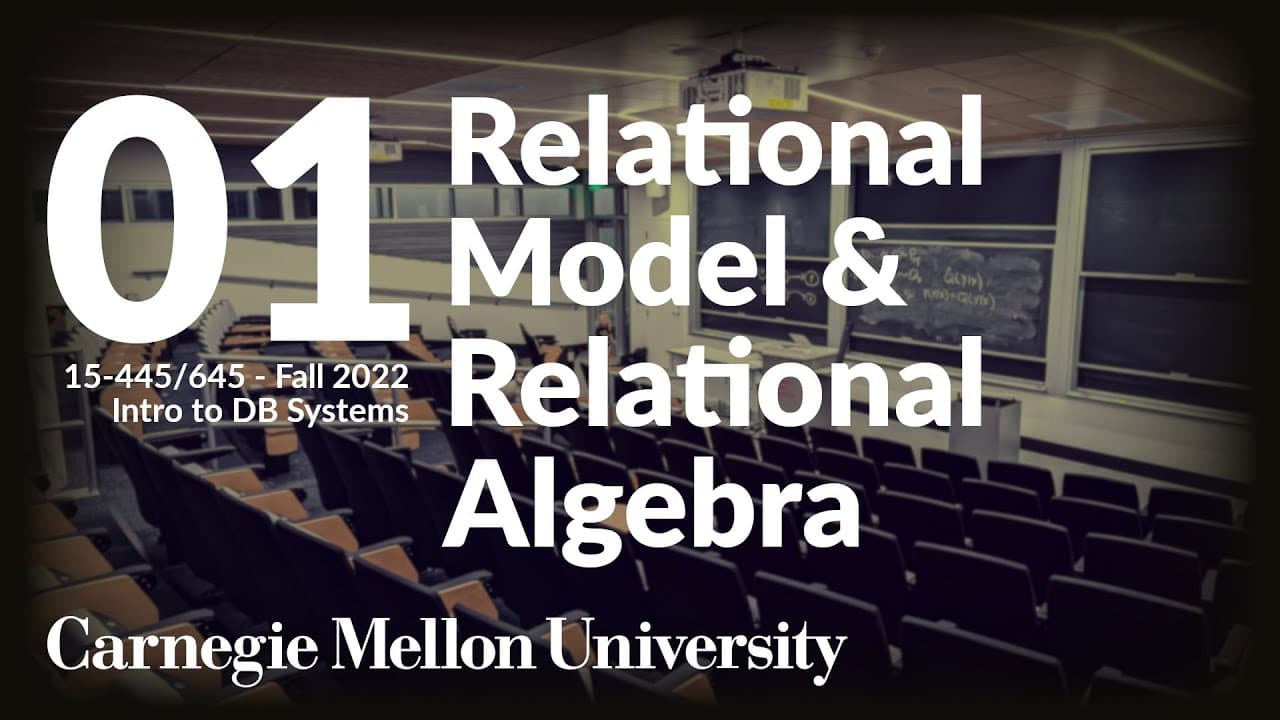
01 - Relational Model & Relational Algebra (CMU Intro to Database Systems / Fall 2022)
TL;DR
Learn about the relational model in database management systems, including the basic operators for manipulating data.
Transcript
uh welcome to davidson my name is andy uh i have not taught this class in a while uh so it's good to be back everybody is very supportive appreciative uh whoever give me the mixtape thank you i'll listen to this later um so i'll give her a round of applause for a dj dj mushu so mushu is the endless dj in pittsburgh so why don't you show what you ca... Read More
Key Insights
- ❓ The relational model provides an abstraction layer for representing and interacting with databases.
- 👻 The basic operators in the relational model allow for manipulating data through filtering, selecting attributes, combining relations, and more.
- 🚰 The join operator is especially important for retrieving related data from multiple tables.
- 🌥️ The Cartesian product operator can be useful for testing and analysis, but it can also result in a large amount of output.
- ❓ The relational model is widely used in modern database management systems, with SQL being the most common language for interacting with relational databases.
- 🉐 While the relational model is powerful, it is not the only data model available, and other models such as NoSQL and object-oriented databases have gained popularity in recent years.
Install to Summarize YouTube Videos and Get Transcripts
Explore YouTube Video Summarizer or Get YouTube Transcript Extractor
Questions & Answers
Q: What is the relational model in database management systems?
The relational model is a mathematical abstraction used to represent and interact with databases. It consists of tables (relations) that contain tuples (rows) with attributes (columns) to represent entities in the real world.
Q: What are the basic operators in the relational model?
The basic operators in the relational model are select, project, union, intersection, difference, Cartesian product, and join. These operators allow for filtering, choosing specific attributes, combining relations, finding common tuples, finding tuples that exist in one relation but not the other, generating all possible combinations of tuples, and matching tuples between two relations, respectively.
Q: What is the purpose of the Cartesian product operator?
The Cartesian product operator generates a new relation by combining all possible combinations of tuples from two input relations. This can be useful for testing and analysis purposes, but it can also result in a large output relation.
Q: How does the join operator work in the relational model?
The join operator is used to match tuples between two relations based on specific conditions. It allows for the combination of data from multiple tables by comparing values in common attributes. This is useful for retrieving related data from different tables.
Summary & Key Takeaways
-
The relational model is a mathematical abstraction used for representing and interacting with databases.
-
It consists of tables (relations) that contain tuples (rows) with attributes (columns) to represent entities in the real world.
-
The basic operators in the relational model include select (filtering data), project (choosing specific attributes), union (combining two relations), intersection (finding common tuples), difference (finding tuples that exist in one relation but not the other), Cartesian product (generating all possible combinations of tuples), and join (matching tuples between two relations).
Read in Other Languages (beta)
Share This Summary 📚
Summarize YouTube Videos and Get Video Transcripts with 1-Click
Try YouTube Summary with ChatGPT & Claude or YouTube Transcript Generator
Explore More Summaries from CMU Database Group 📚
Summarize YouTube Videos and Get Video Transcripts with 1-Click
Try YouTube Summary with ChatGPT & Claude or YouTube Transcript Generator