Line Graph | % of Profit | DI | Reasoning | Part - 06 | Bharath Kumar
TL;DR
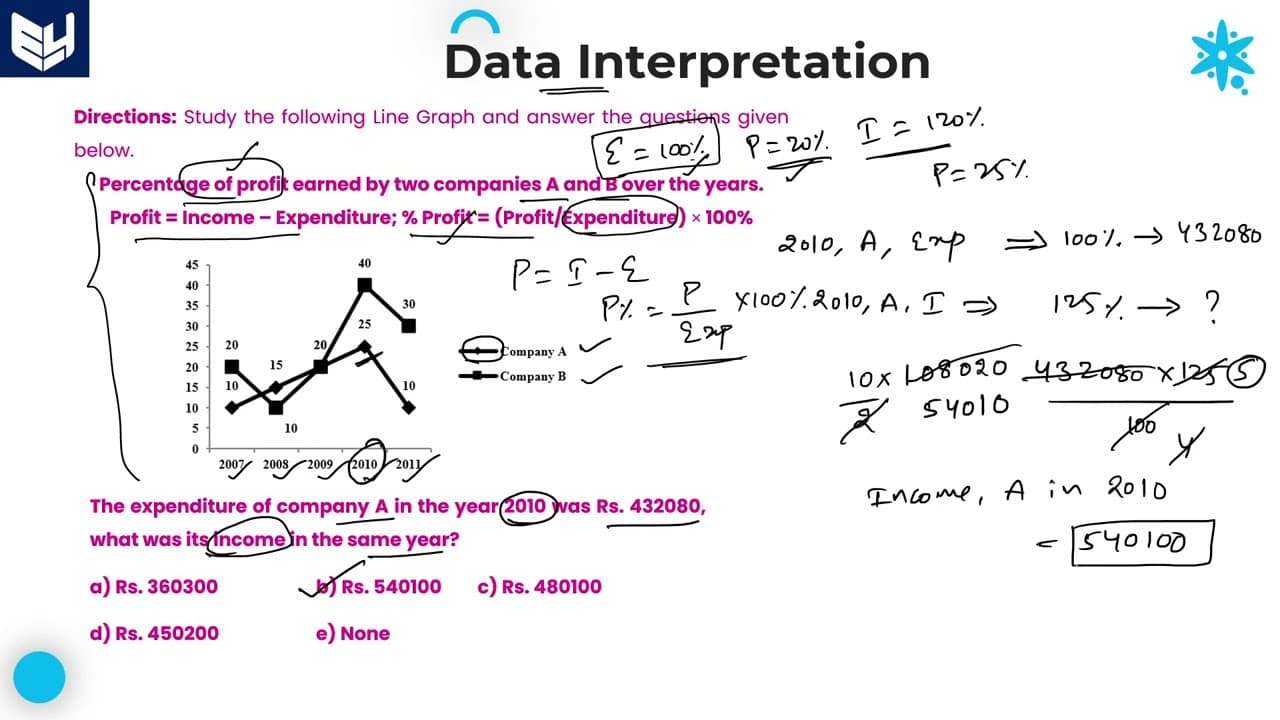
The session covers profit percentages of two companies over five years, including calculations and interpretations.
Transcript
hi everyone welcome to the session in this session I am going to explaining about a line Draft date and repetition here first of all we need to read the information carefully and after that based on the information uh we need to solve the questions uh according to the given line graph data interpretation see here first of all the information is abo... Read More
Key Insights
- ☺️ Profit percentage is calculated as (Profit / Expenditure) x 100, which allows for consistent tracking of financial performance.
- 📈 The success of a company can often be evaluated by analyzing profit trends over multiple years.
- ❓ It is essential to distinguish between profit percentage and actual profits to avoid misconceptions.
- 🥺 In calculations, small errors can lead to different results, emphasizing the need for careful arithmetic when interpreting financial data.
- 🎁 Financial assessments based on graphical data require clear understanding of both the data presented and the underlying mathematical principles.
- ❓ Equating expenditure to 100% supports a standard framework for financial comparisons and facilitates easier calculations.
- 🤩 Identifying key years in financial trends allows companies to make data-driven decisions for future growth.
Install to Summarize YouTube Videos and Get Transcripts
Explore YouTube Video Summarizer or Get YouTube Transcript Extractor
Questions & Answers
Q: What is the importance of understanding profit percentages in business analysis?
Understanding profit percentages is crucial because it allows businesses to determine how efficiently they're converting sales into profits. It aids in financial planning, budgeting, and making strategic decisions to enhance profitability. A comparative analysis between companies can reveal competitive advantages and areas for improvement.
Q: How do we calculate income using profit percentage and expenditure?
Income can be calculated by adding the profit to the expenditure. If expenditure is considered as 100%, then the formula to find income when profit percentage is known is: Income = Expenditure + (Expenditure x Profit Percentage / 100). This relationship helps track financial performance effectively.
Q: Why is expenditure treated as 100% when calculating profit percentages?
Treating expenditure as 100% standardizes calculations and simplifies references to profit percentages. It facilitates easy comparison between different financial variables and allows for straightforward calculations when profit is received as a percentage of total costs.
Q: Can we determine exact profits between Companies A and B without knowing expenditures?
No, exact profits cannot be determined without knowing the actual expenditures. Profit amounts can vary significantly depending on the base expenditures, making it essential to have those figures to calculate correct profit values or ratios accurately.
Summary & Key Takeaways
-
The session discusses the interpretation of a line graph showing profit percentages for Companies A and B from 2007 to 2011, detailing the methodology for calculating income and expenditure based on profit percentages.
-
Essential formulas related to profit and profit percentage are outlined, specifically how to determine income from expenditure and profit percentage using percentages over a base of 100.
-
Several questions are posed regarding the financial performance of Companies A and B, assessing their expenditures and profits while providing clear solutions through mathematical reasoning.
Read in Other Languages (beta)
Share This Summary 📚
Summarize YouTube Videos and Get Video Transcripts with 1-Click
Try YouTube Summary with ChatGPT & Claude or YouTube Transcript Generator