How Are Scientists Creating Black Holes at CERN?
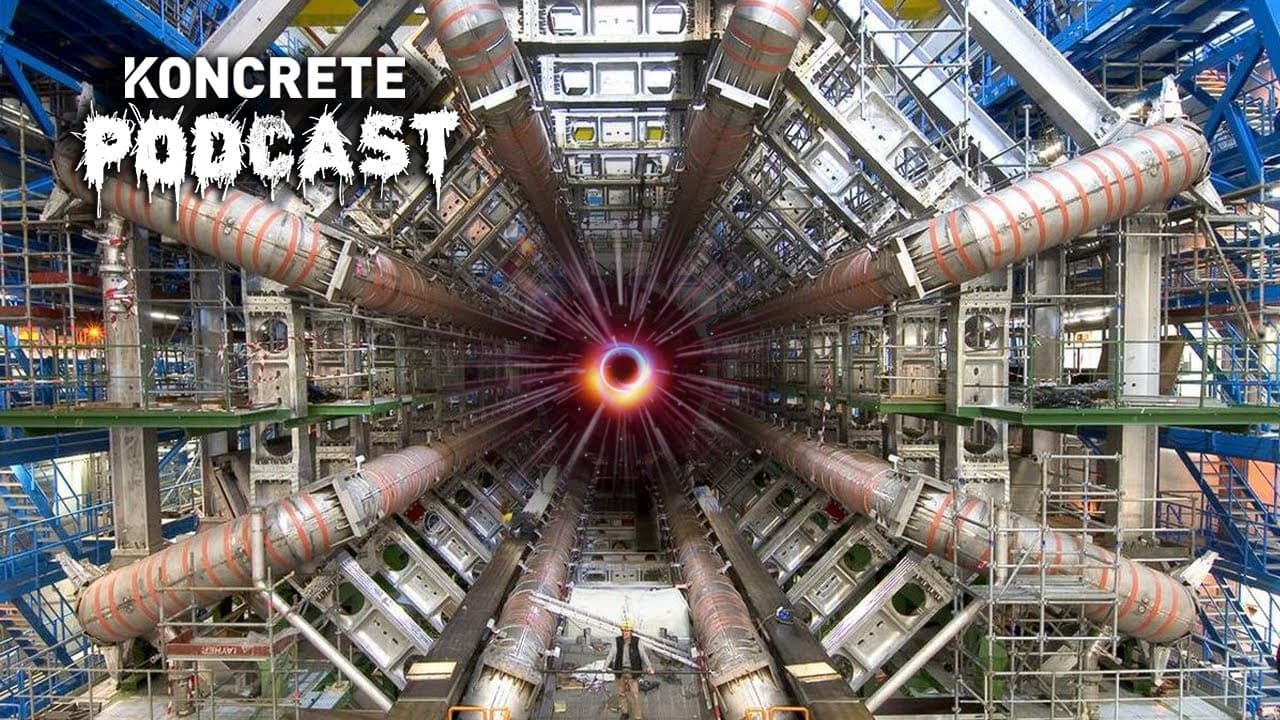
TL;DR
Scientists at CERN are able to create miniature black holes through high-energy particle collisions in the Large Hadron Collider. These experiments, while theoretical in nature, are part of an ongoing effort to explore fundamental physics, dark matter, and the universe's structure. The aim is to better understand the nature of matter, even leading to advancements in medical technology.
Transcript
next week's podcast with matthew b cox is now up on patreon all podcasts will now be posted there a week before youtube as well as bonus content and discounts on concrete merch go to patreon.com concretevideos to check it out hello world welcome to podcast number 78 i think it's 78 is it 78 what [ __ ] podcast are we on uh yeah today's guest is pau... Read More
Key Insights
- 🤗 Paul's approach to teaching physics emphasizes creativity and hands-on learning, making complex topics accessible to students.
- 🔨 The LHC is a powerful tool for understanding the fundamental constituents of matter and exploring theories of the universe.
- 😃 Dark matter remains one of the biggest mysteries in modern astrophysics, with ongoing research aimed at uncovering its properties and implications.
- 😷 Innovations arising from particle physics research, like digital technology and advanced medical techniques, exemplify the relevance of fundamental science.
- 🖤 The concept of primordial black holes challenges traditional notions of how black holes form and behave in the universe.
- 🥺 Engaged teaching and communication of scientific concepts can inspire student interest, leading to future careers in science.
- ⌛ Understanding time dilation and the effects of gravity on time are vital for advancements in technology like GPS.
Install to Summarize YouTube Videos and Get Transcripts
Explore YouTube Video Summarizer or Get YouTube Transcript Extractor
Questions & Answers
Q: What drove Paul Lyan to start his YouTube channel?
Paul originally created the YouTube channel to provide his high school students with access to classroom content when they missed classes. Over time, he recognized the potential to reach a wider audience and decided to refine his content to make it more engaging for general viewers beyond just high school students.
Q: How does the Large Hadron Collider (LHC) at CERN work?
The LHC is a massive particle accelerator that uses strong magnets to propel protons at near light-speed around a circular track. By smashing protons together, scientists can observe the resultant particles, allowing them to explore fundamental questions about matter and the universe.
Q: What is dark matter, and why is it significant?
Dark matter refers to a type of matter that doesn’t emit light or energy, making it invisible and detectable only through its gravitational effects. Its existence accounts for discrepancies in the mass measurements of galaxies and is thought to make up a large portion of the universe.
Q: Can black holes be created at CERN, and what are primordial black holes?
CERN cannot currently create stable black holes due to energy limitations. Primordial black holes are theorized to have formed in the early universe shortly after the Big Bang and are incredibly small, evaporating quickly and posing no threat to our world if created in laboratories.
Q: What are some technological advancements that have arisen from CERN's research?
Technologies developed at CERN include the World Wide Web, advancements in medical imaging like PET scans, and techniques for precise cancer treatments such as hadron therapy, showcasing the practical benefits of fundamental research.
Q: What is the future of the universe according to current theories?
The universe is believed to be expanding at an accelerating rate due to dark energy. If this continues, eventually, stars will run out of fuel, leading to a dark, cold universe filled with remnants of matter left behind, billions of years into the future.
Summary & Key Takeaways
-
The podcast features Paul Lyan, a physics educator, who shares insights about his teaching methods and his YouTube channel, physics high, focusing on making science engaging.
-
Key topics discussed include CERN's groundbreaking research on black holes and dark matter, explaining the complexity and relevance of these concepts to the universe.
-
The conversation emphasizes the importance of curiosity and inquiry-driven learning in science, illustrating how enthusiasm can inspire future scientists.
Read in Other Languages (beta)
Share This Summary 📚
Summarize YouTube Videos and Get Video Transcripts with 1-Click
Try YouTube Summary with ChatGPT & Claude or YouTube Transcript Generator
Explore More Summaries from Danny Jones Podcast 📚






Summarize YouTube Videos and Get Video Transcripts with 1-Click
Try YouTube Summary with ChatGPT & Claude or YouTube Transcript Generator