Theory of Everything | Stephen Wolfram and Lex Fridman
TL;DR
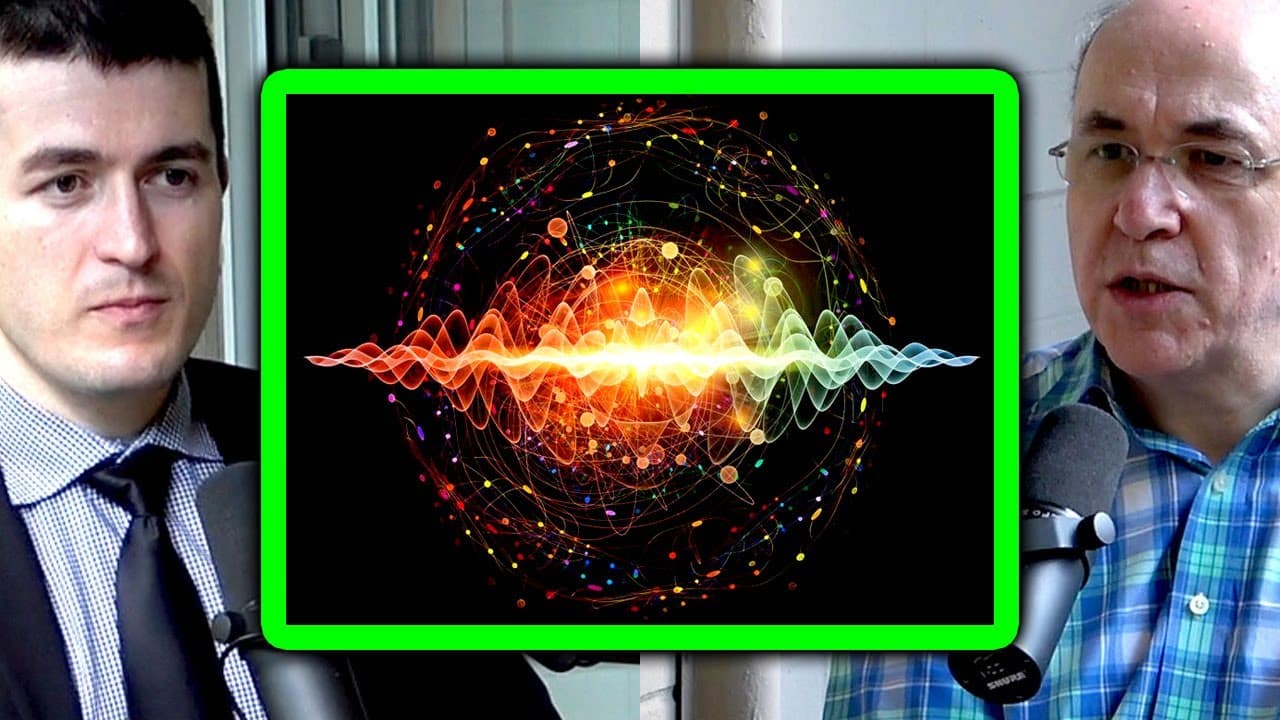
Physicists aim to develop a comprehensive theory that can explain all phenomena in the universe through a simple set of mathematical rules.
Transcript
so let's talk a little bit of physics maybe let's ask the uh the biggest question what is a theory of everything in general what does that mean yeah so i mean the question is can we kind of reduce what has been physics as a something where we have to sort of pick away and say do we roughly know how the world works to something where we have a compl... Read More
Key Insights
- 🛄 The quest for a theory of everything aims to reduce physics to a complete mathematical framework that can explain all phenomena in the universe.
- ❓ Computational irreducibility poses challenges in predicting complex phenomena without extensive computation.
- 🦾 Certain aspects of 20th-century physics, such as general relativity and quantum mechanics, may be derived from simple underlying rules.
- 🦾 The fact that general relativity and quantum mechanics are generic to a wide class of systems suggests their importance in understanding the universe.
- 🦾 The unification of general relativity and quantum mechanics is a long-standing challenge in theoretical physics.
- 🏛️ The discovery of computational reducibility in certain classes of simple rules brings potential insights into the nature of a theory of everything.
- 😮 The existence of unstructured underlying rules that give rise to phenomena like general relativity and quantum mechanics is remarkable.
Install to Summarize YouTube Videos and Get Transcripts
Explore YouTube Video Summarizer or Get YouTube Transcript Extractor
Questions & Answers
Q: What does it mean to have a theory of everything in physics?
A theory of everything refers to a complete mathematical framework that can explain all physical phenomena in the universe, unifying various branches of physics into a cohesive whole.
Q: How does computational irreducibility complicate the search for a theory of everything?
Computational irreducibility implies that some complex phenomena cannot be predicted without extensive computation. Hence, finding a set of simple rules that can accurately represent all physical processes remains challenging.
Q: Can a simple set of rules with a hypergraph data structure serve as a satisfying theory of everything?
While a simple rule-based approach with a hypergraph has its merits, computational irreducibility remains a hurdle. Nonetheless, it is fascinating that certain aspects of 20th-century physics can be derived from these simple rules.
Q: How do general relativity and quantum mechanics fit into the search for a theory of everything?
Surprisingly, aspects of general relativity and quantum mechanics, which are pillars of 20th-century physics, can be derived from simple underlying rules. This suggests that they may be glimpses of a fundamental theory of everything.
Summary & Key Takeaways
-
A theory of everything is a complete and unified mathematical framework that can explain every physical phenomenon in the universe.
-
Computational irreducibility poses a challenge in determining a fundamental theory that can predict complex phenomena without extensive computation.
-
Surprisingly, certain aspects of 20th-century physics, such as general relativity and quantum mechanics, can be derived from simple underlying rules, providing glimpses of a potential theory of everything.
Read in Other Languages (beta)
Share This Summary 📚
Summarize YouTube Videos and Get Video Transcripts with 1-Click
Try YouTube Summary with ChatGPT & Claude or YouTube Transcript Generator
Explore More Summaries from Lex Clips 📚



Summarize YouTube Videos and Get Video Transcripts with 1-Click
Try YouTube Summary with ChatGPT & Claude or YouTube Transcript Generator