Oscillating Reaction - Periodic Table of Videos
TL;DR
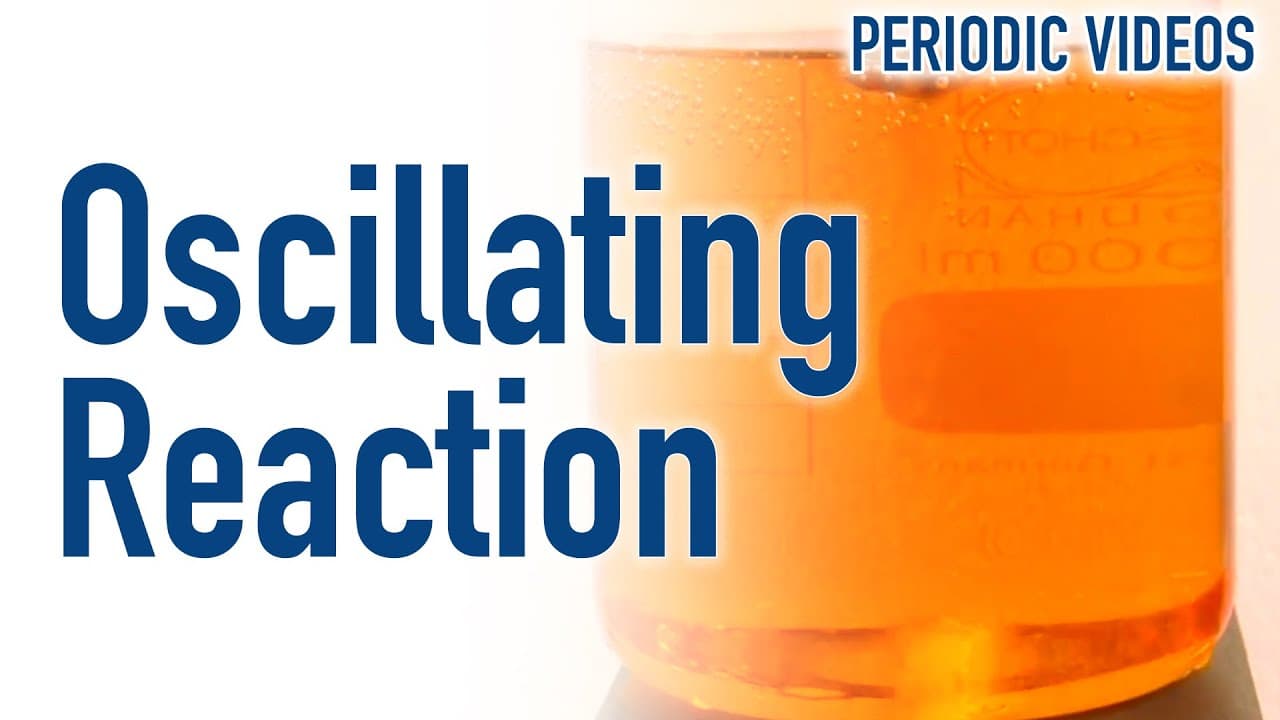
A Russian reaction oscillating between orange and colorless due to a complex mixture of chemicals.
Transcript
my colleague Sam wanted to show you a really interesting reaction the so called belousov shall Burtynsky reaction which oscillates the color changes on and off sadly she's lost her voice so she's done the experiment but you stuck with me to tell you what's happening very fortunately I have a particularly appropriate tie it's actually a Russian tie ... Read More
Key Insights
- 🥺 The Belousov-Zhabotinsky reaction showcases complex chemical interactions leading to color oscillations.
- ❓ Initial disbelief in the reaction's existence highlights the importance of experimental verification.
- ☠️ Understanding reaction rates is crucial in explaining the color changes in the reaction.
- 💖 The reaction's resemblance to living systems sparked interest in its implications for life processes.
- 👨🔬 Research on oscillating reactions like this one contributes to broader scientific knowledge.
- ❓ The role of catalysts and chemical quantities affects the duration and intensity of the reaction.
- 🏍️ The reaction's eventual stoppage is a result of reactants being fully consumed over multiple cycles.
Install to Summarize YouTube Videos and Get Transcripts
Explore YouTube Video Summarizer or Get YouTube Transcript Extractor
Questions & Answers
Q: What are the key elements of the Belousov-Zhabotinsky reaction?
The key elements are manganese, bromine, malonic acid, manganese sulfate, and potassium bromate, which catalyze the oscillating color changes in the reaction.
Q: Why was the Belousov-Zhabotinsky reaction initially doubted in the West?
Western chemists initially doubted this reaction's existence due to the oscillating color changes seeming impossible, but later research confirmed its authenticity.
Q: How do the reaction rates affect the color changes in the Belousov-Zhabotinsky reaction?
The reaction oscillates between orange and colorless as bromine forms and reacts with malonate at different rates, causing the color changes.
Q: What implications does the Belousov-Zhabotinsky reaction have for understanding life processes?
The oscillating nature of this reaction suggests that similar processes could be fundamental in understanding various biological rhythms and cycles.
Summary & Key Takeaways
-
The Belousov-Zhabotinsky reaction involves a complex mix of chemicals like malonic acid, manganese sulfate, and potassium bromate.
-
The reaction starts with a clear solution turning orange as bromine forms, then oscillates between orange and colorless due to reaction rates.
-
Initially doubted in the West, this reaction exemplifies oscillating reactions potentially important in understanding life.
Read in Other Languages (beta)
Share This Summary 📚
Summarize YouTube Videos and Get Video Transcripts with 1-Click
Try YouTube Summary with ChatGPT & Claude or YouTube Transcript Generator
Explore More Summaries from Periodic Videos 📚
Summarize YouTube Videos and Get Video Transcripts with 1-Click
Try YouTube Summary with ChatGPT & Claude or YouTube Transcript Generator