O-Ring Model
TL;DR
O-Ring Theory explains team-based production and its impact on inequality.
Transcript
Welcome everyone. Today we're going to be talking about O-Ring Theory Turns out O-Ring Theory has implications for development, but also has implications for the industrial organization of developed economies. That is, for how firms and workers are organized when maximizing the value of production requires that we work as a team. O-Ring Theory is ... Read More
Key Insights
- O-Ring Theory highlights the importance of team-based production, where failure in any task can significantly reduce the value of the entire product.
- The model suggests that quality cannot be substituted by quantity; high-quality inputs are crucial for successful outcomes.
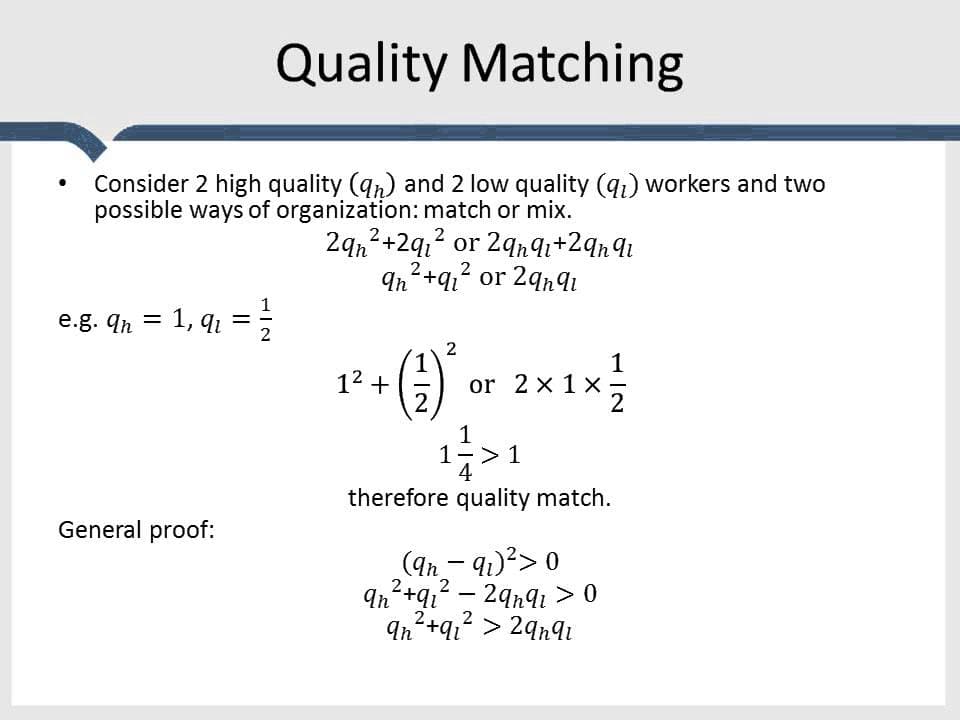
- Quality matching is essential; high-quality workers should be paired together to maximize output, leading to higher wages.
- The theory explains wage inequality, where small differences in worker quality can lead to large disparities in income.
- In a competitive economy, high-quality workers are more productive and thus earn higher wages, exacerbating inequality.
- The model predicts that capital and high-quality workers will cluster together, leaving low-skill workers and capital in poorer regions.
- O-Ring Theory can explain economic bottlenecks and the importance of trade in circumventing these bottlenecks.
- The theory suggests that organizational capital, or the ability to coordinate high-quality teams, is increasingly valuable in complex production environments.
Install to Summarize YouTube Videos and Get Transcripts
Explore YouTube Video Summarizer or Get YouTube Transcript Extractor
Questions & Answers
Q: What is the main concept of O-Ring Theory?
O-Ring Theory, developed by Michael Kremer, focuses on team-based production where the failure of any single task can drastically reduce the value of the entire product. This emphasizes the importance of quality in every task and has implications for understanding economic organization and inequality.
Q: How does O-Ring Theory explain wage inequality?
O-Ring Theory suggests that small differences in worker quality can lead to significant disparities in wages. High-quality workers, when matched together, produce more output and earn higher wages, while low-quality workers earn less. This quality-based wage disparity is a key insight of the model.
Q: Why is quality matching important in O-Ring Theory?
Quality matching is crucial because it maximizes output. By pairing high-quality workers together, the overall production value is higher compared to mixing workers of different quality levels. This principle also leads to higher wages for high-quality workers, reinforcing wage inequality.
Q: What role does capital play in O-Ring Theory?
In O-Ring Theory, capital tends to cluster with high-quality workers, as it seeks to maximize output. This results in a concentration of resources in regions with skilled labor, while poorer areas with low-skilled workers receive less capital investment, exacerbating economic disparities.
Q: How does O-Ring Theory relate to economic bottlenecks?
O-Ring Theory suggests that a failure in any single task or industry can create bottlenecks, reducing output across the entire economy. The interconnectedness of tasks means that inefficiencies in one area can have widespread negative effects, highlighting the importance of trade to circumvent these bottlenecks.
Q: What is the significance of organizational capital in O-Ring Theory?
Organizational capital, or the ability to coordinate high-quality teams, is increasingly valuable in complex production environments. As production requires more tasks to be completed perfectly, the skill to manage and integrate high-quality workers and resources becomes crucial for maximizing output and achieving economic success.
Q: What are the implications of O-Ring Theory for developing countries?
Developing countries with lower-skilled workforces tend to specialize in simpler production tasks, leading to lower wages and economic output. The theory suggests that attracting high-quality workers and capital is essential for achieving higher productivity and escaping the low-skill, low-wage trap.
Q: How does O-Ring Theory explain multiple economic equilibria?
O-Ring Theory posits that economies can reach multiple equilibria based on the skill level of workers. High-skill equilibria result in high productivity and wages, while low-skill equilibria lead to lower economic outcomes. This highlights the importance of investing in education and skill development to achieve a high-skill equilibrium.
Summary & Key Takeaways
-
O-Ring Theory, introduced by Michael Kremer, focuses on team-based production where one weak link can destroy the entire product's value. This concept is crucial in understanding inequality and the organization of economies.
-
The model emphasizes quality over quantity, suggesting that high-quality workers should be matched together to maximize output and wages. This leads to wage disparities and highlights the importance of quality matching.
-
O-Ring Theory explains economic bottlenecks and the role of trade in development. It also underscores the growing importance of organizational capital in complex production, contributing to both virtuous and vicious economic cycles.
Read in Other Languages (beta)
Share This Summary 📚
Summarize YouTube Videos and Get Video Transcripts with 1-Click
Try YouTube Summary with ChatGPT & Claude or YouTube Transcript Generator
Explore More Summaries from Marginal Revolution University 📚

Summarize YouTube Videos and Get Video Transcripts with 1-Click
Try YouTube Summary with ChatGPT & Claude or YouTube Transcript Generator