Permutations and Combinations | Colour balls | Vowels together | Aptitude | Part- 20 | Bharath Kumar
TL;DR
This session explores solving problems involving permutations and combinations, focusing on specific examples.
Transcript
hi everyone welcome to the session in this session i am continuing the problems related to permutations and combinations in the last session we already discussed a few problems related to permutations and combinations uh let's continue in the last session see the first question which is given in the session see the number of new words that can be f... Read More
Key Insights
- 😫 The factorial function calculates the number of ways to arrange a set of items, essential in solving permutation problems.
- 😫 Identifying unique arrangements requires careful attention to repeated elements within a word or set.
- 🅰️ Conditions in combination problems, such as requiring items of certain types (colors or types), necessitate evaluating multiple cases for accuracy.
- 👥 Grouping items, such as vowels or other categories, can simplify calculations significantly by treating those groups as singular units.
- 🔄 Understanding "at least" versus "at most" clarifies the bounds of counting possibilities in combination problems.
- 💁 The examples highlight practical applications of mathematical theories in real-world scenarios like word formation and selection problems.
- ❓ Instructional sessions focusing on specific problem-solving methodologies enhance comprehension of complex concepts.
Install to Summarize YouTube Videos and Get Transcripts
Explore YouTube Video Summarizer or Get YouTube Transcript Extractor
Questions & Answers
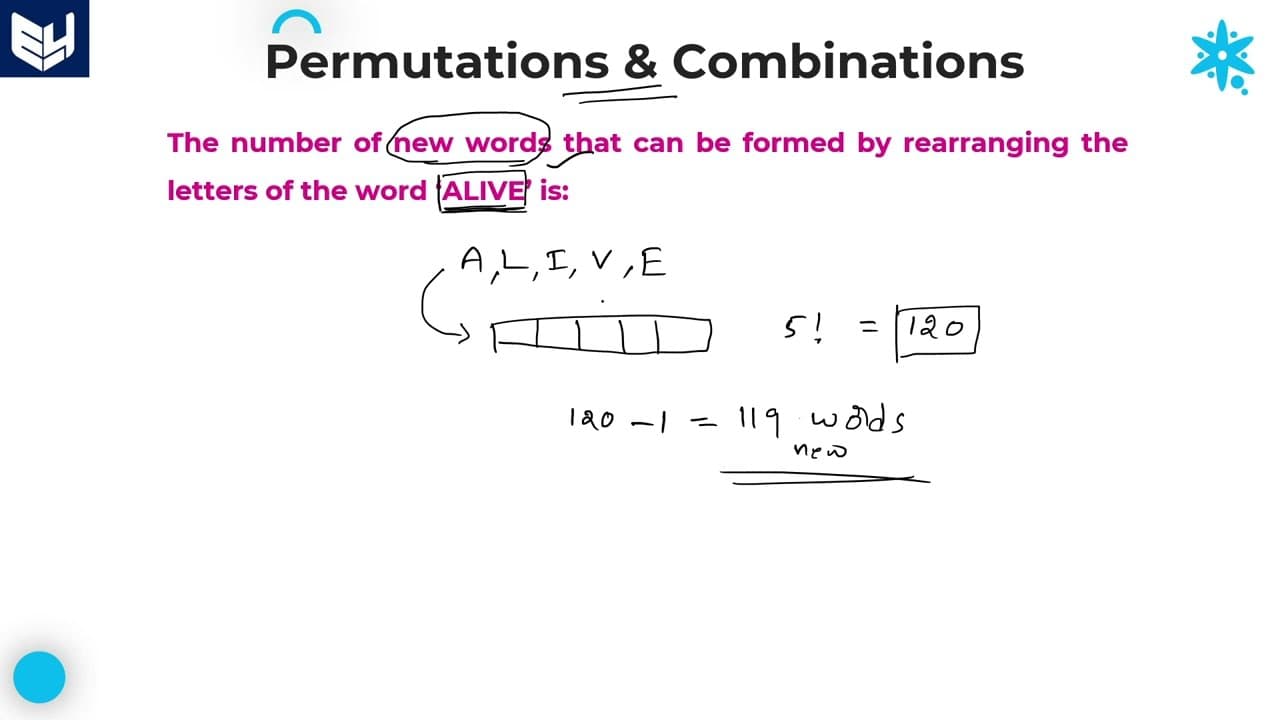
Q: What is the significance of subtracting one when calculating new words from "alive"?
The subtraction accounts for the original word itself, which is included among all possible arrangements. When calculating the total number of arrangements (5!), we find the total is 120. Since the question asks for new words excluding "alive," we subtract that one instance, resulting in 119 new arrangements.
Q: How are combinations affected when drawing balls with specific conditions?
When drawing from a collection with conditions, such as requiring at least one of a specific color, we evaluate multiple scenarios. Each combination is calculated separately based on the number of items drawn and their color. This ensures all rules and conditions are met while determining total possible combinations.
Q: What is the method to count arrangements with vowels grouped together?
To count arrangements where all vowels must be grouped, treat the vowels as a single entity. This simplifies the calculation into arranging these groups alongside other consonants. By calculating the arrangements of this new set with interspersed vowels, the solution accounts for all variations, including repeated letters.
Q: Why do we divide by 2! in the arrangements of the word "capital"?
The division by 2! accounts for the repetition of the vowel "a" in "capital." Since this specific letter appears twice, it creates identical arrangements. To avoid over-counting these permutations, we divide by 2!, which corrects for those repeat arrangements.
Summary & Key Takeaways
-
The session covers the concept of permutations and combinations, providing detailed examples to explain how to calculate the number of new words formed from given letters and conditions.
-
One example illustrates calculating new words from the letters of "alive" by determining all arrangements (5!) and subtracting the original word to find the unique combinations.
-
Another example demonstrates a drawing selection involving colored balls while ensuring specific conditions, showcasing the mathematical principles behind combinations while addressing various cases.
Read in Other Languages (beta)
Share This Summary 📚
Summarize YouTube Videos and Get Video Transcripts with 1-Click
Try YouTube Summary with ChatGPT & Claude or YouTube Transcript Generator