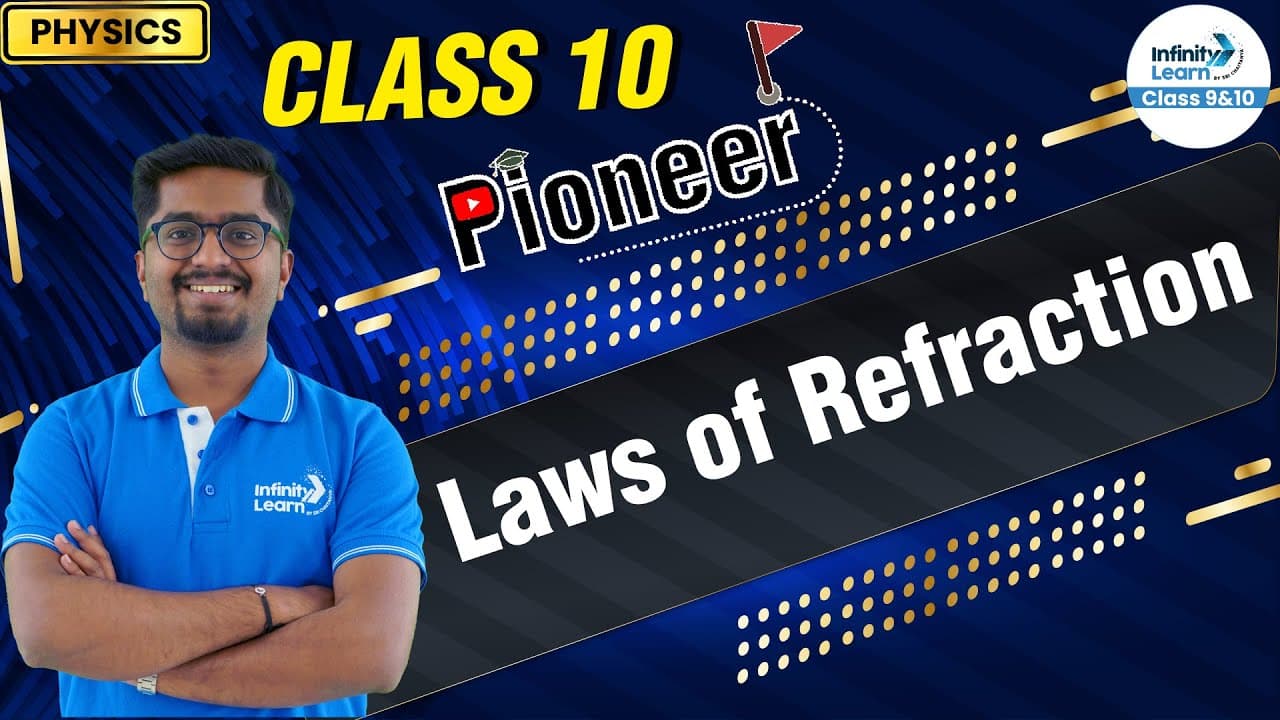
Laws of Refraction - Class 10 Physics || #Pioneer || LIVE || Akash || Infinity Learn
TL;DR
Understanding refraction, laws, and refractive index for clear optics knowledge.
Transcript
hello hi everyone good afternoon so today we are going to learn about laws of refraction so till now we have learned all the different types of reflection which are there in your grade 10 and now we'll start with the refraction Okay so let's begin there's about me if anyone here is seeing me for the first time there's me you can say hi so that I kn... Read More
Key Insights
- 🙂 Refraction involves light bending while passing through different transparent mediums, impacting its trajectory.
- 🥳 Snell's Law dictates the angle of incidence and refraction ratios, crucial for precise refractive index calculations.
- 🫰 Absolute refractive index is determined concerning vacuum, while the relative refractive index is calculated between different mediums.
- 🙂 Optical density influences how light bends, with optically denser mediums causing light to bend towards the normal.
- 🙂 Understanding refractive indices helps comprehend light behavior in various mediums, shaping optical phenomena understanding.
- 🙂 Different mediums have distinct refractive indices, affecting how light travels and bends in optics applications.
- 🙂 The refractive index values relate to the bending of light, showcasing the importance of medium densities in optical studies.
Install to Summarize YouTube Videos and Get Transcripts
Explore YouTube Video Summarizer or Get YouTube Transcript Extractor
Questions & Answers
Q: What is the key difference between reflection and refraction?
Reflection involves the bouncing back of light, while refraction entails the bending of light when transferring through transparent mediums due to changes in densities.
Q: How is the refractive index defined, and why is it crucial in optics?
The refractive index is the ratio of the speed of light in a vacuum to the speed in a medium, determining how much light bends when transitioning between different mediums, vital for understanding optical phenomena.
Q: Explain Snell's Law and its significance in the laws of refraction.
Snell's Law establishes the relationship between the angles of incidence and refraction, maintaining a constant ratio between the sine values to calculate the refractive index accurately in optical scenarios.
Q: What is the absolute refractive index, and how does it differ from the relative refractive index?
The absolute refractive index is measured concerning vacuum, while the relative refractive index is calculated between two different mediums, highlighting the bending of light as per densities and optical densities.
Summary & Key Takeaways
-
Introduction to laws of refraction following lessons on reflection in Grade 10.
-
Refraction explained as the bending of light when traveling through different transparent mediums.
-
Snell's Law, refractive index, and optical density concepts elucidated for a comprehensive understanding.
Read in Other Languages (beta)
Share This Summary 📚
Summarize YouTube Videos and Get Video Transcripts with 1-Click
Try YouTube Summary with ChatGPT & Claude or YouTube Transcript Generator
Explore More Summaries from Infinity Learn NEET 📚

Summarize YouTube Videos and Get Video Transcripts with 1-Click
Try YouTube Summary with ChatGPT & Claude or YouTube Transcript Generator