How To Hear Halfway Around The World
TL;DR
Underwater sound waves travel exceptionally far due to the unique properties of ocean layers.
Transcript
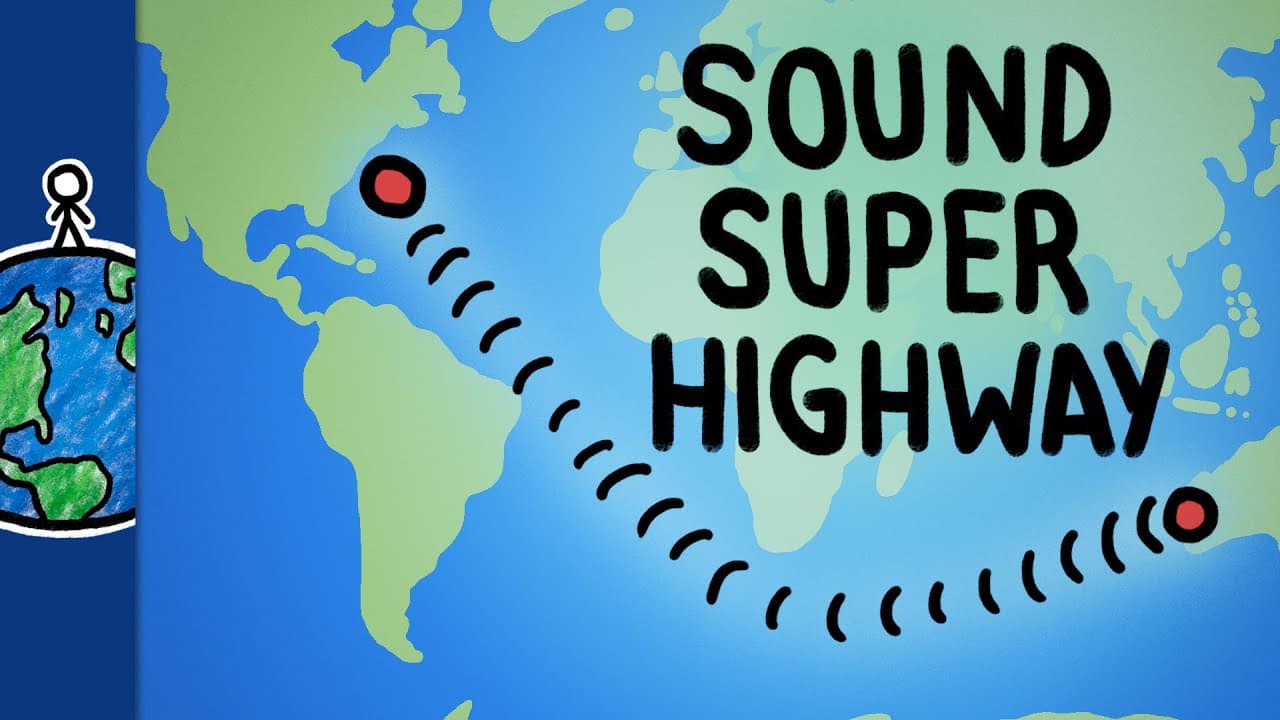
Hi, this is Kate from MinuteEarth. In 1960, scientists blew up hundreds of pounds of explosives off the coast of Australia; nearly four hours later, sounds from the blasts reached underwater microphones near Bermuda - over 19,000 km away. In the air, these sounds would have traveled a few dozen kilometers at most. And sure, sound generally travels ... Read More
Key Insights
- 👻 Ocean layers affect the speed of sound, allowing it to travel significantly farther underwater than in the air.
- 👂 The SOFAR channel acts as an underwater sound superhighway, enabling sound waves to propagate efficiently over long distances.
- 😒 Scientists use the underwater sound superhighway to monitor ocean temperatures, detect whale calls, and track nuclear tests.
- 👂 The CTBTO sponsors research using hydrophones in the SOFAR channel to monitor global sounds for security and environmental purposes.
Install to Summarize YouTube Videos and Get Transcripts
Explore YouTube Video Summarizer or Get YouTube Transcript Extractor
Questions & Answers
Q: How did scientists discover the underwater sound superhighway?
Scientists discovered the underwater sound superhighway in 1960 when explosives detonated off the coast of Australia were heard over 19,000 km away near Bermuda, showcasing the unique properties of ocean layers affecting sound propagation.
Q: What is the significance of the SOFAR channel?
The SOFAR channel, where sound travels slowest, is crucial as it acts as a conduit for sound waves, allowing them to travel long distances without losing energy, making it valuable for monitoring ocean health and detecting various sounds.
Q: How do whales utilize the underwater sound superhighway?
Whales may use the SOFAR channel as a long-distance telephone, communicating over vast distances, showing how marine life can adapt to and benefit from the unique properties of sound transmission in the ocean.
Q: How does the CTBTO use the underwater sound superhighway?
The CTBTO utilizes hydrophone triplets anchored into the SOFAR channel to detect and differentiate between various sounds, including nuclear tests and natural phenomena, helping maintain global nuclear security efforts.
Summary & Key Takeaways
-
Sound waves can travel extremely long distances underwater, unlike in the air, due to different layers of the ocean affecting the speed of sound.
-
The SOFAR channel, where sound moves the slowest, acts as a superhighway for sound waves, allowing them to travel far and efficiently.
-
Scientists use this underwater sound superhighway to monitor ocean temperatures and detect various sounds, including whale calls and nuclear tests.
Read in Other Languages (beta)
Share This Summary 📚
Summarize YouTube Videos and Get Video Transcripts with 1-Click
Try YouTube Summary with ChatGPT & Claude or YouTube Transcript Generator
Explore More Summaries from MinuteEarth 📚




Summarize YouTube Videos and Get Video Transcripts with 1-Click
Try YouTube Summary with ChatGPT & Claude or YouTube Transcript Generator