Voltage drop | Causes | DC machines | Lec-47
TL;DR
This content analyzes the compound characteristics and voltage drop causes in DC generators.
Transcript
hello everyone we are discussing about the characteristics of the DC generator in that we are completed OCC and the load saturation curve the next is the compound characteristics here the compound characteristics is the graph between the field current and the Armature current here the if you know that that is the field current and the Ia is the r m... Read More
Key Insights
- 🏑 Compound characteristics are critical for understanding the behavior of field and armature currents within DC generators.
- ❓ The armature reaction is a fundamental aspect that impacts the overall efficiency and output of DC generators.
- 💦 Voltage drops need to be carefully considered in generator design and operation, especially under load conditions, to ensure ample power delivery.
- 🗯️ Comparison of voltage regulation can help in choosing the right generator type for specific applications based on load requirements.
- 🍉 Separately excited generators provide better stability in terms of EMF, particularly under varying load conditions, compared to shunt generators.
- ✊ Understanding the operational differences in generator types is vital for electrical engineers in the design and management of power systems.
- ⚡ Circuit diagrams depicting generator configurations can significantly enhance comprehension of operational principles and voltage behaviors.
Install to Summarize YouTube Videos and Get Transcripts
Explore YouTube Video Summarizer or Get YouTube Transcript Extractor
Questions & Answers
Q: What are compound characteristics in DC generators?
Compound characteristics refer to the graphical representation of the relationship between field current and armature current specifically in compound machines. In these generators, both series and shunt fluxes are combined, which means that as the armature current increases, the field current also rises, affecting EMF output.
Q: Why does voltage drop occur in DC generators?
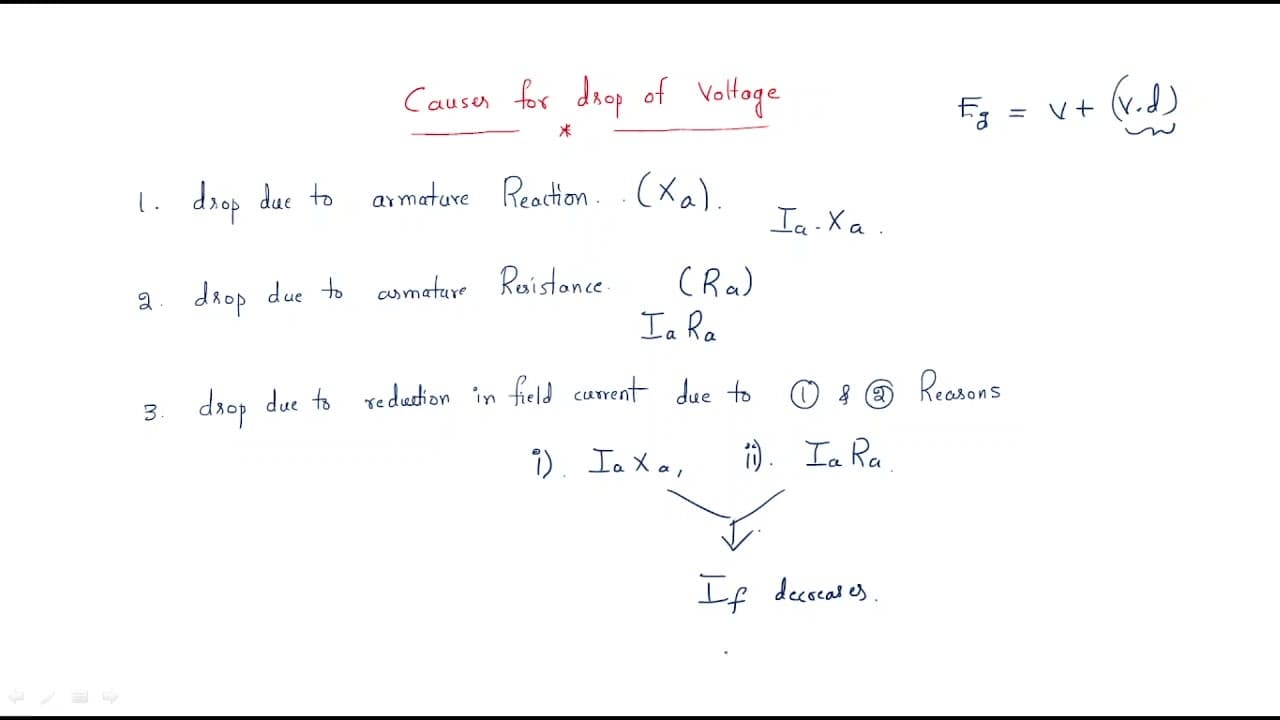
Voltage drops in DC generators are primarily due to armature reaction and armature resistance. These conditions cause the generated EMF to be lower than the ideal maximum as some voltage is "lost" in these processes, diminishing the effective output of the generator and the field current itself.
Q: How do shunt generators differ from separately excited generators in terms of voltage regulation?
Shunt generators typically exhibit more substantial voltage regulation compared to separately excited generators. In shunt configurations, the reduction in EMF under load is significant, whereas separately excited generators maintain a more stable output with less voltage drop due to independent flux generation.
Q: What is the significance of the voltage regulation percentage mentioned in the content?
The voltage regulation percentage signifies the difference between no-load and full-load voltages in a generator. If a DC generator shows a voltage regulation of 10%, it means that when the load increases, the voltage drop will be considerable, demonstrating how effectively the generator can maintain stable voltage levels under varying conditions.
Summary & Key Takeaways
-
The discussion focuses on compound characteristics in DC generators, detailing the relationship between field and armature currents, known also as armature or regulation characteristics.
-
Voltage drops in DC generators arise from armature reactions and resistance, affecting the generated EMF and thus reducing field currents under load conditions.
-
The content concludes with a comparison of voltage regulation between shunt and separately excited generators, highlighting that shunt generators exhibit higher voltage regulation.
Read in Other Languages (beta)
Share This Summary 📚
Summarize YouTube Videos and Get Video Transcripts with 1-Click
Try YouTube Summary with ChatGPT & Claude or YouTube Transcript Generator