Translation of Assignment Statements | Compiler Design | Lec-37 | Bhanu Priya
TL;DR
This content explains the translation of assignment statements using direct translation techniques in compiler design.
Transcript
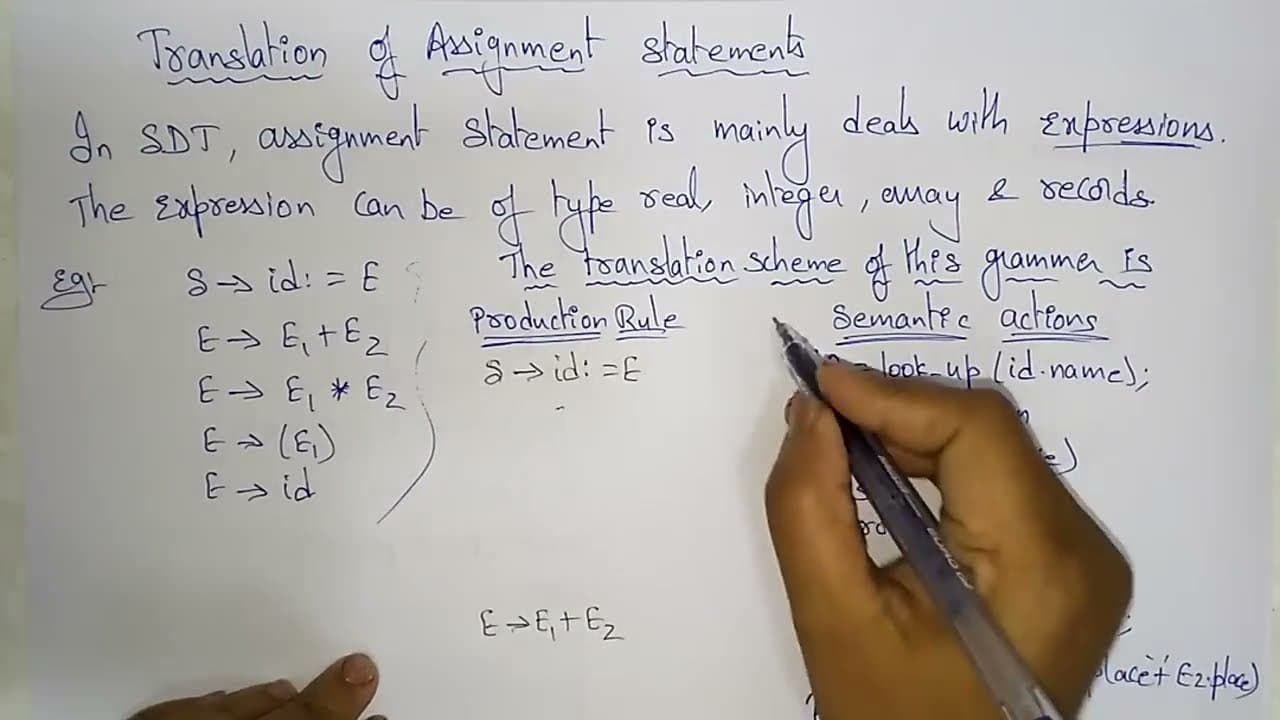
hi students now let's see the translation of assignment statement in the compiler design using the syntax direct translation technique so in syntax uh direct translation assignment statement is mainly deals with Expressions so uh we are discussing about the assignment statements so that assignment statements is having the arithmetic operators so uh... Read More
Key Insights
- 😑 The translation of assignment statements is fundamental in compiler design, focusing on expressions with various types.
- 🦮 Semantic actions are critical as they guide the generation of correct translations through defined grammar rules.
- 🤬 A lookup in the symbol table is an essential step to confirm variable existence and retrieve necessary values for calculations.
- 👨💻 Three-address code provides clarity and simplicity, enabling easier optimization during the compilation process.
- ❓ Error handling is incorporated to maintain robustness by managing undefined identifiers and ensuring proper declarations.
- ❓ The technique discussed exemplifies a top-down approach with no reductive grammar, focusing on structured computations instead.
- 😑 The importance of temporary variables in managing complex expressions is highlighted as they streamline the process of compiling multi-step calculations.
Install to Summarize YouTube Videos and Get Transcripts
Explore YouTube Video Summarizer or Get YouTube Transcript Extractor
Questions & Answers
Q: What is the primary focus of the translation technique discussed?
The primary focus of the technique discussed is the translation of assignment statements in compiler design through syntax-directed translation. It emphasizes the importance of understanding expressions and associated operators while detailing how grammars define structure and actions for code translation.
Q: How is the symbol table utilized in the assignment statement translation?
The symbol table is utilized to look up identifiers during the translation process. Whenever an ID is encountered, the translation process checks the symbol table to ensure the identifier exists and fetch its corresponding value, which is crucial for creating accurate three-address code and avoiding errors.
Q: What are the main semantic actions taken for production rules?
The main semantic actions involve performing lookups in the symbol table to retrieve identifier values, generating temporary variables when needed, and emitting three-address code based on calculations or operations defined in the grammar rules. These actions ensure that correct variable assignments and operations are coded.
Q: Can you explain the role of three-address code in the translation process?
In the translation process, three-address code serves as an intermediate representation that simplifies the translation tasks. It breaks down operations into manageable pieces, facilitating the compilation by explicitly detailing variable assignments and arithmetic calculations, making optimization and further processing easier.
Q: What happens if an identifier is not found in the symbol table?
If an identifier is not found in the symbol table during the lookup process, an error is generated. This error signifies that the variable is undeclared or unrecognized in the current scope, which prevents further operations involving that identifier from proceeding, adhering to strict type checking.
Q: How are temporary variables generated in the translation process?
Temporary variables are generated using a function designed to create new variable names whenever expressions require intermediate results. For example, when calculating an expression like "E1 + E2," a temporary variable can hold the sum to facilitate further operations without losing the initial operands' values.
Summary & Key Takeaways
-
The content focuses on the direct translation of assignment statements, detailing grammar rules and semantic actions associated with arithmetic expressions.
-
It provides production rules for assignment statements, describing actions such as symbol table lookups and generating three-address code based on these rules.
-
A practical example illustrates how to systematically generate intermediate code using specified productions, with a focus on expressions involving arithmetic operations.
Read in Other Languages (beta)
Share This Summary 📚
Summarize YouTube Videos and Get Video Transcripts with 1-Click
Try YouTube Summary with ChatGPT & Claude or YouTube Transcript Generator