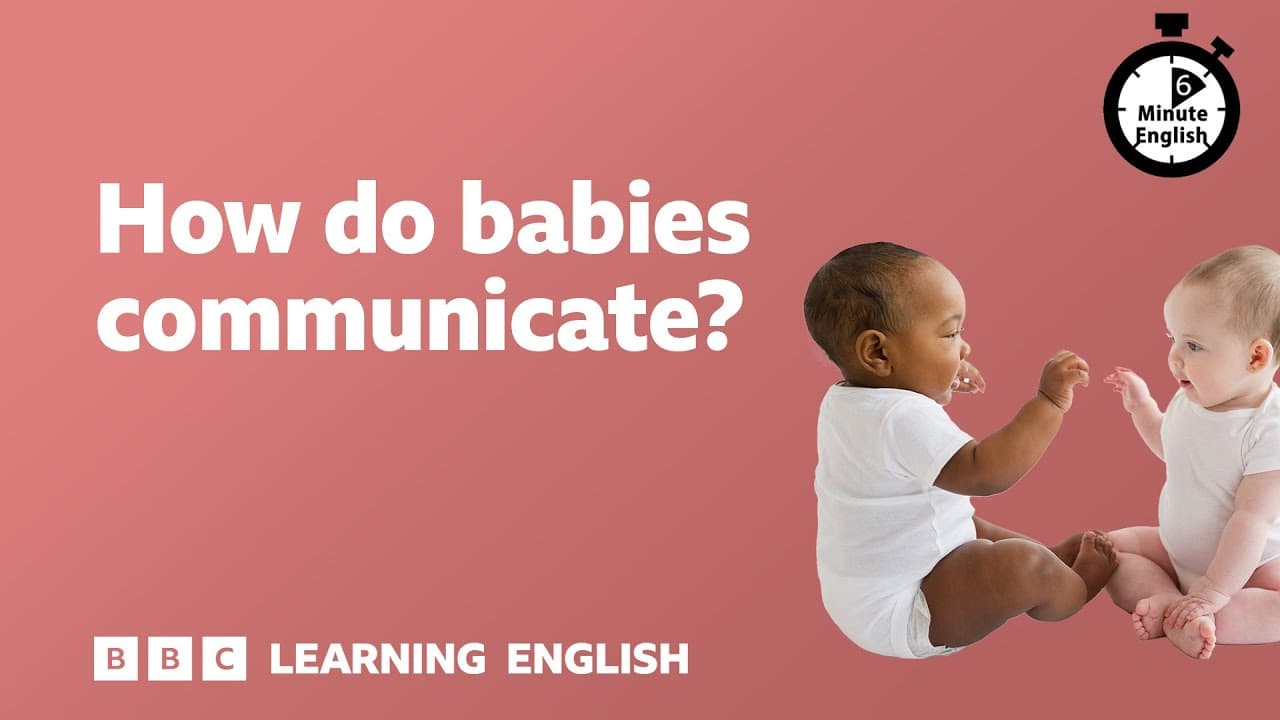
How do babies communicate? ⏲️ 6 Minute English
TL;DR
Babies communicate through body movements and crying before speaking.
Transcript
Hello. This is 6 Minute English from BBC Learning English. I'm Neil. And I'm Beth. As an adult, when I need to tell somebody something, I just open my mouth and speak. Neil, I'm hungry! Ah, you'd better get something to eat then. And when I want something, it's the same, I just ask. Um, can you pass me that pen, please? Beth? Yep. There you go. So ... Read More
Key Insights
- Newborns rely entirely on adults for survival, communicating their needs through body language and crying.
- Marie Derome emphasizes that babies need parents 100%, highlighting the complete dependency of infants.
- Babies' movements, though appearing jerky, are intentional to attract parental attention and create bonds.
- Love at first sight with a newborn is a cliché; bonding with a baby takes time and effort.
- Unrealistic expectations about instant bonding can cause guilt and stress in new parents.
- Babies are born with amazing abilities, such as changing eye color, which surprises many new parents.
- Understanding a baby's body language helps parents respond better to their needs and strengthens the parent-child bond.
- The episode provides new vocabulary to help understand and discuss baby communication more effectively.
Install to Summarize YouTube Videos and Get Transcripts
Explore YouTube Video Summarizer or Get YouTube Transcript Extractor
Questions & Answers
Q: How do newborn babies communicate their needs to parents?
Newborn babies communicate their needs primarily through body movements and crying. These movements, though they appear jerky, are intentional and designed to catch the attention of their parents. By doing so, babies express their dependence and need for care, as they cannot articulate their needs verbally.
Q: What does Marie Derome say about the dependency of newborns?
Marie Derome emphasizes that newborns need their parents 100%, highlighting their complete dependency for survival. Without parental care, infants would not be able to clothe, feed, or clean themselves, underscoring the critical role caregivers play in the early stages of a child's life.
Q: Why do babies' movements appear jerky, and what is their purpose?
Babies' movements appear jerky to the naked eye, but they are actually intentional and planned. The purpose of these movements is to attract the attention of their parents, facilitating bonding and ensuring that their needs are noticed and met. These movements are a form of non-verbal communication.
Q: What is the significance of the phrase 'love at first sight' in the context of parenting?
The phrase 'love at first sight' is often considered an unhelpful cliché in the context of parenting. Marie Derome argues that this ideal can create unrealistic expectations for new parents, leading to guilt and stress if they do not immediately bond with their baby. Instead, bonding is a gradual process.
Q: What amazing ability of newborns is highlighted in the episode?
The episode highlights the amazing ability of newborns to change their eye color. This fact often surprises new parents and underscores the remarkable, yet often underestimated, capabilities that babies possess from birth.
Q: How can understanding a baby's body language benefit parents?
Understanding a baby's body language allows parents to better interpret and respond to their infant's needs, strengthening the parent-child bond. By recognizing intentional movements and cries, parents can provide the appropriate care and attention, fostering a nurturing environment for their child's development.
Q: What new vocabulary is introduced in the episode?
The episode introduces vocabulary such as 'jerky,' 'intentional,' 'to the naked eye,' and 'unhelpful cliché.' These terms help listeners understand the nuances of baby communication and offer a framework for discussing infant behavior and parental expectations more effectively.
Q: What resources does the episode provide for further learning?
The episode provides access to a free transcript and worksheet on the BBC Learning English website. It also offers additional episodes and resources to help listeners improve their English and understanding of various topics, including baby communication and parenting.
Summary & Key Takeaways
-
The episode explores how newborn babies communicate before they can speak, emphasizing their complete reliance on parents for survival. It discusses Marie Derome's insights on baby communication and the importance of understanding infants' body language.
-
Babies' movements, though seemingly jerky, are intentional and serve to attract parental attention, facilitating bonding. The episode challenges the cliché of love at first sight with a newborn, suggesting that bonding takes time.
-
The discussion includes amazing facts about newborns, such as their ability to change eye color, and introduces new vocabulary to help parents understand and respond to their baby's needs effectively.
Read in Other Languages (beta)
Share This Summary 📚
Summarize YouTube Videos and Get Video Transcripts with 1-Click
Try YouTube Summary with ChatGPT & Claude or YouTube Transcript Generator
Explore More Summaries from BBC Learning English 📚
Summarize YouTube Videos and Get Video Transcripts with 1-Click
Try YouTube Summary with ChatGPT & Claude or YouTube Transcript Generator