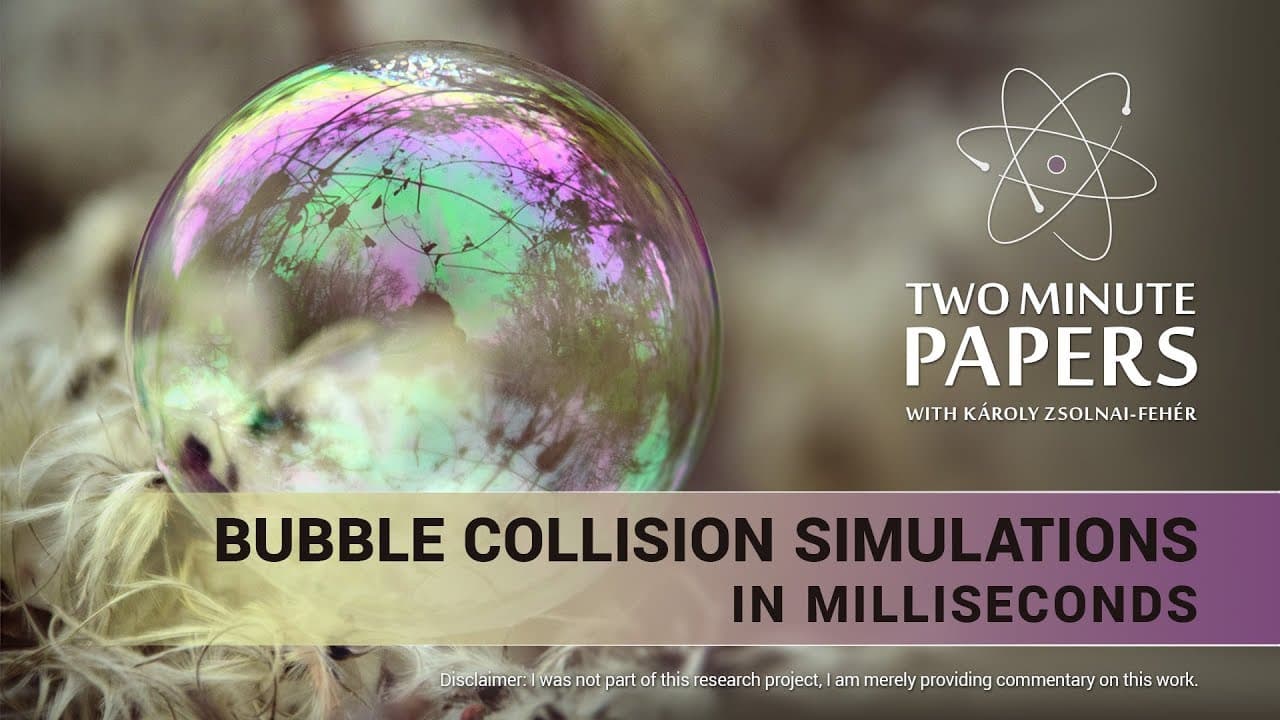
Bubble Collision Simulations in Milliseconds | Two Minute Papers #231
TL;DR
Cutting-edge bubble simulation software creates stunning visuals through advanced computational methods.
Transcript
Dear Fellow Scholars, this is Two Minute Papers with Károly Zsolnai-Fehér. This paper is about simulating on a computer what happens when bubbles collide. Prepare for lots of beautiful footage. This is typically done by simulating the Navier-Stokes equations that describe the evolution of the velocity and pressure within a piece of fluid over time.... Read More
Key Insights
- 👁️🗨️ High-resolution grids are required to capture fine details, like the thickness of soap bubbles.
- 👁️🗨️ Soap bubbles seek to minimize surface area while maintaining volume, guiding simulation processes.
- 🐎 The software's effective implementation of hyperbolic mean curvature flow significantly speeds up simulations.
- 👮 Results of the simulations closely follow Plateau's laws, validated against real-life experimental setups.
- ⌛ Computational times have been drastically reduced, now in the order of milliseconds.
- 🚱 The software addresses issues like non-manifold junctions, improving overall accuracy.
- 👨💻 Source code for the project is available, enhancing transparency and accessibility.
Install to Summarize YouTube Videos and Get Transcripts
Explore YouTube Video Summarizer or Get YouTube Transcript Extractor
Questions & Answers
Q: How is simulating bubble collisions on a computer achieved?
The process involves using the Navier-Stokes equations to compute the evolution of velocity and pressure within the fluid, combined with advanced computational methods.
Q: What challenges are faced in simulating bubble collisions accurately?
Challenges arise from the need for extremely high-resolution grids to capture fine details like bubble thickness, which results in overly long computation times.
Q: How do soap bubbles evolve over time according to Belgian physicist Joseph Plateau?
Soap bubbles seek to minimize their surface area while retaining their volume, guiding the simulation process to accurately depict bubble shapes.
Q: How does the software in this study improve upon previous simulations?
The software implements an effective hyperbolic mean curvature flow, making the simulations 3 to 20 times faster and more robust in handling complex scenarios like splitting and merging.
Summary & Key Takeaways
-
Simulation of bubble collisions on a computer involves computing the evolution of velocity and pressure using the Navier-Stokes equations.
-
Challenges arise from the need to create high-resolution grids to capture fine details like bubble thickness.
-
By simulating forces that shape soap bubbles and applying volume corrections, the software produces realistic results validated against experimental setups.
Read in Other Languages (beta)
Share This Summary 📚
Summarize YouTube Videos and Get Video Transcripts with 1-Click
Try YouTube Summary with ChatGPT & Claude or YouTube Transcript Generator
Explore More Summaries from Two Minute Papers 📚



Summarize YouTube Videos and Get Video Transcripts with 1-Click
Try YouTube Summary with ChatGPT & Claude or YouTube Transcript Generator