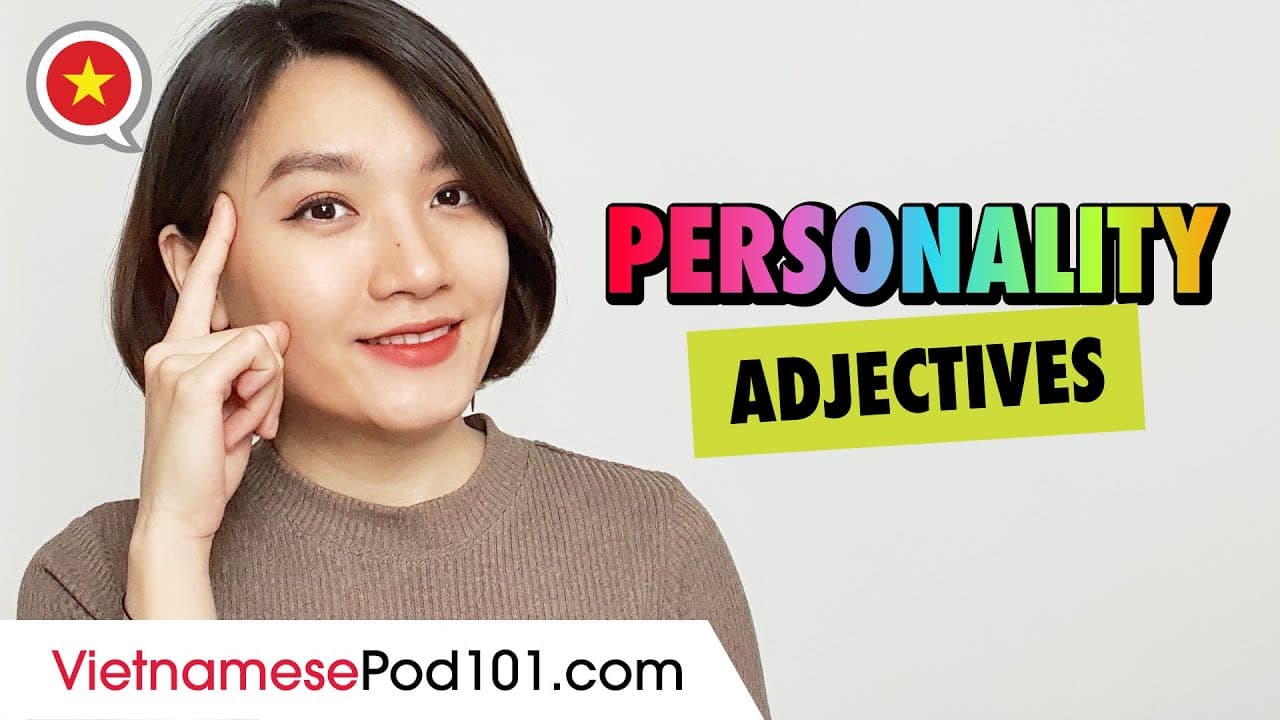
How to Describe the Personality in Vietnamese (adjectives)
TL;DR
Learn to describe personalities in Vietnamese using adjectives.
Transcript
want to speak real vietnamese from your first lesson sign up for your free lifetime account at vietnamesepod101.com hi everyone my name is ling and welcome back to vietnamese pot 101. the 5ds easiest and most fun way to learn vietnamese our topic today is going to be very interesting because it talks about you but before we start i'd like you to wr... Read More
Key Insights
- The video provides a comprehensive guide to describing personalities in Vietnamese using adjectives, focusing on both positive and negative traits.
- In Vietnamese, the word order is different from English; adjectives come after nouns, which is crucial for constructing sentences correctly.
- The video emphasizes the importance of knowing both positive and negative adjectives to describe a wide range of personalities accurately.
- Some adjectives in Vietnamese do not have direct opposites, similar to English, and the video offers tips on how to express these concepts.
- The host encourages interaction by asking viewers to comment on adjectives that describe themselves, fostering engagement and practical application.
- The lesson includes examples of how to use adjectives in sentences, enhancing understanding and retention for learners.
- The host introduces the concept of using prefixes like 'bất' to create opposites for certain adjectives, expanding learners' vocabulary.
- The video is designed for beginner learners, using simple language and clear explanations, making it accessible and easy to follow.
Install to Summarize YouTube Videos and Get Transcripts
Explore YouTube Video Summarizer or Get YouTube Transcript Extractor
Questions & Answers
Q: What is the main focus of the video?
The main focus of the video is to teach viewers how to describe personality traits in Vietnamese using adjectives. The lesson covers both positive and negative adjectives, explaining their usage and providing examples in simple language. It is designed for beginner learners to help them build a foundational vocabulary.
Q: How does the video explain the Vietnamese word order?
The video explains that in Vietnamese, the word order differs from English in that adjectives follow nouns rather than precede them. This is a crucial aspect of sentence construction in Vietnamese, and the host provides examples to illustrate how to correctly form sentences using this structure.
Q: What are some examples of adjectives covered in the video?
The video covers a variety of adjectives, including 'tích cực' (positive), 'tiêu cực' (negative), 'thông minh' (intelligent), 'lười biếng' (lazy), 'vui vẻ' (happy), and 'buồn' (sad). It also discusses adjectives without direct opposites and how to express those concepts in Vietnamese.
Q: How does the host encourage viewer engagement?
The host encourages viewer engagement by asking them to comment on adjectives that describe their own personalities. This interactive approach not only fosters engagement but also allows viewers to apply what they've learned, reinforcing their understanding and retention of the vocabulary.
Q: What is the significance of using prefixes like 'bất' in Vietnamese?
In Vietnamese, prefixes like 'bất' are used to create opposites for certain adjectives. This expands the vocabulary and allows for more nuanced descriptions of personalities. The video introduces this concept, providing examples to help learners understand how to use these prefixes effectively.
Q: Why is the video suitable for beginner learners?
The video is suitable for beginner learners because it uses simple language and clear explanations, combining Vietnamese and English to aid comprehension. The host provides practical examples and encourages interaction, making the lesson accessible and engaging for those new to the language.
Q: What resources are suggested for further learning?
The video suggests signing up for a free lifetime account at VietnamesePod101.com, which offers a complete learning program with lessons by real teachers. This resource is recommended for learners who want to continue building their Vietnamese language skills beyond the basics covered in the video.
Q: How does the video handle adjectives without direct opposites?
For adjectives without direct opposites, the video suggests using phrases like 'không' (not) to convey the opposite meaning. This approach helps learners express concepts that lack direct antonyms in Vietnamese, enhancing their ability to describe a broader range of personality traits.
Summary & Key Takeaways
-
This video lesson focuses on teaching Vietnamese adjectives to describe personality traits. It covers both positive and negative adjectives, providing examples and explanations in simple language. The host encourages viewers to engage by commenting on adjectives that describe themselves, enhancing the learning experience.
-
The lesson explains the unique Vietnamese word order, where adjectives follow nouns, and introduces prefixes like 'bất' to create opposites. The host provides practical examples to help learners construct sentences and understand the nuances of describing personalities in Vietnamese.
-
Aimed at beginners, the video combines Vietnamese and English explanations to aid comprehension. It emphasizes interaction and practical application, making it an effective resource for those new to learning Vietnamese and looking to build a foundational vocabulary.
Read in Other Languages (beta)
Share This Summary 📚
Summarize YouTube Videos and Get Video Transcripts with 1-Click
Try YouTube Summary with ChatGPT & Claude or YouTube Transcript Generator
Explore More Summaries from Learn Vietnamese with VietnamesePod101.com 📚


Summarize YouTube Videos and Get Video Transcripts with 1-Click
Try YouTube Summary with ChatGPT & Claude or YouTube Transcript Generator