How to Talk About Mistakes in English
TL;DR
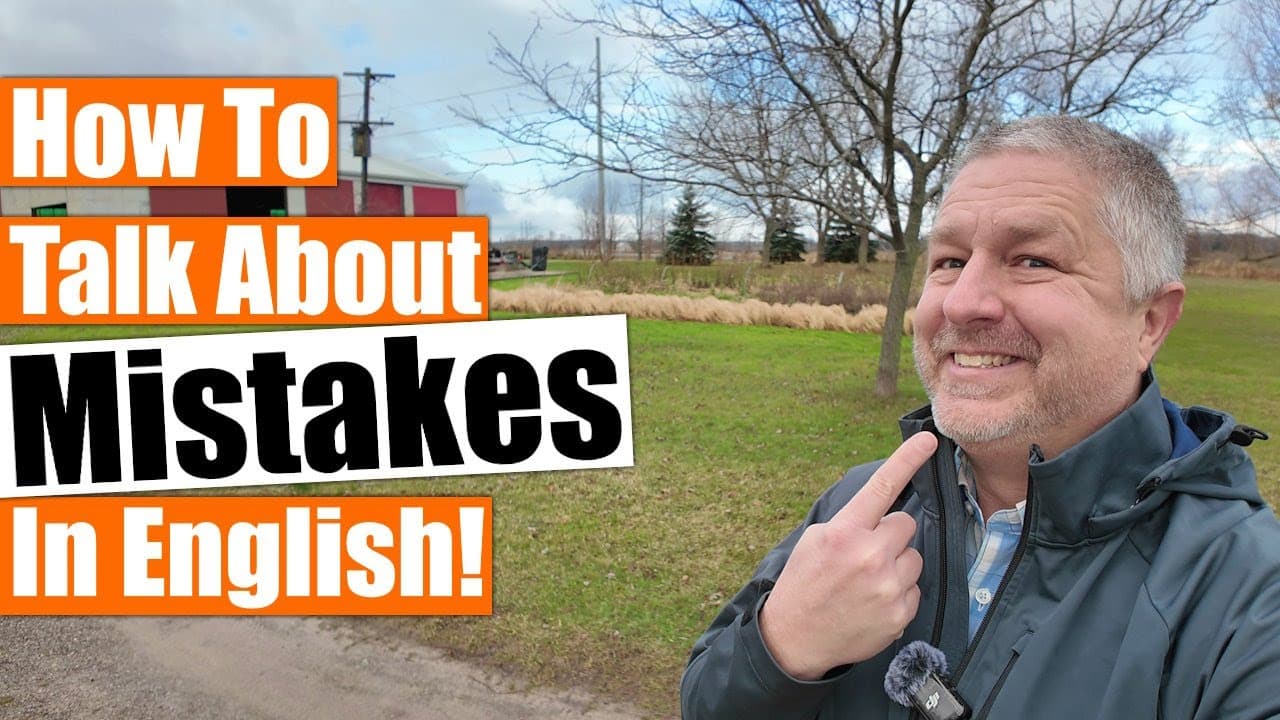
Learn 4 phrases to express mistakes in English with examples and nuances.
Transcript
So I thought I would make a little English lesson this week. I'm starting to feel a lot better, by the way, for those of you that don't know, I was a little bit sick for a couple of weeks, but I thought since I'm just feeling a little bit better, I'll just make a little English lesson. And this little English lesson will be about three phrases you ... Read More
Key Insights
- 🪛 English phrases for mistakes: "I made a mistake," "I messed up," "I screwed up," and "I made an error."
- 🎚️ Nuances in usage: Each phrase carries different levels of formality and context suitability.
- ⚾ Distinction between "mistake" and "error": Explained based on general actions versus numerical inaccuracies.
- ❓ Bonus phrase: "I made an error" for numerical mistakes.
- 😒 Examples provided: Illustrate how to use each phrase in real-life situations effectively.
- 😑 Informative English lesson: Introduces essential vocabulary for expressing mistakes in conversations.
- 💇 Recovery from mistakes: Emphasized by mentioning how some errors, like a bad haircut, can be fixed with time.
Install to Summarize YouTube Videos and Get Transcripts
Explore YouTube Video Summarizer or Get YouTube Transcript Extractor
Questions & Answers
Q: What are the three main phrases to describe mistakes in English?
The three main phrases are "I made a mistake," "I messed up," and "I screwed up," each with its own connotations and levels of formality. These phrases are commonly used in everyday English to acknowledge errors.
Q: How does the speaker differentiate "error" from "mistake"?
The speaker explains that while "mistake" is a general term for unintended actions, "error" is often used in situations involving numbers or calculations. This distinction helps clarify when to use each term appropriately in English.
Q: Why does the speaker provide examples for each phrase?
Examples are crucial for learners to understand how to use each phrase in context. By providing real-life scenarios where each phrase is applicable, the speaker ensures a deeper comprehension of their usage in conversation.
Q: What is the bonus phrase mentioned in the lesson?
The bonus phrase is "I made an error," which is commonly used when referring to numerical inaccuracies or miscalculations. This phrase adds to the vocabulary of describing mistakes, especially in technical or mathematical contexts.
Summary & Key Takeaways
-
The speaker discusses 4 phrases used to talk about mistakes in English: "I made a mistake," "I messed up," "I screwed up," and "I made an error."
-
Examples are provided for each phrase, with a focus on nuances and when to use them.
-
The speaker highlights that while "error" is commonly used with numbers, "mistake" is a general term for unplanned actions.
Read in Other Languages (beta)
Share This Summary 📚
Summarize YouTube Videos and Get Video Transcripts with 1-Click
Try YouTube Summary with ChatGPT & Claude or YouTube Transcript Generator
Explore More Summaries from Learn English with Bob the Canadian 📚






Summarize YouTube Videos and Get Video Transcripts with 1-Click
Try YouTube Summary with ChatGPT & Claude or YouTube Transcript Generator