Implementing original U-Net from scratch using PyTorch
TL;DR
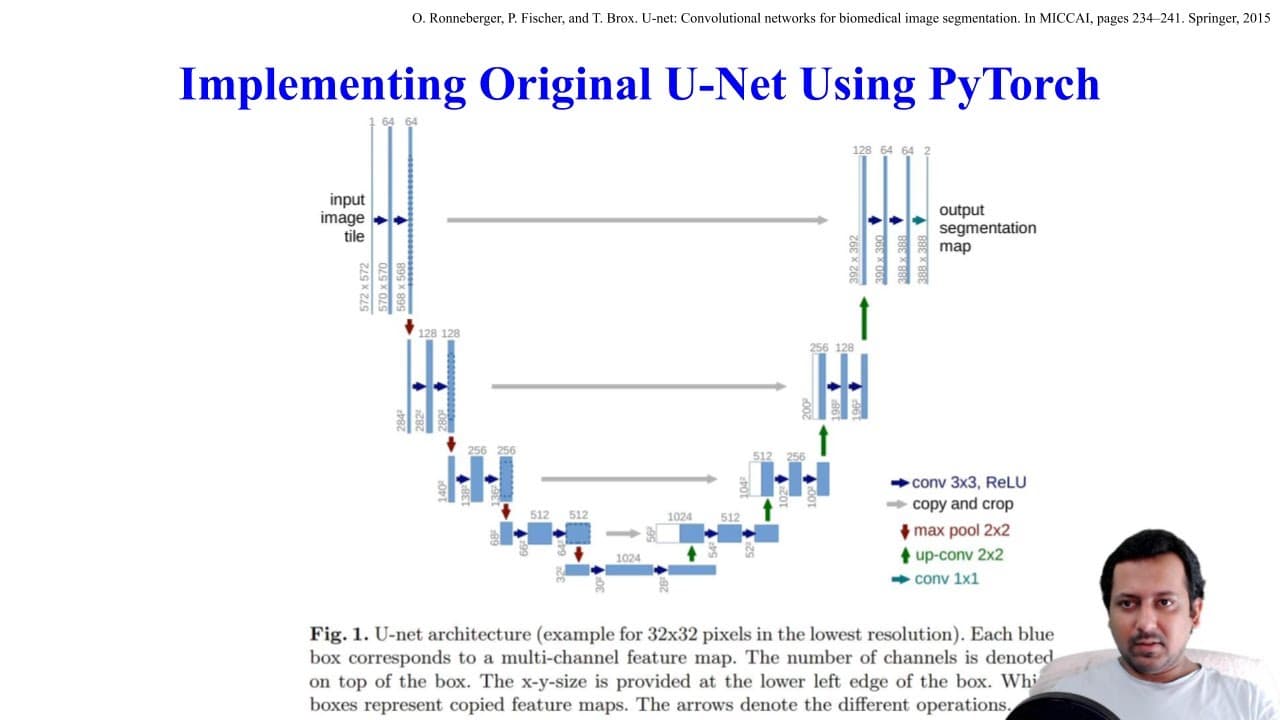
This video demonstrates how to implement the U-Net architecture in Python, staying true to the original paper from 2015, which is widely used for segmentation tasks.
Transcript
hello everyone and welcome back this episode is a bit different from other episodes in this episode we are going to take a look at units and see how it is implemented in Python we will use the original unit paper and I've seen a lot of implementations of this paper and different kinds of units floating around on the internet but all of them are ver... Read More
Key Insights
- 💻 The U-Net architecture is widely used for segmentation tasks in computer vision.
- 🍉 Important terms in the architecture include convolutions, strides, padding, max pooling, and transposed convolutions (or up convolutions).
- ❓ The architecture consists of a contracting path (encoder) and an expanding path (decoder).
- 💁 Concatenating feature maps from the contracting path to the expanding path is crucial in maintaining spatial information.
- 😮 The U-Net architecture can be customized by replacing the encoder part with pre-trained models or using different neural network architectures.
- 🤩 Using transposed convolutions in the decoder part is key to proper upsampling, rather than using bilinear upsampling.
- 😥 The U-Net implementation discussed in the video follows the original paper and can be used as a starting point for implementing the architecture in Python.
Install to Summarize YouTube Videos and Get Transcripts
Explore YouTube Video Summarizer or Get YouTube Transcript Extractor
Questions & Answers
Q: What is the U-Net architecture used for?
The U-Net architecture is commonly used for image segmentation tasks, providing a network that can be used for both classification and segmentation.
Q: What is the difference between up convolutions and deconvolutions?
Up convolutions, also known as transposed convolutions, are the correct term for the process of upsampling in the U-Net architecture. Deconvolutions, on the other hand, refer to a different operation.
Q: Can the U-Net architecture be used with pre-trained models?
Yes, it is possible to replace the encoder part of the U-Net architecture with a pre-trained model, such as a ResNet, by ensuring proper concatenation of the feature maps in the decoder part.
Q: What are the advantages of using up convolutions instead of bilinear upsampling?
Up convolutions learn filters, allowing for better quality upsampling and preserving more details in the images, while bilinear upsampling simply applies a function to make the image bigger.
Summary & Key Takeaways
-
The video introduces the U-Net architecture, which is commonly used for image segmentation tasks.
-
The presenter explains various key terms related to the architecture, such as convolutions, strides, padding, max pooling, and transposed convolutions.
-
The architecture consists of a contracting path (encoder) and an expanding path (decoder), with repeated applications of convolutions, max pooling, and up convolutions.
Read in Other Languages (beta)
Share This Summary 📚
Summarize YouTube Videos and Get Video Transcripts with 1-Click
Try YouTube Summary with ChatGPT & Claude or YouTube Transcript Generator
Explore More Summaries from Abhishek Thakur 📚


Summarize YouTube Videos and Get Video Transcripts with 1-Click
Try YouTube Summary with ChatGPT & Claude or YouTube Transcript Generator