9's Complement | 10's Complements | Decimal Number | STLD | Lec-02
TL;DR
This video explains how to calculate and use n's complement and 10's complement for subtraction in decimal systems.
Transcript
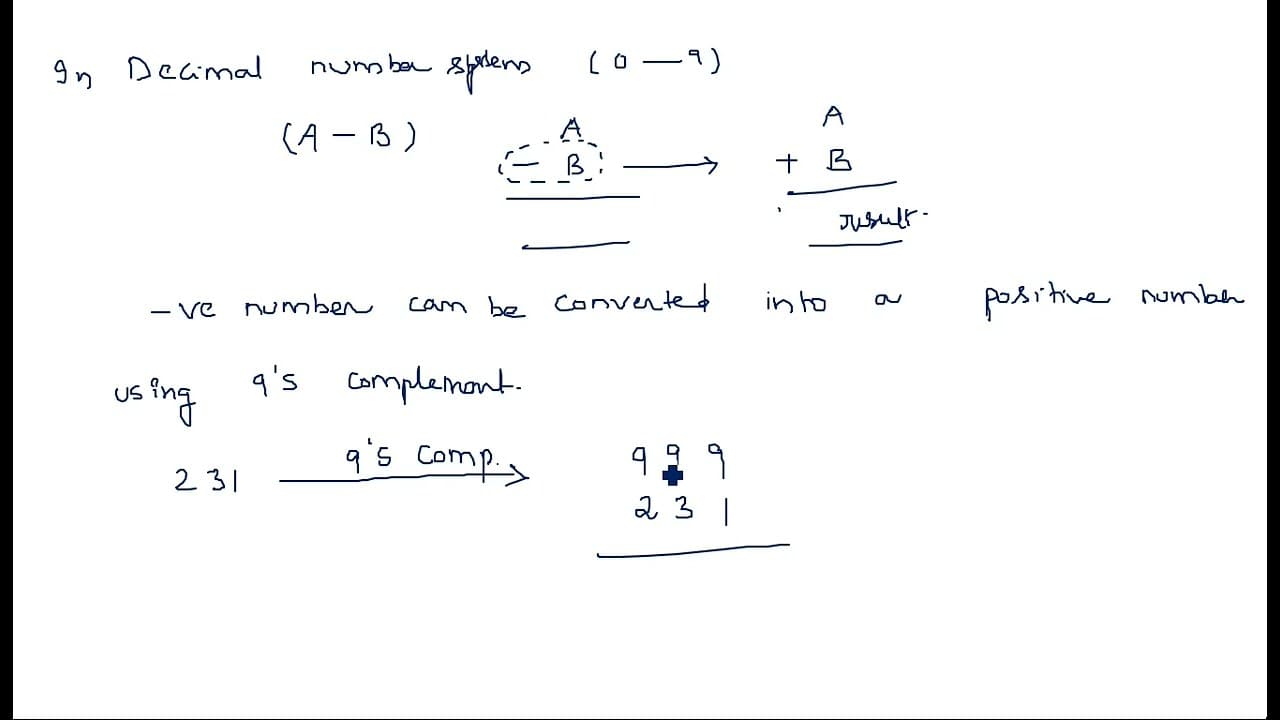
hi everyone in this video I'm going to introduce the nin's complement and 10's complement so what do you mean by n9th complement and what do you mean by 10's complement see when you are using the binary number system or any decimal number system when you are going for subtractions from bigger number to bigger number because n's complement in the de... Read More
Key Insights
- 👻 N's complement (9's complement) and 10's complement are essential tools in decimal subtraction, allowing for simplified computation.
- 😀 The process of finding n's complement involves subtracting each digit from 9, while 10's complement requires adding 1 to the 9's complement.
- 😀 Carry handling differs significantly between n's and 10's complements, with n's requiring the carry to be added back for precise results.
- #️⃣ The video emphasizes that the methodology for calculating n's and 10's complements is applicable for both whole numbers and decimal numbers, reflecting versatility in various arithmetic contexts.
- 🧑🎓 Understanding these complements is vital for students learning advanced arithmetic and number systems, as they provide foundational skills for computing in different bases.
- 🌍 Real-world applications of n's and 10's complements include programming, electronics, and computing, where binary, decimal, and other number systems are frequently applied.
- 🛟 Practicing various examples enhances conceptual understanding, solidifying the learner's ability to apply these concepts in real-life scenarios and different problems.
Install to Summarize YouTube Videos and Get Transcripts
Explore YouTube Video Summarizer or Get YouTube Transcript Extractor
Questions & Answers
Q: What is n's complement and how is it calculated?
N's complement, commonly referred to as 9's complement in the decimal system, is calculated by subtracting each digit of a number from 9, considering the total number of digits. For instance, the 9’s complement of the number 231 is calculated as 9-2, 9-3, and 9-1, resulting in 768.
Q: How do you compute 10's complement?
To find the 10's complement of a number, first calculate its 9's complement, then add 1 to the result. For example, for the number 4526.075, the 9's complement is 5473.924, and adding 1 gives you the 10's complement of 5473.925.
Q: Why do we prefer n's and 10's complements for subtraction in the decimal system?
In the decimal number system, n's and 10's complements allow us to transform subtraction problems into addition, making them simpler to compute. This method utilizes the principles of complements to avoid directly dealing with negative numbers.
Q: What is the role of the end-around carry in n's complement subtraction?
In n's complement subtraction, if a carry is generated during the addition of the n's complement to the original number, that carry must be added back to the final result. This step ensures accuracy in the final answer derived from using n's complement.
Q: How does 10's complement differ from n's complement in carry handling?
With 10's complement, any carry generated during addition is ignored, whereas with n's complement, the carry must be added back to the result for an accurate final answer. This distinction is crucial when applying these methods in calculations.
Q: Can you illustrate a practical example of using n's complement for subtraction?
Certainly! If you need to compute 745.81 - 436.62, first calculate the 9's complement of 436.62 to get 563.37. Next, add it to 745.81, and then incorporate any carry from the addition into the result, ensuring accuracy in the final answer.
Q: What happens when computing the 10's complement and there is an empty space in numbers?
In cases where there are empty spaces in numbers, you can treat those positions as 9. While adding using the 10's complement method, ensure consistency in maintaining the decimal structure, but without the need to include extra spaces as actual digits.
Summary & Key Takeaways
-
The video introduces n's complement (9's complement) and 10's complement, illustrating their importance in facilitating subtraction in the decimal number system.
-
It provides detailed examples of how to compute the n's and 10's complements for various decimal numbers and how to use these complements in subtraction.
-
The content also outlines key differences between n's complement and 10's complement, particularly in handling carries during calculations.
Read in Other Languages (beta)
Share This Summary 📚
Summarize YouTube Videos and Get Video Transcripts with 1-Click
Try YouTube Summary with ChatGPT & Claude or YouTube Transcript Generator