Root Locus | Angle of Arrival for O.L.T.F | Example | CS | Control Systems | Lec-72
TL;DR
This session explains root locus problems, focusing on angle of arrival and calculating poles and zeros.
Transcript
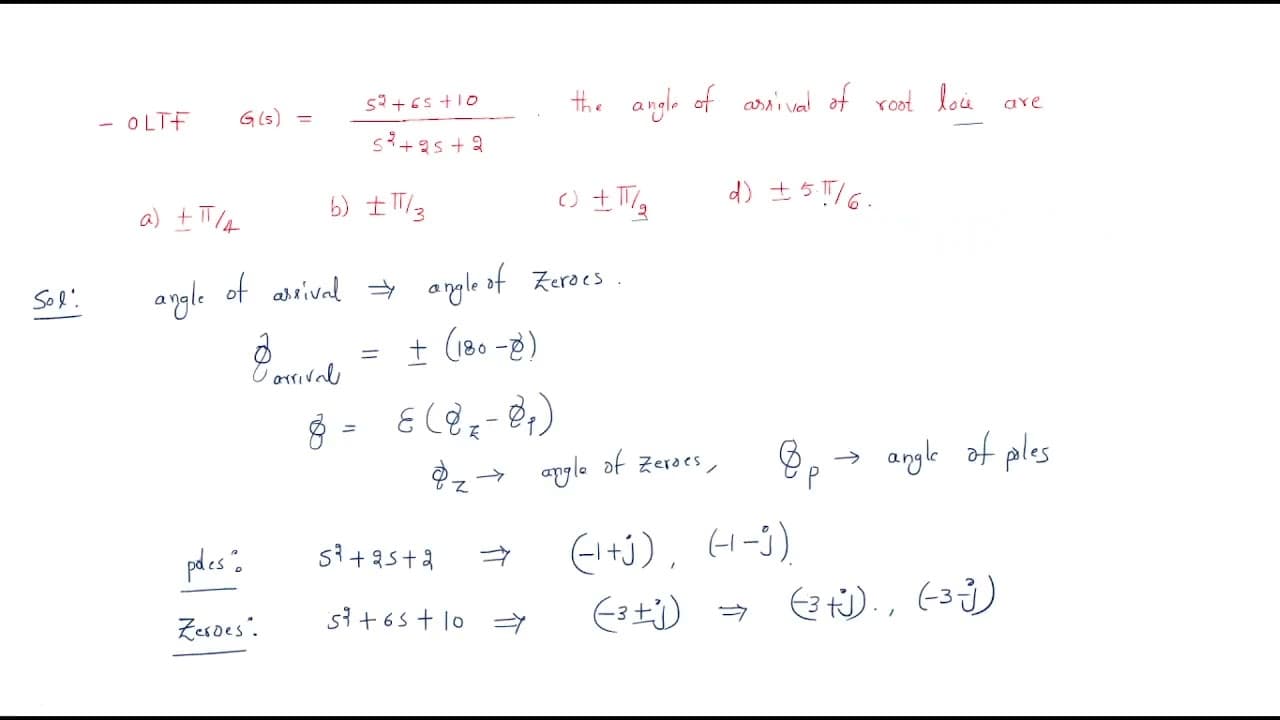
hello everyone in this session we will discuss some more problems regarding the road locus here the first problem is open loop transfer function given j of a sql s squared plus 6x plus 10 s square plus 2 s plus 2 the angular arrival of root plus c r root closing means root locus directly first plus or minus 5 by 4 second plus or minus 5 by 3 c plus... Read More
Key Insights
- 🫚 Root locus provides a graphical tool to analyze system poles and zeros, crucial for control engineering.
- 🛫 The angle of arrival and departure affects system stability, which is vital for precise control in engineering applications.
- 💈 Understanding how to derive poles and zeros from transfer functions is essential for effective analysis and design.
- 🔺 The calculations involved in determining angles require a methodical approach to mathematics and geometry, reflecting systems behavior.
- 🧘 For effective system control, both poles and zeros must be positioned thoughtfully in the complex plane.
- 🫚 Feedback gain variations directly influence the root locus, dictating system stability and dynamic response adaptations.
- 🈸 Formula applications are critical in deriving angles, demonstrating the integration of theoretical knowledge and practical engineering issues.
Install to Summarize YouTube Videos and Get Transcripts
Explore YouTube Video Summarizer or Get YouTube Transcript Extractor
Questions & Answers
Q: What is the purpose of the root locus in control systems?
The root locus is a graphical method used in control systems to analyze how the roots of a transfer function change with varying feedback gain. It helps in understanding system stability and response, facilitating the design of controllers by examining how pole placement affects performance characteristics.
Q: How are poles and zeros determined from the given transfer function?
From the transfer function, poles and zeros can be identified by setting the numerator and denominator to zero. For the given function G(s), the zeros are the values of s that make the numerator zero, while the poles are determined from the denominator, revealing critical points in the system's response.
Q: Can you explain the concept of angle of arrival in this context?
The angle of arrival refers to the angle at which a zero approaches a pole on the root locus plot. It is calculated using the difference between the angles contributed by the zeros and the poles, influencing how system stability and transient response are affected as the gain varies.
Q: What is the formula mentioned for calculating the angle of arrival?
The angle of arrival is calculated using the formula Angle of arrival = (180 - φ), where φ is the sum of the angles of the zeros minus the angles of the poles. This approach helps determine how the system behaves near the respective poles in the locus.
Q: Why is understanding angles significant in control system design?
Understanding angles is crucial because they determine the stability and transient response of control systems. By knowing how poles and zeros interact through their angles, engineers can fine-tune system behaviors to achieve desired performance metrics, such as settling time and overshoot.
Q: How do changes in the system parameters affect the root locus?
Changes in system parameters, such as feedback gain or system configuration, alter the locations of poles and zeros in the complex plane. This can lead to shifts in the root locus path, which directly affects system dynamics, stability, and response characteristics, warranting careful analysis and adjustments in design.
Summary & Key Takeaways
-
The session discusses root locus analysis, especially concerning the calculation of angles of arrival for poles and zeros within a control system context.
-
The calculations include identifying poles and zeros of given transfer functions and using specific formulas to determine angles related to root locus placements.
-
A step-by-step approach is provided in finding the angles involved, illustrating how these calculations influence overall system response.
Read in Other Languages (beta)
Share This Summary 📚
Summarize YouTube Videos and Get Video Transcripts with 1-Click
Try YouTube Summary with ChatGPT & Claude or YouTube Transcript Generator