Circular wave guide | Field expressions | Microwave Engineering | Lec-32
TL;DR
This video explains field expressions in circular wave guides compared to rectangular wave guides.
Transcript
hi everyone in this video I'm going to explain about the field expressions in circular wave guide so field expressions in the case of rectangular wave guide also we have calculated four different field equations HX Hy e x eyy okay that is quite different from the circular wave guide okay why I am comparing every time with rectangular wave guide is ... Read More
Key Insights
- 👋 Circular wave guides differ from rectangular wave guides primarily in their use of cylindrical coordinates, impacting field expression formulations.
- 👋 Field expressions in circular wave guides utilize parameters R and Theta instead of X and Y, essential for accurate wave propagation analysis.
- 👋 The derivation of equations for circular wave guides involves substituting Cartesian coordinates relevant to rectangular systems, ensuring proper mathematical adaptation.
- 👋 The relationship between the two wave guides emphasizes the continuity of electromagnetic theory, facilitating a smoother transition for learners in electrical engineering.
- 👋 Understanding parameters like cutoff wave number and propagation constants is vital for analyzing circular wave guide performance.
- 👶 The video highlights a practical demonstration of deriving new equations from established theories, showcasing an important educational approach in engineering.
- 👋 Further exploration of TM (Transverse Magnetic) and TE (Transverse Electric) modes in the next video promises deeper insights into circular wave guides' functional behavior.
Install to Summarize YouTube Videos and Get Transcripts
Explore YouTube Video Summarizer or Get YouTube Transcript Extractor
Questions & Answers
Q: What are the main differences between the field expressions of circular and rectangular wave guides?
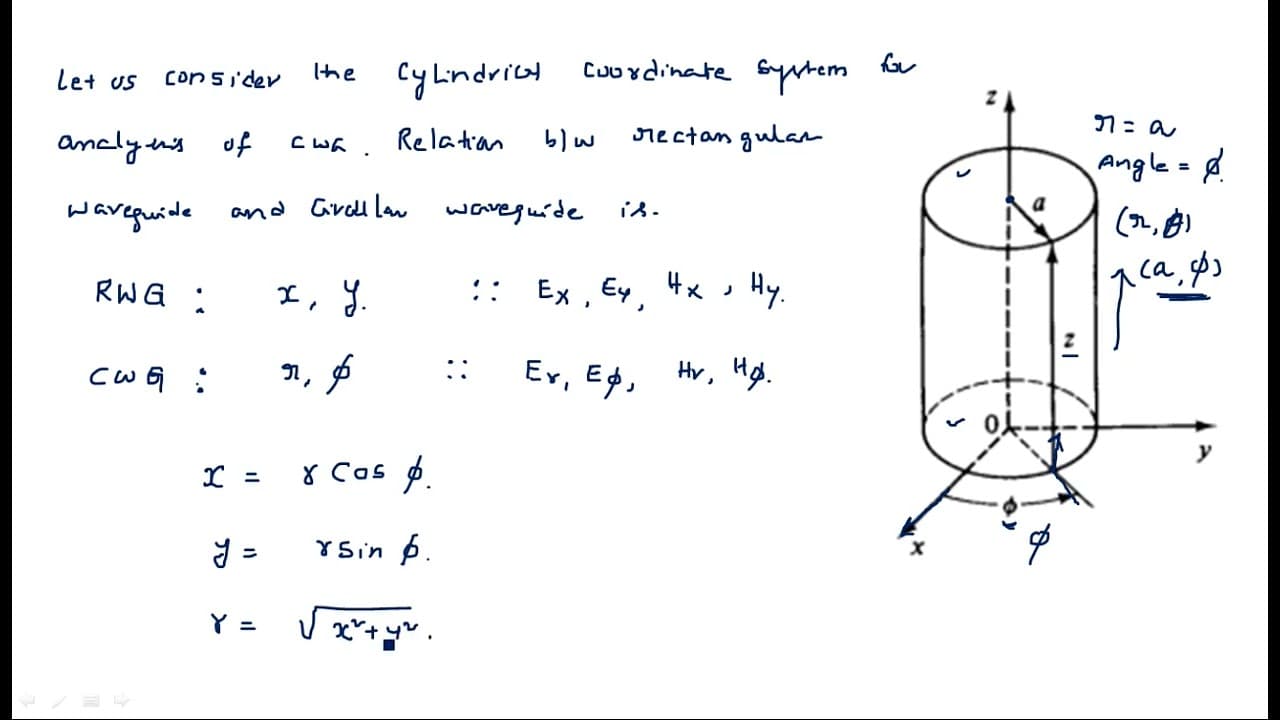
The primary difference lies in the coordinate systems used; rectangular wave guides use Cartesian coordinates (X, Y), while circular wave guides employ cylindrical coordinates (R, Theta). This transition affects the expressions of the electric and magnetic field components, requiring adaptations in mathematical formulation.
Q: Why is the relationship between rectangular and circular wave guides significant?
Understanding the relationship helps in transitioning knowledge from rectangular wave guides to circular ones, facilitating easier learning and application of principles in electromagnetic theory. The parameters, though expressed differently, maintain a fundamental connection that is essential for analyzing wave propagation.
Q: How are the electric and magnetic field components represented in circular wave guides?
In circular wave guides, electric and magnetic field components are expressed with parameters E_r, E_Theta, H_r, and H_Theta. These differ from the rectangular wave guide's ex, ey, HX, and Hy, highlighting the need to adapt previous equations when moving from one type of wave guide to another.
Q: What is the significance of the cylindrical coordinate system in analyzing circular wave guides?
The cylindrical coordinate system provides a more appropriate framework for analyzing wave propagation in circular wave guides, as it accounts for the guide's uniform cross-section and allows for accurate representation of dimensions and angles necessary for electromagnetic field calculations.
Q: Can you explain the transition of equations from rectangular wave guides to circular wave guides?
The transition involves substituting X with R cos(Theta) and Y with R sin(Theta) to derive the circular wave guide equations from rectangular wave guide equations. This substitution is crucial in converting from Cartesian to cylindrical coordinates, fundamentally changing how field expressions are evaluated.
Q: What are the key parameters involved in the field equations for circular wave guides?
Key parameters include R (radius), Theta (angle), gamma (propagation constant), and h (cutoff wave number). These parameters are essential in calculating the electric and magnetic field components and understanding the wave behavior in the circular guide structure.
Summary & Key Takeaways
-
The video discusses the differences in field expressions between circular and rectangular wave guides, highlighting the parameters' similarities but differing expressions in a cylindrical coordinate system.
-
It details the transition from using Cartesian coordinates (X, Y) in rectangular wave guides to cylindrical coordinates (R, Theta) in circular wave guides, with relevant equations.
-
The presenter derives the circular wave guide field equations from previously established rectangular wave guide equations, illustrating the relationship between the two systems.
Read in Other Languages (beta)
Share This Summary 📚
Summarize YouTube Videos and Get Video Transcripts with 1-Click
Try YouTube Summary with ChatGPT & Claude or YouTube Transcript Generator