Products
Features
YouTube Video Summarizer
Summarize YouTube videos
Web & PDF Highlighter
Highlight web pages & PDFs
Chat with PDF
Ask any PDF questions with AI
Ask AI Clone
Chat with your highlights & memories
Audio Transcriber
Transcribe audio files to text
Glasp Reader
Read and highlight articles
Kindle Highlight Export
Export your Kindle highlights
Idea Hatch
Hatch ideas from your highlights
Integrations
Obsidian Plugin
Notion Integration
Pocket Integration
Instapaper Integration
Medium Integration
Readwise Integration
Snipd Integration
Hypothesis Integration
Apps & Extensions
Chrome Extension
Safari Extension
Edge Add-ons
Firefox Add-ons
iOS App
Android App
Discover
Discover
Ideas
Discover new ideas and insights
Articles
Curated articles and insights
Books
Book recommendations by great minds
Posts
Essays and notes from readers
Quotes
Inspiring quotes collection
Videos
Curated videos and summaries
Explore Glasp
Glasp Newsletter
Weekly insights and updates
Glasp Talk
Interview series with great minds
Glasp Blog
Latest news and articles
Glasp Use Cases
Learn how others use Glasp
Build & Support
Glasp API
Access Glasp's API for developers
MCP Connector
Connect Glasp to Claude & ChatGPT
Community
Glasp Reddit Community
Students
Student discount and benefits
FAQs
Frequently Asked Questions
AboutPricing
DashboardLog inSign up

IVT Conjugate Poles | Z-Transform in Signals and Systems | Problem 5
240 views
•
April 4, 2022
by
Ekeeda
YouTube video player
IVT Conjugate Poles | Z-Transform in Signals and Systems | Problem 5

TL;DR

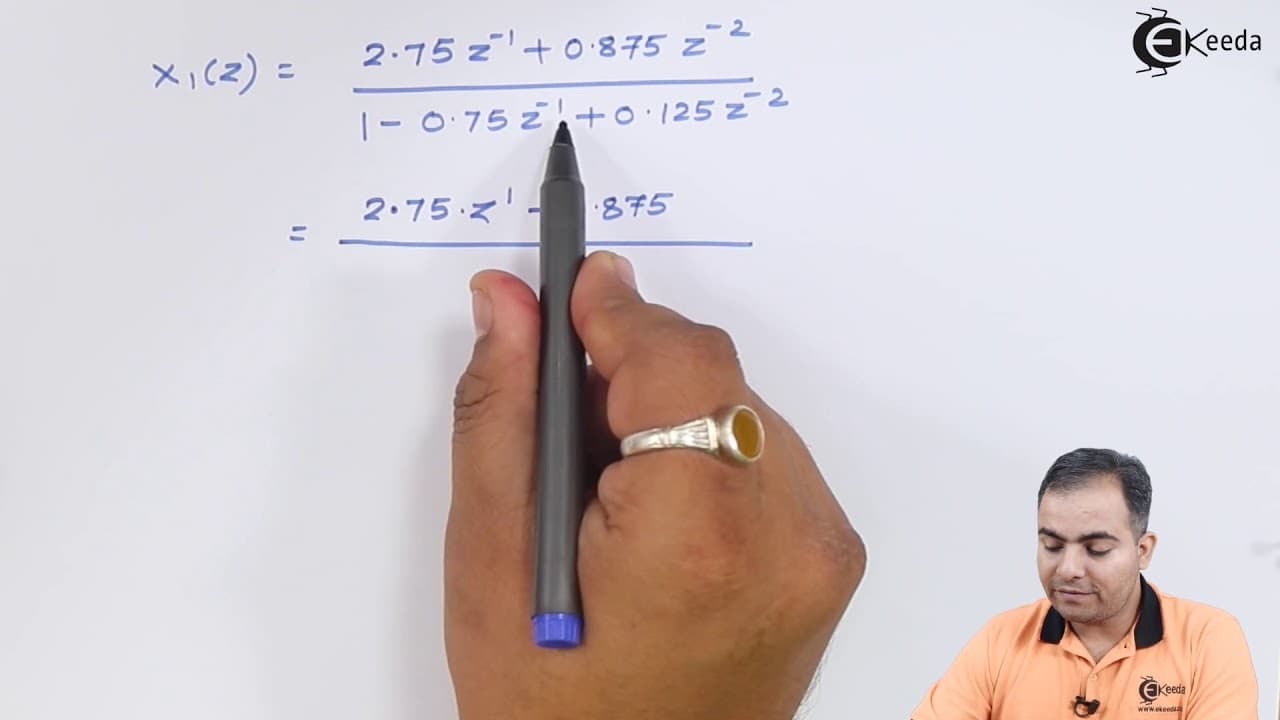
Solving an inverse Z-transform numerical problem with step-by-step division and partial fraction method.

Transcript

click the bell icon to get latest videos from equator hello friends and today we are going to study a numerical that is problem 5 which is based on when or you can say inverse z-transform signals when numerator degree is greater than dynamometer we will see a problem or 5 first now the question is find inverse the transfer of following signal and s... Read More

Key Insights

  • 🤪 Division is performed once when the numerator and denominator degrees are equal to simplify the inverse Z-transform calculation.
  • 🤪 Partial fraction method is employed to break down complex Z-transform functions into simpler components for easier manipulation.
  • 🤪 Conversion of Z-transform functions to a normal form involves adjusting degrees by multiplication to enhance the inverse transformation process.
  • 🤪 Substituting Z values in equations derived from Z-transform functions helps determine coefficients accurately for inverse Z-transform calculations.
  • 🤪 Step-by-step process involving division, partial fractions, and coefficient substitution is essential in solving inverse Z-transform numeric problems efficiently.
  • 🤪 Understanding the principles of Z-transform and inverse Z-transform operations is crucial for solving numerical problems with complex signal functions.
  • 🤪 The importance of following a systematic approach in inverse Z-transform problem-solving to simplify calculations and obtain accurate results.

Install to Summarize YouTube Videos and Get Transcripts

Explore YouTube Video Summarizer or Get YouTube Transcript Extractor

Questions & Answers

Q: How do you determine the degree of the numerator and denominator in an inverse Z-transform problem?

The degree of the numerator and denominator helps decide if division is needed; if equal, divide once for a remainder degree less than the denominator.

Q: Why is partial fraction method used in solving inverse Z-transforms?

Partial fractions simplify complex functions for easier calculations, especially when converting Z-transform functions to a normal form.

Q: How is Z-transform function converted to a normal form for inverse transformation?

By multiplying the function with factors to adjust degrees and convert to a standard form for easier inverse transformation.

Q: Why is substitution of Z values essential in finding coefficients for inverse Z-transforms?

Substituting specific Z values helps determine coefficients using equations derived from the Z-transform function for accurate results.

Summary & Key Takeaways

  • Solving inverse Z-transform signals numeric problem with step-by-step division.

  • Using division and partial fraction method to find the inverse transfer of a given signal.

  • Demonstrating how to apply division and convert Z-transform function into a normal form for easier calculations.


Read in Other Languages (beta)

English

Share This Summary 📚

Summarize YouTube Videos and Get Video Transcripts with 1-Click

Download browser extensions on:

Try YouTube Summary with ChatGPT & Claude or YouTube Transcript Generator

Explore More Summaries from Ekeeda 📚
Problem 2 on Angle between Two Polar Curves - Polar Curves - Engineering Mathematics - 2 thumbnail
Problem 2 on Angle between Two Polar Curves - Polar Curves - Engineering Mathematics - 2
Ekeeda
How to Project an Isosceles Triangle in Engineering Drawing thumbnail
How to Project an Isosceles Triangle in Engineering Drawing
Ekeeda
Software Testing and Quality Assurance - Agile Testing | 12 November | 6 PM thumbnail
Software Testing and Quality Assurance - Agile Testing | 12 November | 6 PM
Ekeeda
Energy Banking - Power System Security - Power System 3 thumbnail
Energy Banking - Power System Security - Power System 3
Ekeeda
Digital Certificate | Cryptography and Network Security thumbnail
Digital Certificate | Cryptography and Network Security
Ekeeda
InP Diodes - Transferred Electron Devices - Microwave Engineering thumbnail
InP Diodes - Transferred Electron Devices - Microwave Engineering
Ekeeda

Summarize YouTube Videos and Get Video Transcripts with 1-Click

Download browser extensions on:

Try YouTube Summary with ChatGPT & Claude or YouTube Transcript Generator

Apps & Extensions

  • Chrome Extension
  • Safari Extension
  • Edge Add-ons
  • Firefox Add-ons
  • iOS App
  • Android App

Key Features

  • YouTube Video Summarizer
  • Web & PDF Summarizer
  • Web & PDF Highlighter
  • Chat with PDF
  • Ask AI Clone
  • Audio Transcriber
  • Glasp Reader
  • Kindle Highlight Export
  • Idea Hatch

Integrations

  • Obsidian Plugin
  • Notion Integration
  • Pocket Integration
  • Instapaper Integration
  • Medium Integration
  • Readwise Integration
  • Snipd Integration
  • Hypothesis Integration

More Features

  • APIs
  • MCP Connector
  • Blog & Post
  • Embed Links
  • Image Highlight
  • Personality Test
  • Quote Shots

Company

  • About us
  • Blog
  • Community
  • FAQs
  • Job Board
  • Newsletter
  • Pricing
Terms

•

Privacy

•

Guidelines

© 2026 Glasp Inc. All rights reserved.