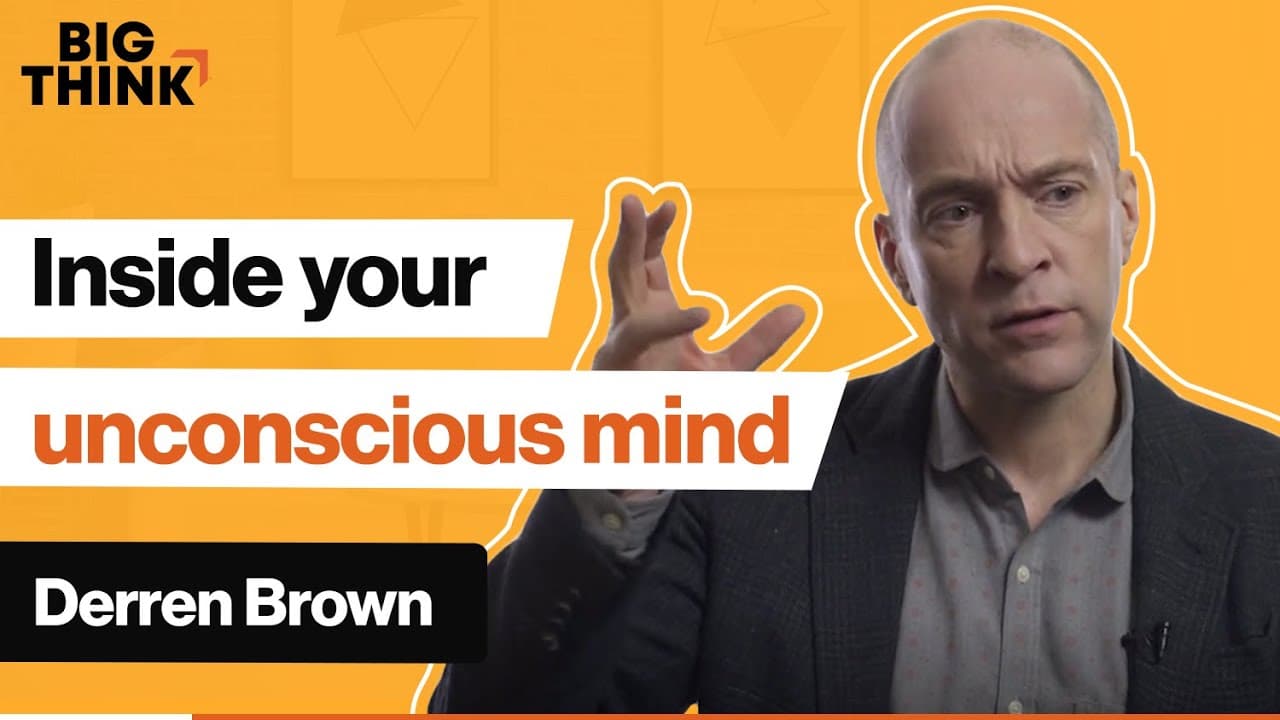
This is how an illusionist targets your unconscious mind | Derren Brown | Big Think
TL;DR
Magicians employ psychological tricks to manipulate conscious and unconscious processes during performances.
Transcript
When you work I think with any sort of magic you become a very good applied psychologist just in a very niche area, which is why it’s generally magicians that are brought in to kind of test for psychic claims and that kind of thing to sort of debunk or look for that kind of evidence because scientists get fooled very easily like the rest of us, mag... Read More
Key Insights
- 🚱 Magicians excel in applied psychology, utilizing conscious and non-conscious processes to captivate audiences.
- ❓ Techniques like false shuffling and hypnotic inductions exploit cognitive vulnerabilities to enhance magical illusions.
- 😒 Bafflement and disorientation are tools magicians use to increase suggestibility and control narratives during performances.
- 🦮 By understanding both conscious and unconscious cues, magicians can guide and influence audience reactions effectively.
- 🛀 The structure of magic shows is tailored to manipulate suggestibility and filter for responsive participants.
- 🖐️ Hypnotic inductions, false memories, and other psychological tactics play a significant role in crafting captivating magic performances.
- ❓ Magicians create a powerful influence by leveraging audience disorientation and suggestibility.
Install to Summarize YouTube Videos and Get Transcripts
Explore YouTube Video Summarizer or Get YouTube Transcript Extractor
Questions & Answers
Q: How do magicians use false memories to enhance their performances?
Magicians can implant false memories by guiding audiences to shuffle cards in a specific way, creating a narrative that aligns with their tricks. This manipulation of memory enhances the magical experience for spectators.
Q: What role does suggestibility play in magic performances?
Suggestibility, induced through techniques like rapid hypnotic inductions, makes participants more susceptible to the magician's instructions, enabling them to perform actions they might not normally do.
Q: How do magicians leverage bafflement to influence spectators?
Magicians like to induce bafflement in their audience, as disorientation makes people more suggestible. By exploiting this cognitive state, magicians can guide spectators to accept their performances.
Q: Why is understanding both conscious and unconscious processes crucial for magicians?
Magicians rely on manipulating both conscious awareness and unconscious responses to craft compelling narratives and control audience perceptions, highlighting the interplay between psychology and magic.
Summary & Key Takeaways
-
Magicians leverage conscious and non-conscious processes to deceive and manipulate audiences.
-
Techniques like false shuffling and rapid hypnotic inductions create bafflement and suggestibility in participants.
-
Understanding psychology is crucial for magicians to control narratives and influence spectators effectively.
Read in Other Languages (beta)
Share This Summary 📚
Summarize YouTube Videos and Get Video Transcripts with 1-Click
Try YouTube Summary with ChatGPT & Claude or YouTube Transcript Generator
Explore More Summaries from Big Think 📚



Summarize YouTube Videos and Get Video Transcripts with 1-Click
Try YouTube Summary with ChatGPT & Claude or YouTube Transcript Generator