Moving verbs | Learn Vietnamese with TVO
TL;DR
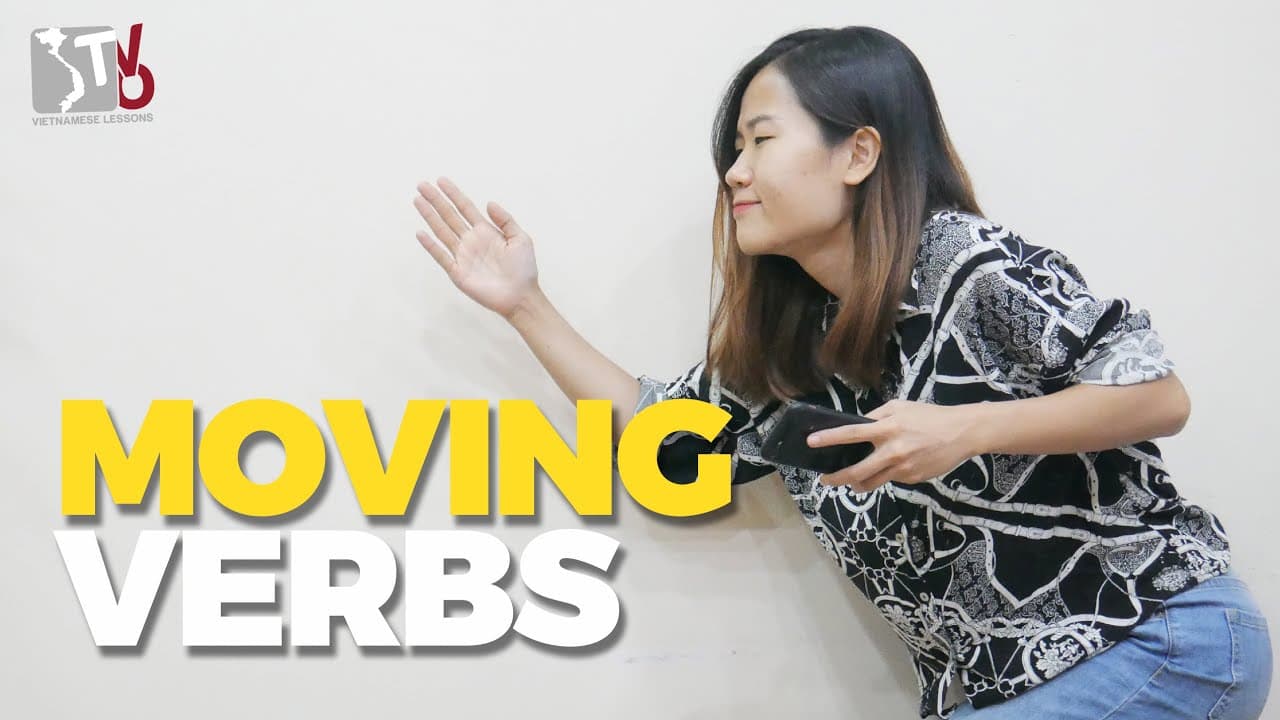
Learn nine Vietnamese moving verbs with examples and exercises.
Transcript
hi guys welcome back to our youtube channel how are you today do you know how to say go up go down go in and go out if not then keep on watching this video because today i'm going to give you the meanings as well as how to use nine moving verbs in vietnamese since these verbs can be used as both verbs and prepositions i'm going to give the meanings... Read More
Key Insights
- The video covers nine essential Vietnamese moving verbs, providing meanings and usage examples for both verbs and prepositions.
- The verb 'đi' can be combined with other verbs or destinations, focusing on the action rather than the destination.
- 'Đến' emphasizes the destination more than the action, and as a preposition, it means 'to' or 'toward'.
- 'Vào' and 'ra' are used for going into and out of places, respectively, with context aiding comprehension.
- 'Lên' and 'xuống' describe upward and downward movements, with examples illustrating correct usage.
- 'Sang' and 'qua' are interchangeable in many contexts, with meanings like crossing, passing by, or going to the other side.
- The video emphasizes using these verbs without prepositions when used as verbs, simplifying sentence construction.
- Practice exercises are provided to reinforce understanding, with answers available in the description box.
Install to Summarize YouTube Videos and Get Transcripts
Explore YouTube Video Summarizer or Get YouTube Transcript Extractor
Questions & Answers
Q: What is the focus of the video?
The focus of the video is to teach viewers about nine essential moving verbs in Vietnamese. It explains the meanings and usage of these verbs as both verbs and prepositions. Additionally, the video provides examples and practice exercises to help learners understand and retain the information effectively.
Q: How is the verb 'đi' used in Vietnamese?
In Vietnamese, the verb 'đi' can be combined with another verb or a destination to indicate the action of going. It focuses more on the action itself rather than the destination. As a preposition, 'đi' means 'away'. The video provides examples to demonstrate these uses, emphasizing its versatility in the language.
Q: What is the significance of 'đến' in Vietnamese?
The verb 'đến' in Vietnamese is used to emphasize the destination more than the action of going. As a preposition, it means 'to' or 'toward'. The video illustrates its usage with examples, showing how it can be integrated into sentences to convey movement toward a specific place or goal.
Q: How are 'vào' and 'ra' used in sentences?
In Vietnamese, 'vào' means to go into a place, while 'ra' means to go out. These verbs are used to describe movements in and out of locations. The video provides examples to demonstrate how these verbs function in sentences, highlighting the importance of context in interpreting their meanings accurately.
Q: What do 'lên' and 'xuống' mean?
The verbs 'lên' and 'xuống' are used to describe upward and downward movements, respectively. 'Lên' means to go up, while 'xuống' means to go down. The video provides examples to show how these verbs are used in sentences, emphasizing the tonal aspect of Vietnamese that can affect their meaning.
Q: Can 'sang' and 'qua' be used interchangeably?
Yes, in many situations, the verbs 'sang' and 'qua' can be used interchangeably in Vietnamese. They share several meanings, such as crossing, passing by, or going to the other side of something. The video explains these meanings and provides examples to illustrate their interchangeable nature in various contexts.
Q: What is the importance of context in using these verbs?
Context plays a crucial role in using Vietnamese moving verbs correctly. It helps determine the intended meaning and appropriate usage of verbs like 'vào', 'ra', 'lên', and 'xuống'. The video emphasizes understanding the context to ensure accurate communication, as some verbs can convey different meanings based on the situation.
Q: How can learners practice these verbs?
Learners can practice these Vietnamese moving verbs by engaging with the exercises provided in the video. The exercises are designed to reinforce understanding and retention of the verbs' meanings and usage. Answers are available in the description box, allowing learners to check their work and practice repeatedly for mastery.
Summary & Key Takeaways
-
The video introduces nine moving verbs in Vietnamese, explaining their meanings and usage as both verbs and prepositions. Examples are provided for each verb, illustrating how they can be combined with other words to form meaningful phrases. The video aims to enhance understanding and retention of these essential verbs.
-
Key verbs covered include 'đi', 'đến', 'vào', 'ra', 'lên', 'xuống', 'sang', and 'qua'. Each is explained with examples to highlight their function as verbs and prepositions. The video stresses the importance of context in understanding when to use these verbs without additional prepositions.
-
Practice exercises are included to test comprehension, with answers provided in the description. The video encourages viewers to practice repeatedly to ensure mastery of the verbs. The teacher also invites learners to subscribe for more videos and offers information on classes for further learning.
Read in Other Languages (beta)
Share This Summary 📚
Summarize YouTube Videos and Get Video Transcripts with 1-Click
Try YouTube Summary with ChatGPT & Claude or YouTube Transcript Generator
Explore More Summaries from Tieng Viet Oi - Vietnamese Lessons 📚

Summarize YouTube Videos and Get Video Transcripts with 1-Click
Try YouTube Summary with ChatGPT & Claude or YouTube Transcript Generator