How Does the Solow Model Explain Economic Growth?
TL;DR
The Solow model suggests that higher savings and investment, more human capital, and lower population growth lead to higher GDP per capita. However, it struggles to explain large income disparities across countries solely through these factors. The model requires additional elements, like productivity differences, to fully account for real-world economic growth variations.
Transcript
so in our third lecture on the solo model we're going to take the model to data we're going to see whether the model is consistent with the basic facts of economic growth let's take a look so from our previous lectures we know that in the soal model GDP per capita is a positive function of savings or investment positive function of human capital an... Read More
Key Insights
- GDP per capita is positively related to savings and investment, according to the Solow model.
- Higher levels of human capital correlate with greater GDP per capita.
- Population growth negatively impacts GDP per capita in the Solow model.
- The steady state is reached when investment equals depreciation.
- Differences in GDP per capita can be partly explained by variations in savings rates.
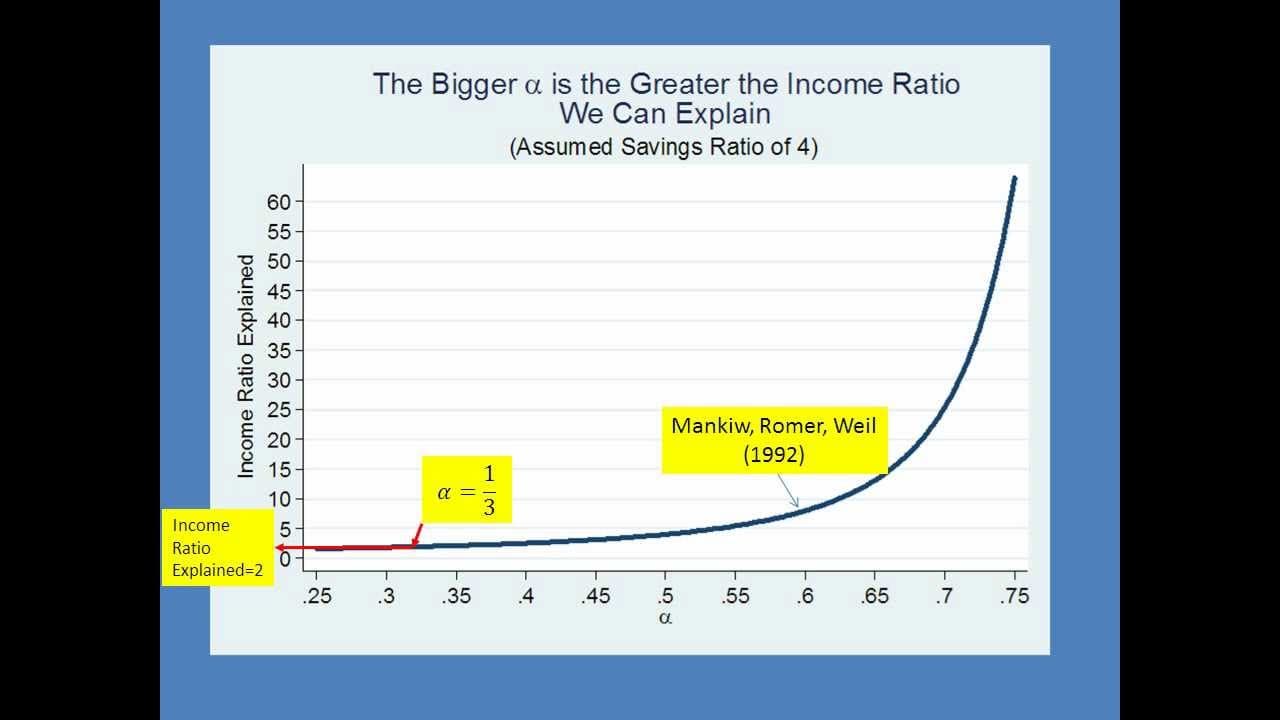
- Alpha, representing capital's share of income, significantly affects the model's predictions.
- A higher Alpha value suggests larger income differences can be explained by savings rate disparities.
- The Solow model alone cannot fully explain global income disparities; productivity differences are needed.
Install to Summarize YouTube Videos and Get Transcripts
Explore YouTube Video Summarizer or Get YouTube Transcript Extractor
Questions & Answers
Q: How does the Solow model relate savings rates to GDP per capita?
The Solow model posits that higher savings rates lead to increased investment, which in turn raises GDP per capita. This relationship is based on the model's assumption that investment drives economic growth by enhancing capital accumulation. The model suggests that countries with higher average savings over time tend to achieve a higher steady-state level of GDP per capita.
Q: What role does human capital play in the Solow model?
In the Solow model, human capital is a critical factor that positively influences GDP per capita. The model suggests that more years of schooling and higher levels of education lead to greater human capital accumulation, which enhances productivity and economic growth. This relationship underscores the importance of investing in education to boost a country's economic performance.
Q: Why does the Solow model struggle to explain large income disparities?
The Solow model struggles to explain large income disparities because it primarily focuses on savings, investment, and population growth, without accounting for differences in productivity across countries. While these factors influence GDP per capita, they are insufficient to fully explain the vast income variations observed globally. The model requires additional elements, such as productivity differences, to better capture real-world economic disparities.
Q: What is Alpha in the Solow model, and why is it important?
Alpha in the Solow model represents the capital's share of income in the production function. It is crucial because it determines how changes in savings rates translate into differences in GDP per capita. A higher Alpha suggests that savings rate disparities can explain larger income differences across countries. However, the model's reliance on Alpha limits its ability to account for all observed economic variations.
Q: How does the Solow model predict the steady state of an economy?
The Solow model predicts that an economy reaches its steady state when investment equals depreciation. At this point, the capital stock remains constant, and GDP per capita stabilizes. The steady-state level is determined by factors such as the savings rate, population growth, and technological progress. The model uses this concept to explain long-term economic growth and the convergence of economies over time.
Q: Why is the Solow model's assumption about capital and labor returns problematic?
The Solow model's assumption about capital and labor returns is problematic because it suggests that poor countries should have higher returns on capital and skilled labor due to scarcity. However, real-world observations show that capital and skilled labor often flow from poor to rich countries, contradicting the model's expectations. This discrepancy highlights the need to consider additional factors, such as institutional quality and productivity differences, to better understand economic growth.
Q: What additional factors are needed to enhance the Solow model's predictions?
To enhance the Solow model's predictions, additional factors like productivity differences, institutional quality, and technological advancements must be considered. These elements help explain why some countries achieve higher economic growth despite similar savings and investment rates. Incorporating these factors allows for a more comprehensive understanding of global income disparities and the drivers of economic growth.
Q: How does the Solow model explain the relationship between population growth and GDP per capita?
The Solow model explains that higher population growth negatively impacts GDP per capita by diluting capital accumulation. As the population increases, the available capital per worker decreases, leading to lower productivity and economic output. This relationship highlights the importance of balancing population growth with investments in capital and human resources to sustain economic growth and improve living standards.
Summary & Key Takeaways
-
The Solow model predicts that increased savings, investment, and human capital, alongside reduced population growth, enhance GDP per capita. However, the model's ability to explain large income disparities across countries is limited, as it doesn't fully account for productivity variations. To better understand global economic growth, additional factors like productivity differences must be considered.
-
A key equation in the Solow model shows that the steady state occurs when investment equals depreciation. The model suggests that countries with higher savings rates achieve higher GDP per capita. However, the model's reliance on Alpha, the capital's share of income, affects its predictive power, and a higher Alpha value indicates greater income differences explained by savings rate disparities.
-
Despite the Solow model's predictions, real-world observations show capital and skilled labor often flow from poor to rich countries, contradicting the model's expectations. This suggests that the model's assumptions about capital and labor returns in poor countries are flawed, highlighting the need for additional elements like productivity differences to fully explain economic disparities.
Read in Other Languages (beta)
Share This Summary 📚
Summarize YouTube Videos and Get Video Transcripts with 1-Click
Try YouTube Summary with ChatGPT & Claude or YouTube Transcript Generator
Explore More Summaries from Marginal Revolution University 📚

Summarize YouTube Videos and Get Video Transcripts with 1-Click
Try YouTube Summary with ChatGPT & Claude or YouTube Transcript Generator