VHDL Code for 4-bit Down / Up counter | IC 7493 | VHDL | Digital Systems Design | Lec-102
TL;DR
This video explains VHDL coding for 4-bit up and down counters.
Transcript
hi everyone in this video I'm going to explain about the vhdl code for an up counter or a down counter so in the previous video we have started this is 7493 counter where it counts the number of clock pulses in a sequential incremental manner which starts with four zeros and goes up to four ones because each and every clock pulse changes the state ... Read More
Key Insights
- 🍵 The 7493 counter architecture is central to implementing basic counting functionality in VHDL, handling both incremental and decremental counting.
- 🔄 Key signals in sequential logic, such as clock and reset, dictate the behavior and state transitions of the counting circuit.
- 👨💻 VHDL code structure is fundamental, including entity definitions and behavioral processes tailored for specific counter operations.
- 🔄 Resetting the counter is essential for maintaining accuracy and consistency in counting applications, enabling a reliable start state.
- 🔄 Incrementing or decrementing count values through simple arithmetic changes defines whether the counter operates in an up or down fashion.
- 🔄 Clock pulses act as the driving force behind state changes in the counter, making accurate timing vital for reliable counting.
- 🔄 Future explorations into decade counters promise to expand on the principles discussed, showcasing more complex counting mechanisms.
Install to Summarize YouTube Videos and Get Transcripts
Explore YouTube Video Summarizer or Get YouTube Transcript Extractor
Questions & Answers
Q: What is the function of the 7493 counter mentioned in the video?
The 7493 counter is an integrated circuit designed to count clock pulses in a sequential manner. It starts at a value of four zeros and can count up to four ones, incrementing its count with each clock pulse. This functionality serves as the basis for implementing up and down counting in VHDL.
Q: How is the VHDL code structured for counting?
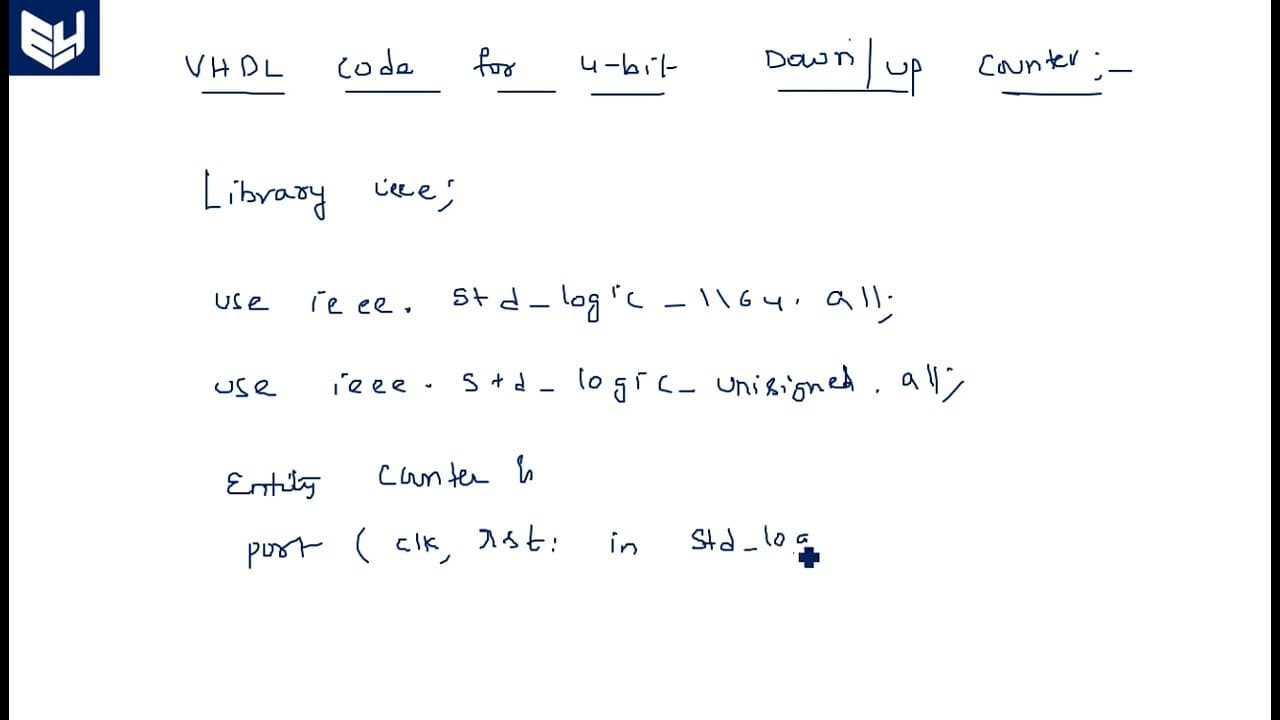
The VHDL code starts with necessary libraries and then defines the entity and architecture for the counter. It includes the declaration of inputs like clock and reset and an output for the count, with a behavioral process defined to manage the counting logic when the clock pulses are detected.
Q: What happens during a reset in the counter?
When the reset signal is activated (set to 1), the counter's output is set to zero. This is a crucial part of ensuring that the counter can start fresh from a known state whenever it is needed, guaranteeing reliable counting when the system initializes or restarts.
Q: Can you explain how the up and down counter functions change in the code?
In the code, to implement an up counter, the count variable is incremented (count = count + 1) with each clock pulse. Conversely, for a down counter, the count variable is decremented (count = count - 1) on each pulse, effectively allowing the counter to count backwards with each clock cycle.
Q: What is the significance of clock pulses in the counter implementation?
Clock pulses serve as the timing mechanism in the counter's operation, triggering state changes in the flip-flops that determine the count value. Each pulse represents a discrete event that instructs the counter to either increment or decrement based on the desired counting direction.
Q: How does the video relate to future content about the decade counter?
The video provides a foundational understanding of counting mechanisms, which is essential for grasping more complex counting circuits like the decade counter, specifically the 7490 IC. The subsequent video promises to explore this IC, further building on the knowledge of clock-based counting systems.
Q: What adjustments can be made in the code to switch between up and down counting?
The adjustment is quite simple: to change the direction of counting, one can modify the arithmetic operation in the code. For an up counter, the operation would be count = count + 1, and for a down counter, one would switch it to count = count - 1, allowing for flexible counting behavior.
Q: Why are libraries important in VHDL code?
Libraries in VHDL are critical as they provide access to predefined functions, data types, and methodologies that facilitate hardware description and synthesis. Including them at the beginning of the code ensures that essential components and operations are readily available for building the desired logic.
Summary & Key Takeaways
-
The video delves into the VHDL code for designing a 4-bit up counter and down counter, utilizing the 7493 counter architecture.
-
It emphasizes the importance of the clock and reset signals in sequential logic circuits, detailing how they impact counting.
-
The explanation includes the logic for incrementing and decrementing the count based on clock pulses, pivoting between up and down counting.
Read in Other Languages (beta)
Share This Summary 📚
Summarize YouTube Videos and Get Video Transcripts with 1-Click
Try YouTube Summary with ChatGPT & Claude or YouTube Transcript Generator