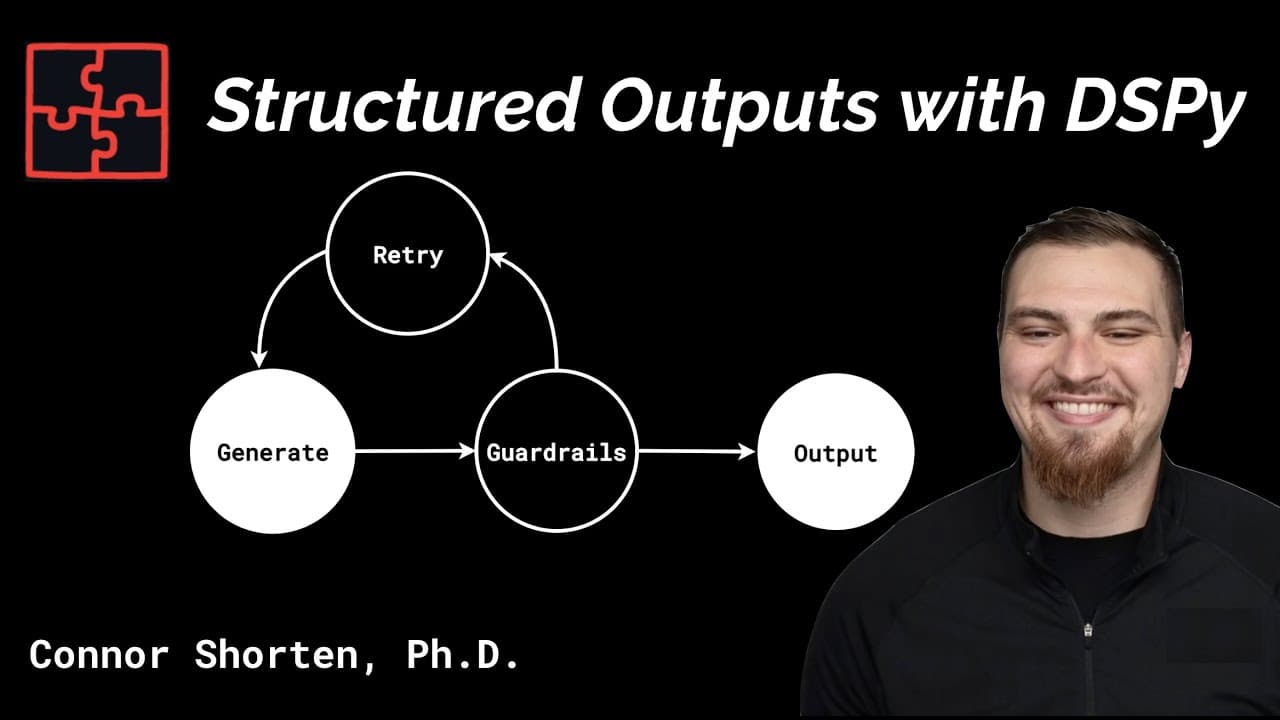
Structured Outputs with DSPy
TL;DR
Achieving structured outputs from large language models requires specific techniques to ensure accurate formatting.
Transcript
hey everyone thank you so much for watching this video on achieving structured outputs with DSP there are so many different angles to this topic of structuring outputs of large language models I've had so much fun researching this topic and I can't wait to share with you what I've learned structuring outputs with large language models is super impo... Read More
Key Insights
- 🌥️ Large language models' stochastic nature creates significant challenges in reliably generating structured outputs, requiring targeted solutions.
- 🅰️ DSP’s typed predictors offer a way to enforce specific data format types, enabling consistent output structures from language models.
- 👻 DSi assertions help manage output errors by allowing for refinement and retries in generating compliant formats, critical for enhancing user experience.
- 💂 Custom guard rails offer flexibility and control in defining output parameters, helping developers tailor the system to meet specific requirements.
- 💁 The application of JSON output formatting simplifies data integration and enhances compatibility with various systems, making it a preferred choice in many implementations.
- 🪡 Language models demonstrate varying levels of adherence to formatting rules, highlighting the need for structured output technologies like typed predictors.
- ❓ Troubleshooting structured output issues is an ongoing necessity, requiring effective logging and error correction strategies for optimal performance.
Install to Summarize YouTube Videos and Get Transcripts
Explore YouTube Video Summarizer or Get YouTube Transcript Extractor
Questions & Answers
Q: Why is structuring outputs from large language models important?
Structuring outputs is crucial because large language models are intrinsically stochastic, meaning they can generate inconsistent responses to the same prompts. This inconsistency can complicate downstream tasks that rely on specific formatting, such as data parsing. Without structured outputs, tasks requiring precise formats may fail, necessitating strategies to enforce compliance.
Q: What are DSP’s typed predictors and how do they function?
DSP’s typed predictors are a method designed to enforce output formatting in large language models. By defining expected output types, developers can guide the LLM to produce structured results, such as lists or dictionaries. Typed predictors help ensure that the generated data adheres to predefined schemas, significantly reducing inconsistencies and errors.
Q: Can you explain DSi assertions and their importance?
DSi assertions provide a mechanism for ensuring output correctness by allowing the system to backtrack and retry failed tasks. By implementing assertions, developers can define what constitutes a successful output format. If the output doesn't meet the defined standards, the system can refine its approach and attempt to correct the output without fully crashing the program, which is essential for robust application development.
Q: What role do custom guard rails play in output structuring?
Custom guard rails offer developers flexibility in defining their output validation criteria and handling processes. They allow for the integration of additional checks and logic to ensure that outputs are formatted correctly. By using custom guard rails alongside other techniques, developers can create a more comprehensive framework for managing language model outputs.
Q: How do different language models perform when tasked with structured outputs?
Language models exhibit varying capabilities in adhering to output formatting requirements. For instance, some may output structured lists successfully, while others could default to numbered lists or other non-compliant formats. This inconsistency necessitates strategies such as typed predictors or DSi assertions to guide models towards the desired output structure effectively.
Q: What is the significance of using JSON syntax in model outputs?
JSON syntax plays a significant role in structuring outputs because it provides a universally accepted format for data representation. When large language models are trained to use JSON, they can seamlessly integrate structured data outputs. This capability enhances interoperability across different systems and simplifies the parsing of generated data, making it easier to implement in various applications.
Q: How can developers troubleshoot issues with structured outputs from language models?
Troubleshooting structured output issues involves analyzing the generated data against predefined requirements, utilizing tools that log model calls (like Phoenix), and applying techniques such as DSi assertions to refine outputs. Developers can implement retry logic that corrects errors and track origins of failures, thus facilitating better handling of exceptions.
Q: What opportunities exist for combining these different output structuring methods?
There are extensive opportunities to combine structured output techniques, such as using typed predictors within custom guard rails or integrating DSi assertions with type validations. This synergistic approach can provide more robust control over outputs, ensure higher accuracy, and enhance the overall performance of large language models in practical applications.
Summary & Key Takeaways
-
Structured outputs from large language models are crucial due to their stochastic nature, which often leads to inconsistent formatting. This can complicate the application of language model outputs in subsequent processes.
-
The video discusses three primary methods for structuring outputs: DSP’s typed predictors, DSi assertions, and custom guard rails, each offering different advantages for ensuring accurate data formats.
-
Practical examples highlight the application of these techniques, illustrating how to enforce desired output formats while tackling common challenges such as retries and validation in language model implementations.
Read in Other Languages (beta)
Share This Summary 📚
Summarize YouTube Videos and Get Video Transcripts with 1-Click
Try YouTube Summary with ChatGPT & Claude or YouTube Transcript Generator
Explore More Summaries from Connor Shorten 📚
Summarize YouTube Videos and Get Video Transcripts with 1-Click
Try YouTube Summary with ChatGPT & Claude or YouTube Transcript Generator