What Is the Routh-Hurwitz Criteria for System Stability?
TL;DR
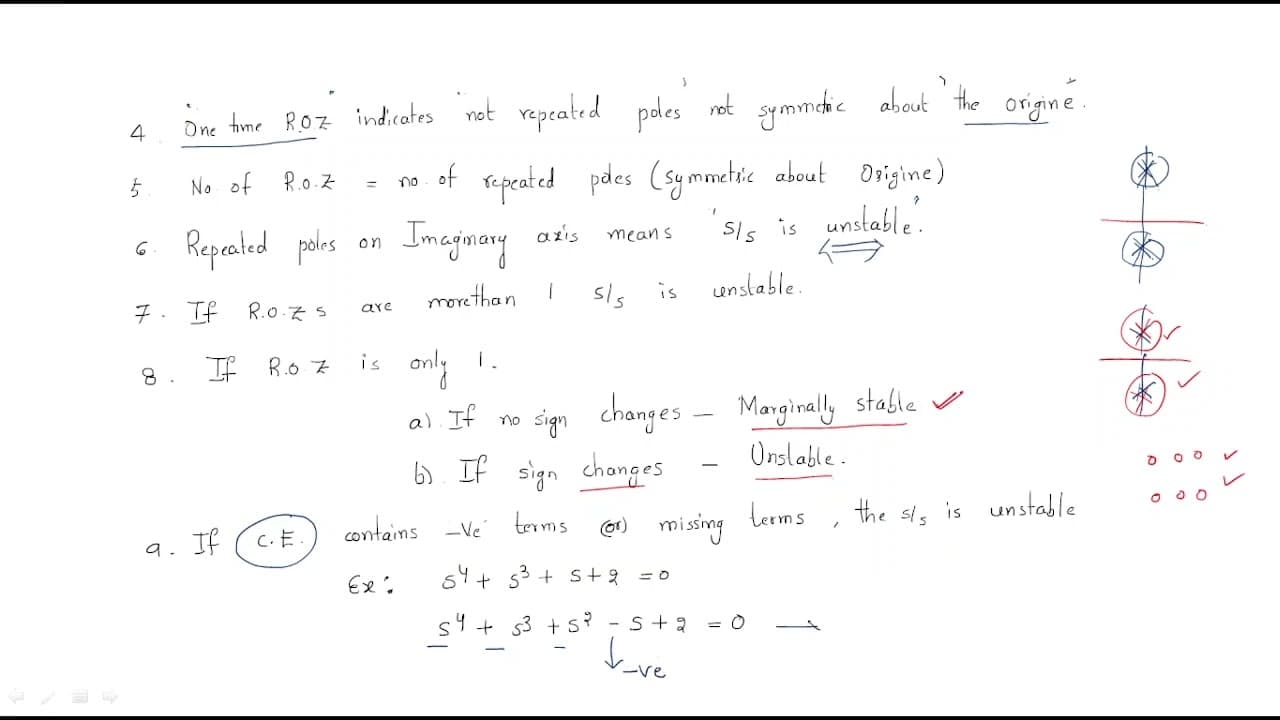
The Routh-Hurwitz (RH) criteria assess system stability by analyzing the characteristic equation and pole locations. A system is marginally stable if all coefficients in the first column of the RH table are positive and there are no sign changes. Repeated poles on the imaginary axis indicate instability, while sign changes suggest the presence of unstable poles in the right half-plane.
Transcript
hello everyone in this session we will discuss some more points of the RH criteria so first what is r criteria Ruth her criteria it is useful for analyze the any system and it is much important during the stability of the system so in the first point if in RH table R occurs one time all coefficients of the first column are positive then the system ... Read More
Key Insights
- 🔨 Routh-Hurwitz criteria are a critical tool in systems engineering for ascertaining stability from characteristic equations.
- 🗯️ Each sign change in the Routh-Hurwitz table indicates a pole in the right half of the plane, indicative of instability.
- 💈 The arrangement of poles determines whether a system exhibits marginal stability or is unstable.
- 🍉 Negative coefficients or missing terms in the characteristic equation suggest a direct instability in system behavior.
- 🥺 Repeated poles in the context of stability are particularly problematic, often leading to sustained oscillations.
- ❓ An understanding of auxiliary equations and their usage is essential for comprehensive stability analysis within the Routh-Hurwitz framework.
- 🧘 Continuous monitoring of pole positions is vital to ensure system designs remain stable under varying operational conditions.
Install to Summarize YouTube Videos and Get Transcripts
Explore YouTube Video Summarizer or Get YouTube Transcript Extractor
Questions & Answers
Q: What is the significance of the Routh-Hurwitz criteria in control systems?
The Routh-Hurwitz criteria are essential in control systems for evaluating stability. They provide a systematic method for determining the number and location of poles in the complex plane, which indicates whether a system will respond adequately over time or spiral out of control. A system is stable if all poles are on the left-hand side of the complex plane.
Q: How can one interpret sign changes in the Routh-Hurwitz table?
In the Routh-Hurwitz table, sign changes suggest the presence of poles on the right-hand side, which indicates instability. Specifically, each sign change corresponds to a pole in the right-half plane; the number of these changes tells you how many poles contribute to the instability of the system.
Q: What happens if a characteristic equation has negative terms?
If a characteristic equation contains negative terms or missing terms, it signals potential instability within the system. When analyzing stability, negative coefficients lead to poles being placed in regions that indicate unstable behavior, emphasizing the importance of all terms being positive or appropriately arranged.
Q: What does it mean for a system to be marginally stable?
A system is marginally stable when it has poles on the imaginary axis but no poles in the right-half plane. This situation implies that the system will neither grow unbounded nor settle down but will exhibit oscillatory behavior that persists indefinitely.
Q: How do repeated poles affect system stability?
Repeated poles, particularly those on the imaginary axis, imply that the system is unstable. The presence of such poles suggests that the response to inputs may not settle and can lead to sustained oscillations or growth, indicating poor performance and reliability.
Q: In the case where the order of a characteristic equation is six, how do we analyze stability?
For a characteristic equation of order six, we construct the Routh-Hurwitz table and look for sign changes to determine the number of poles in the right-hand side. By comparing against the number of repeated poles and their arrangements, we can assess the stability of the system.
Q: Can you explain the role of auxiliary equations in Routh-Hurwitz analysis?
Auxiliary equations are derived when the Routh-Hurwitz table yields a row of zeros. These equations help analyze the stability of the system further by providing additional polynomial forms to work with. The behavior of these auxiliary equations can indicate the existence of repeated poles and their implications for stability.
Q: What indicates a system is unstable according to the Routh-Hurwitz criteria?
A system is deemed unstable when there are sign changes in the Routh-Hurwitz table, which suggests that poles exist in the right-hand side. Additionally, the presence of repeated poles on the imaginary axis also implies instability, as they can lead to oscillations that don’t stabilize.
Summary & Key Takeaways
-
The Routh-Hurwitz (RH) criteria provide methods to determine system stability by analyzing the characteristic equation and pole locations.
-
Sign changes in the RH table indicate the presence of poles in the right-hand side, signaling instability, while no sign changes result in marginally stable systems.
-
Repeated poles on the imaginary axis lead to instability, while a certain arrangement of poles determines overall system stability or marginal stability.
Read in Other Languages (beta)
Share This Summary 📚
Summarize YouTube Videos and Get Video Transcripts with 1-Click
Try YouTube Summary with ChatGPT & Claude or YouTube Transcript Generator