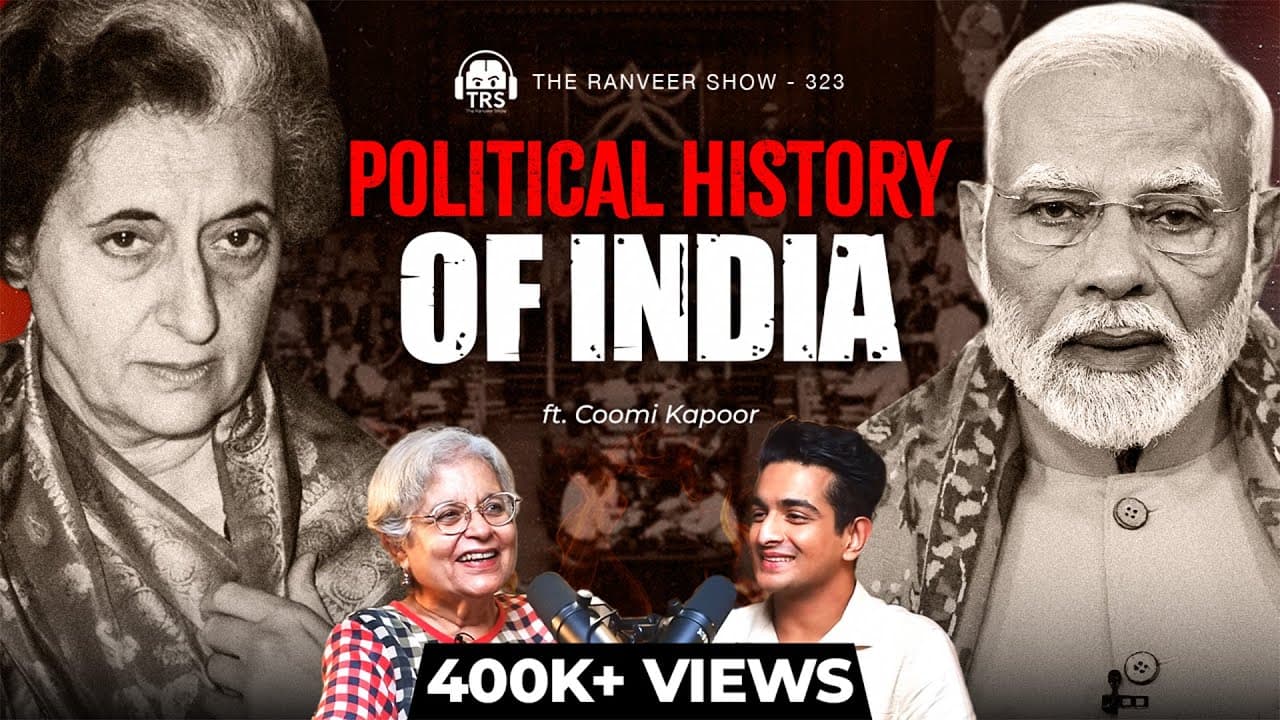
EXPLOSIVE: India's Untold Politics Explained - Gandhi To Modi | Sr Journalist Coomi Kapoor | TRS 323
TL;DR
The discussion compares Indira Gandhi's leadership with Narendra Modi's, highlighting censorship and media dynamics.
Transcript
take the Mrs Gandhi's Reign a lot of her behavior patterns would seem somewhat similar to Mr Modi today some of the things that Indira Gandhi was criticized for as a press censorship you know self-aggrandizement the pattern is repeated and also one party Even parties are not democratically run in in Indira Gandhi never believe she was the Lone woma... Read More
Key Insights
- ❓ Historical parallels between Indira Gandhi and Narendra Modi reveal concerns about censorship and democratic decline.
- 😑 Weaker governments have historically been more conducive to a free press compared to stronger regimes with tighter controls.
- 🔉 The Emergency period was a significant traumatic experience for journalists, shaping their resolve and the evolution of media ethics in India.
- 😑 Political personalities like Rahul Gandhi struggle with connecting to the electorate due to a lack of perceived authenticity and relevance in pressing issues.
- ✊ Increased authoritarianism is foreseen if current trends continue without checks on government power.
- ✊ The influence of the RSS remains substantial, but the balance of power currently favors Prime Minister Modi.
- 🧑🏭 The electorate's awareness of government actions can act as a safeguard against authoritarianism in a democratic society.
Install to Summarize YouTube Videos and Get Transcripts
Explore YouTube Video Summarizer or Get YouTube Transcript Extractor
Questions & Answers
Q: How does the journalist compare Indira Gandhi's reign to Modi's?
The journalist notes similarities in leadership style, such as press censorship and the consolidation of power. Both leaders were criticized for self-aggrandizement and creating environments where dissent is stifled, which raises concerns about the health of democracy today.
Q: What insights does she offer about the media landscape during different government regimes?
She highlights that during weaker governments, there tends to be more information flow and less media control, allowing for a more vibrant press environment. In contrast, stronger governments, like those of Indira Gandhi and Modi, often lead to a more cautious media in fear of reprisals.
Q: What was the most difficult period in her journalism career?
The journalist describes the Emergency period during Indira Gandhi's rule as harrowing. Government censorship and personal threats against her and her family made it a challenging time, yet it also solidified her commitment to independent journalism.
Q: How does she assess Rahul Gandhi's political prospects?
She believes that if Rahul Gandhi is positioned as a single leader of opposition, it could significantly benefit the ruling party. She highlights his struggle to connect with the electorate and suggests that he often misunderstands the primary concerns of the masses.
Q: Does she feel the current government is authoritarian?
Yes, she expresses concerns that the direction of the current regime is increasingly authoritarian, emphasizing a retreat from genuine democratic engagement, where citizens feel alienated from those in power.
Q: What does she think about the RSS's influence on the current government?
The journalist opines that while the RSS has significant grassroots strength, Prime Minister Modi currently holds substantial authority and often may prioritize his agenda over the RSS's directives, creating a complex relationship between the two.
Q: How does she view the future of India with respect to its democracy?
She remains hopeful that the electorate will react against any drastic moves towards authoritarianism, as citizens tend to be aware and can recognize the government overreach; ultimately, they hold the power through their votes.
Q: What role does she believe social media plays in modern journalism?
The journalist points out that social media has been a double-edged sword for journalism, allowing for more voices and opinions to emerge while also leading to polarization and misinformation, complicating the landscape for reporters.
Summary & Key Takeaways
-
The conversation draws parallels between the leadership styles of Indira Gandhi and Narendra Modi, particularly regarding issues like media censorship and government control.
-
The journalist reflects on her 50-year career, noting that weaker governments allow for more press freedom, contrasting with stronger regimes where information flow is restricted.
-
Insights into the political history of India showcase key events, including the rise of the Ambani empire and the challenges faced by political leaders like Rajiv Gandhi, highlighting how past issues resonate today.
Read in Other Languages (beta)
Share This Summary 📚
Summarize YouTube Videos and Get Video Transcripts with 1-Click
Try YouTube Summary with ChatGPT & Claude or YouTube Transcript Generator
Explore More Summaries from The Ranveer Show - All Episodes 📚
Summarize YouTube Videos and Get Video Transcripts with 1-Click
Try YouTube Summary with ChatGPT & Claude or YouTube Transcript Generator