Root Locus | Find O.L.T.F | Example | CS | Control Systems | Lec-71
TL;DR
The session explores root locus techniques and open loop transfer functions in control system analysis.
Transcript
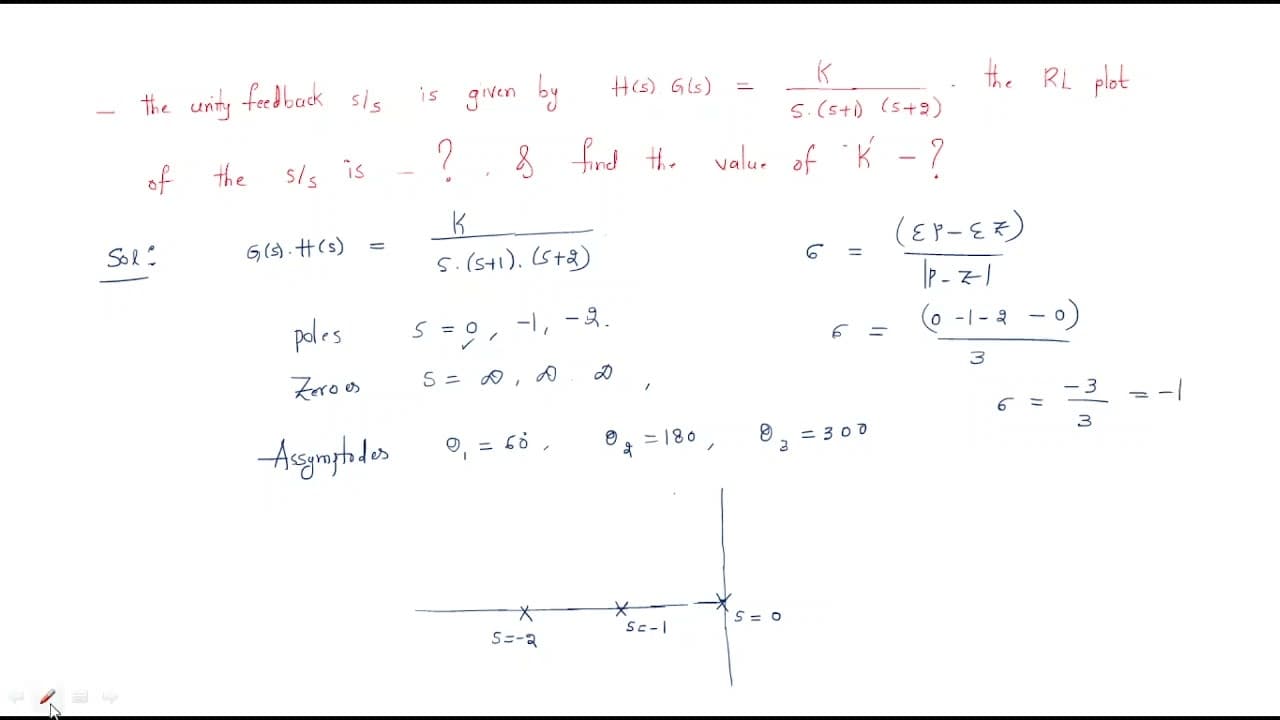
hello everyone in this session we will discuss another model of the problem that is the problem is the root locus is given below so this is the root locus the open loop transfer function corresponding to poles is and is asking to find out the open loop transfer function so what is open loop transfer function g office into h off is value okay right ... Read More
Key Insights
- 🤗 The open loop transfer function structure includes factors like DC gain and is influenced by poles and zeros.
- 👷 Identifying poles and zeros is crucial in constructing a root locus which helps analyze system stability.
- 💈 The relationship between poles and zeros provides insights into the system dynamic behavior, including transient responses.
- 🫚 Asymptotes help visualize the behavior of the root locus, especially in complex systems with multiple poles.
- 🥺 Gaining an understanding of system configurations can lead to better strategies for controlling system performance and stability.
- 😉 Establishing the value of gain 'k' helps ensure that the system operates safely and effectively within desired parameters.
- 🎮 The characteristics equation is a pivotal tool for determining the stability and performance of a control system.
Install to Summarize YouTube Videos and Get Transcripts
Explore YouTube Video Summarizer or Get YouTube Transcript Extractor
Questions & Answers
Q: What is an open loop transfer function and why is it important?
An open loop transfer function is a mathematical representation of the relationship between the input and output of a control system without feedback. It is important because it helps engineers analyze system stability, predict system behavior, and design control strategies by understanding pole-zero configurations.
Q: How do you determine poles and zeros from a given root locus?
To determine poles and zeros from a root locus, you begin by plotting the given locus on a complex plane, identifying where the paths of the locus start (poles) and end (zeros). Poles are typically designated by the points where the locus originates, and zeros by points where it ends, helping visualize system response.
Q: What role do asymptotes play in sketching a root locus?
Asymptotes provide the direction along which the root locus will extend towards infinity when there are more poles than zeros in the system. The angles of these asymptotes help determine the orientation of the paths taken by the roots, thus aiding in visualizing how the system will behave under varying gain.
Q: Can you explain the concept of marginal stability in control systems?
Marginal stability refers to a condition where a system neither converges to a steady state nor diverges uncontrollably; it oscillates indefinitely. In the context of control systems, a pole located on the imaginary axis signifies marginal stability, affecting system design and stability criteria.
Summary & Key Takeaways
-
The lecture explains how to determine the open loop transfer function from a given root locus problem by identifying poles and zeros.
-
It covers the structure of open loop transfer functions, emphasizing the inclusion of a DC gain and configuration of poles and zeros.
-
A practical example illustrates how to find the value of the gain 'k' for a unity feedback system using the characteristics equation.
Read in Other Languages (beta)
Share This Summary 📚
Summarize YouTube Videos and Get Video Transcripts with 1-Click
Try YouTube Summary with ChatGPT & Claude or YouTube Transcript Generator