Products
Features
YouTube Video Summarizer
Summarize YouTube videos
Web & PDF Highlighter
Highlight web pages & PDFs
Chat with PDF
Ask any PDF questions with AI
Ask AI Clone
Chat with your highlights & memories
Audio Transcriber
Transcribe audio files to text
Glasp Reader
Read and highlight articles
Kindle Highlight Export
Export your Kindle highlights
Idea Hatch
Hatch ideas from your highlights
Integrations
Obsidian Plugin
Notion Integration
Pocket Integration
Instapaper Integration
Medium Integration
Readwise Integration
Snipd Integration
Hypothesis Integration
Apps & Extensions
Chrome Extension
Safari Extension
Edge Add-ons
Firefox Add-ons
iOS App
Android App
Discover
Discover
Ideas
Discover new ideas and insights
Articles
Curated articles and insights
Books
Book recommendations by great minds
Posts
Essays and notes from readers
Quotes
Inspiring quotes collection
Videos
Curated videos and summaries
Explore Glasp
Glasp Newsletter
Weekly insights and updates
Glasp Talk
Interview series with great minds
Glasp Blog
Latest news and articles
Glasp Use Cases
Learn how others use Glasp
Build & Support
Glasp API
Access Glasp's API for developers
MCP Connector
Connect Glasp to Claude & ChatGPT
Community
Glasp Reddit Community
Students
Student discount and benefits
FAQs
Frequently Asked Questions
AboutPricing
DashboardLog inSign up

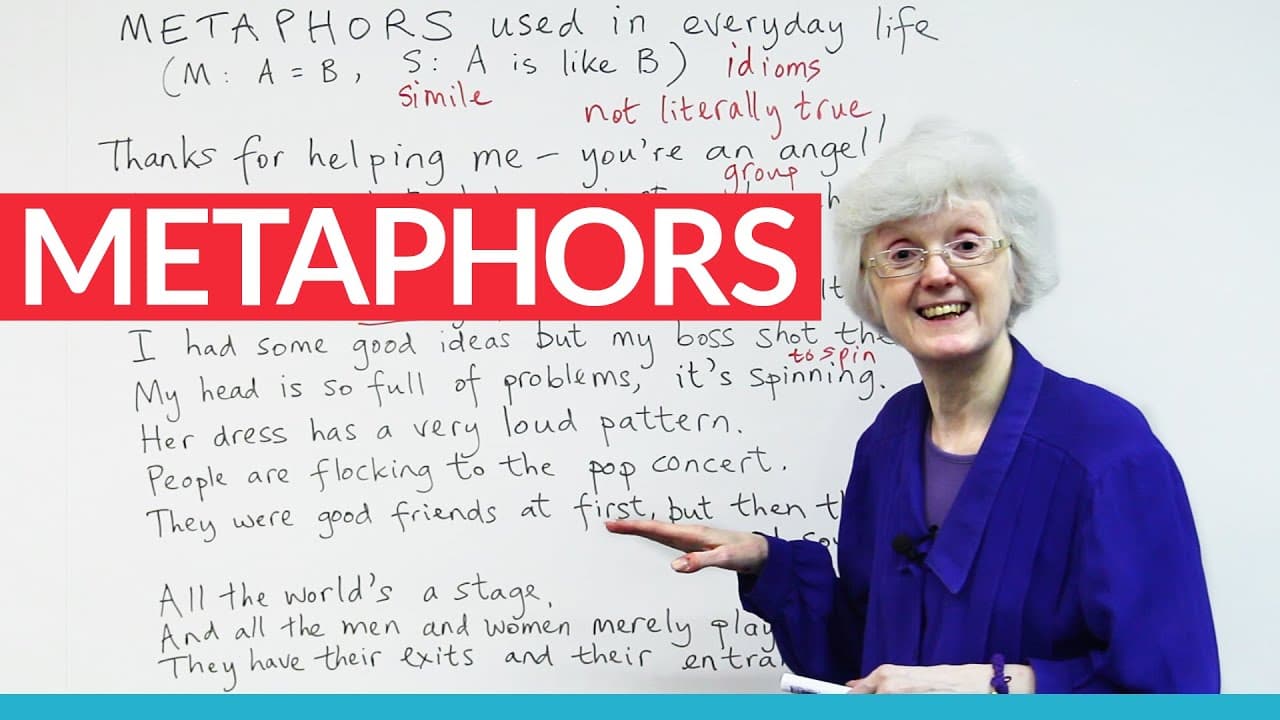
Using metaphors to speak English more fluently
1.0M views
•
January 25, 2016
by
Learn English with Gill · engVid
YouTube video player
Using metaphors to speak English more fluently

TL;DR

Metaphors compare one thing to another, similes use 'like'; both are common in everyday speech.

Transcript

Hi. I'm Gill from www.engvid.com, and today in this lesson, we're going to look at metaphors, which are a different way of using language, really. But these metaphors are used a lot in everyday life. You could also call them idioms. They're a little bit like idioms. And there are a lot of them. But I just want to mention that there are metaphors an... Read More

Key Insights

  • ❓ Metaphors enhance language by concretely comparing one thing to another.
  • 😒 Similes use 'like' or 'as' for comparisons, while metaphors make direct connections.
  • 🫠 Metaphors like 'busy bee' and 'melting pot' create vivid imagery in speech.
  • 🌍 'All the world's a stage' shows an extended metaphor in Shakespeare's work.
  • 🌠 'Shoot down' metaphorically represents rejecting ideas.
  • 🐑 Metaphors like 'flocking' and 'sheep' create visual associations in language.
  • 🤪 'Turning sour' metaphorically describes relationships going wrong.

Install to Summarize YouTube Videos and Get Transcripts

Explore YouTube Video Summarizer or Get YouTube Transcript Extractor

Questions & Answers

Q: How do metaphors differ from similes?

Metaphors directly equate one thing to another, while similes use 'like' or 'as' for comparison.

Q: What does the metaphor 'a melting pot' imply about London?

It suggests London is a diverse city with people and cultures from various backgrounds mixing together.

Q: Explain the meaning behind the metaphor 'a bunch of sheep.'

It implies people mindlessly follow others like sheep in a herd without independent thought.

Q: How does the metaphor 'turning sour' describe a relationship?

It signifies a once-friendly relationship that has deteriorated or gone bad over time.

Summary & Key Takeaways

  • Metaphors compare things directly, like calling someone an angel to express gratitude.

  • Similes use 'like' or 'as' to draw comparisons, such as saying someone is like an angel.

  • Through examples like 'busy bee' and 'melting pot,' metaphors enhance language with vivid imagery.


Read in Other Languages (beta)

English

Share This Summary 📚

Summarize YouTube Videos and Get Video Transcripts with 1-Click

Download browser extensions on:

Try YouTube Summary with ChatGPT & Claude or YouTube Transcript Generator

Explore More Summaries from Learn English with Gill · engVid 📚
Where do the names of the days of the week come from? thumbnail
Where do the names of the days of the week come from?
Learn English with Gill · engVid
How to Use the Auxiliary Verb 'Could' in English thumbnail
How to Use the Auxiliary Verb 'Could' in English
Learn English with Gill · engVid
English Pronunciation: How to say words ending with -OW: grow, cow, slow, now... thumbnail
English Pronunciation: How to say words ending with -OW: grow, cow, slow, now...
Learn English with Gill · engVid
Learn 10 English Idioms with ‘BOOK’ thumbnail
Learn 10 English Idioms with ‘BOOK’
Learn English with Gill · engVid
English Pronunciation Practice: CH & SH thumbnail
English Pronunciation Practice: CH & SH
Learn English with Gill · engVid
Easy English Lesson: Should you use “A” or “AN”? thumbnail
Easy English Lesson: Should you use “A” or “AN”?
Learn English with Gill · engVid

Summarize YouTube Videos and Get Video Transcripts with 1-Click

Download browser extensions on:

Try YouTube Summary with ChatGPT & Claude or YouTube Transcript Generator

Apps & Extensions

  • Chrome Extension
  • Safari Extension
  • Edge Add-ons
  • Firefox Add-ons
  • iOS App
  • Android App

Key Features

  • YouTube Video Summarizer
  • Web & PDF Summarizer
  • Web & PDF Highlighter
  • Chat with PDF
  • Ask AI Clone
  • Audio Transcriber
  • Glasp Reader
  • Kindle Highlight Export
  • Idea Hatch

Integrations

  • Obsidian Plugin
  • Notion Integration
  • Pocket Integration
  • Instapaper Integration
  • Medium Integration
  • Readwise Integration
  • Snipd Integration
  • Hypothesis Integration

More Features

  • APIs
  • MCP Connector
  • Blog & Post
  • Embed Links
  • Image Highlight
  • Personality Test
  • Quote Shots

Company

  • About us
  • Blog
  • Community
  • FAQs
  • Job Board
  • Newsletter
  • Pricing
Terms

•

Privacy

•

Guidelines

© 2026 Glasp Inc. All rights reserved.