Harmonic distortion analyzer | Other Types | Electrical Instruments ( EIM ) | Lec - 24
TL;DR
This video discusses harmonic distortion analyzers, their types, and methods for suppressing fundamental frequencies.
Transcript
hi everyone in this video i will discuss harmonic distortion analyzer and what are the different types of harmonic distortion analyzer we are generally using so harmonic distortion analyzer means it is also another type of analyzers in the previous concept you have seen what is the wave analyzer and what are the different types of vm analyzers one ... Read More
Key Insights
- 🖐️ Harmonic distortion analyzers play a critical role in evaluating complex waveforms by focusing on harmonic components.
- ✋ Suppression techniques, such as high-pass filters, effectively eliminate fundamental frequencies from the analysis.
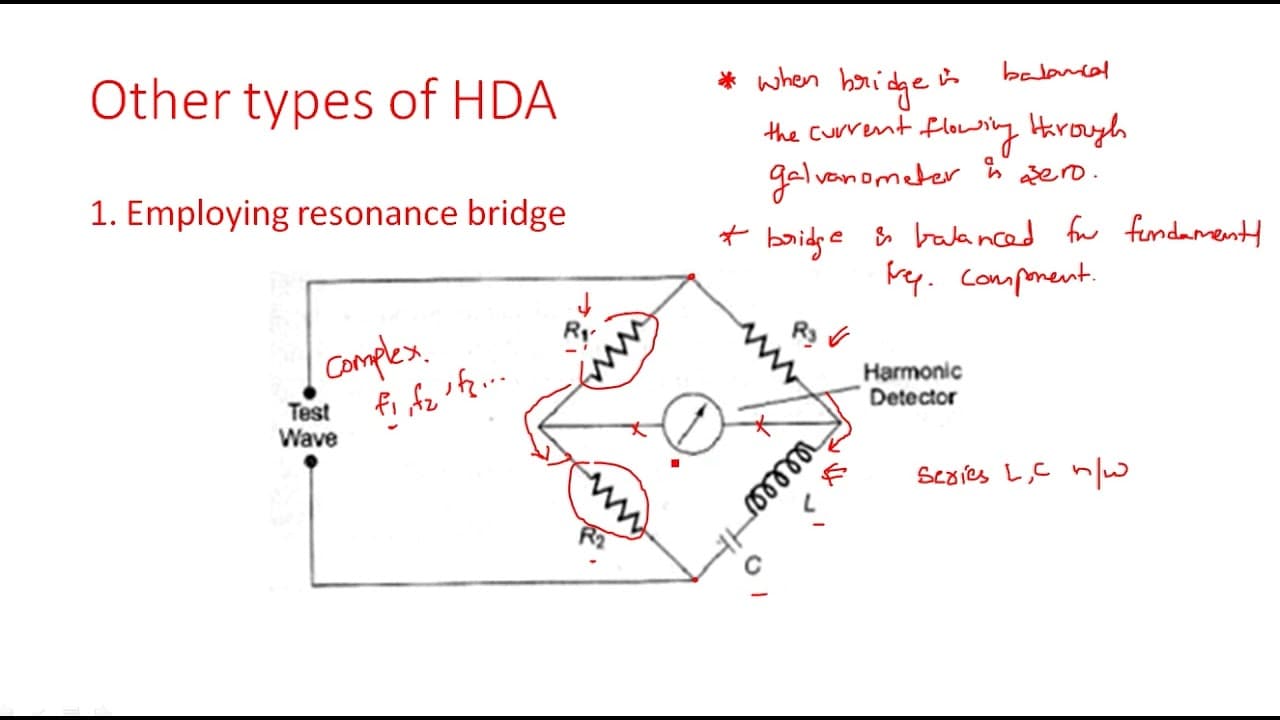
- 🌉 Resonance bridge circuits are commonly used to balance the input for accurate harmonic measurement, serving as a fundamental suppression method.
- 👻 Balancing conditions in the bridge circuits allow for precise isolation of harmonic frequency contributions to the overall signal.
- 🌉 Wien bridges provide a systematic approach for analyzing waveforms by balancing the circuit specifically for fundamental frequencies.
- 🎁 Brigitte networks present an alternative method to suppress fundamental frequencies while enabling harmonic evaluation in electronic signals.
- 💦 Understanding the configurations and functions of these systems is crucial for engineers working in signal processing and instrumentation.
Install to Summarize YouTube Videos and Get Transcripts
Explore YouTube Video Summarizer or Get YouTube Transcript Extractor
Questions & Answers
Q: What is the primary function of a harmonic distortion analyzer?
The primary function of a harmonic distortion analyzer is to measure the total amount of harmonic distortion present in a signal while disregarding the fundamental frequency component. It focuses on the harmonics and quantifies their contribution to the overall waveform distortion, providing critical insights for various applications.
Q: How does a high-pass filter contribute to harmonic distortion analysis?
A high-pass filter contributes by allowing frequencies above a chosen cutoff to pass while blocking the fundamental frequency. This selective filtering enables the analyzer to measure the harmonic distortions effectively, ensuring accurate assessment of total harmonic distortion without interference from the primary signal.
Q: What techniques are commonly used to suppress the fundamental frequency in these analyzers?
Common techniques include using resonance bridge circuits, Wien bridges, and Brigitte networks. These methods balance the circuit specifically for the fundamental frequency, ensuring that only harmonic components contribute to the output, which can then be measured effectively for distortion analysis.
Q: What is the significance of balancing the bridge in the harmonic distortion analysis?
Balancing the bridge in harmonic distortion analysis is crucial as it ensures that the current flowing through the galvanometer is zero when the fundamental frequency is present. This indicates that the fundamental frequency is adequately suppressed, allowing only the harmonics to be measured, which is essential for accurate distortion analysis.
Q: What is a resonance bridge and how does it work in harmonic distortion analysis?
A resonance bridge is a type of circuit used to suppress the fundamental frequency component while allowing harmonics to pass through. By adjusting the values of inductors and capacitors, the bridge can be balanced for the fundamental frequency. When imbalanced, it indicates the presence of harmonics, which can be quantified as total harmonic distortion.
Q: Can you explain the Wien bridge method and its application in harmonic analysis?
The Wien bridge method uses a specific configuration of resistors and capacitors to suppress the fundamental frequency and balance the circuit for precise harmonic measurement. It works by ensuring that the fundamental frequency does not affect the current flowing through the measurement device, allowing only the harmonic components to be analyzed.
Q: How does the Brigitte network function in suppressing the fundamental frequency?
The Brigitte network employs a T-shaped arrangement of components, including inductors and capacitors, to suppress the fundamental frequency. It balances the circuit, ensuring that when harmonic frequencies are present, they can be analyzed without interference from the fundamental frequency, thus providing a clear picture of total harmonic distortion.
Summary & Key Takeaways
-
The video explains harmonic distortion analyzers, which focus on measuring the harmonics in complex waveforms while eliminating the fundamental frequency component.
-
Different methods for suppressing the fundamental frequency, such as high-pass filters, resonance bridges, Wien bridges, and Brigitte networks, are discussed.
-
Each method aims to balance circuits in a way that only harmonics are evaluated, allowing for accurate measurement of total harmonic distortion.
Read in Other Languages (beta)
Share This Summary 📚
Summarize YouTube Videos and Get Video Transcripts with 1-Click
Try YouTube Summary with ChatGPT & Claude or YouTube Transcript Generator