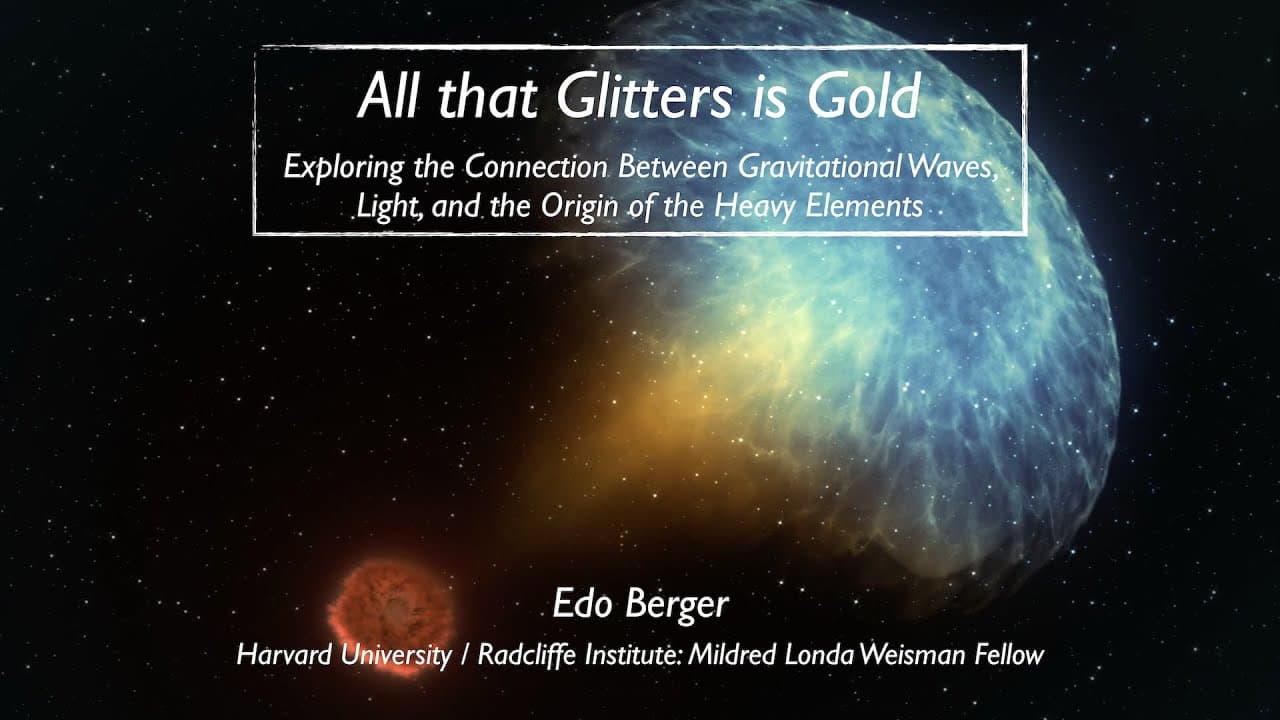
Gravitational Waves, Light, and the Origin of the Heavy Elements | Edo Berger || Radcliffe Institute
TL;DR
The detection of a gravitational wave signal from the collision of neutron stars unveiled the origin of heavy elements like gold, providing new insights into the formation of the universe.
Transcript
- Good afternoon, everyone. I'm Tomiko Brown-Nagin, the Dean of the Radcliffe Institute for Advanced Study, and it's wonderful to see all of you here this afternoon. I'd like to begin by extending a very special welcome to members of the Harvard and Radcliffe classes of 1979 and 1974, who are celebrating their 40th and 45th reunions. Let's all give... Read More
Key Insights
- 👋 Gravitational wave detection from neutron star collisions has allowed scientists to connect light and gravitational waves, revealing the formation of heavy elements.
- 🤩 Neutron star collisions generate violent explosions that eject matter rich in neutrons, likely playing a crucial role in the formation of heavy elements like gold.
- 🤩 Observations of the visible counterparts of neutron star collisions and subsequent spectroscopic analysis confirm the presence of heavy elements and provide valuable insights into their origin.
- 🤩 The discovery of heavy elements' cosmic origin through neutron star collisions has reshaped the understanding of the periodic table and the formation of elements in the universe.
- 🤩 Advancements in gravitational wave detectors and the planned construction of next-generation detectors will allow for more extensive observations and studies of neutron star collisions.
Install to Summarize YouTube Videos and Get Transcripts
Explore YouTube Video Summarizer or Get YouTube Transcript Extractor
Questions & Answers
Q: How are heavy elements like gold formed in the universe?
Heavy elements are believed to be formed through the rapid process of nucleosynthesis, where high and rapid influxes of neutrons onto seed nuclei lead to the creation of heavy elements.
Q: How are neutron star collisions detected?
Neutron star collisions are detected through the observation of gravitational wave signals using ground-based detectors like LIGO and Virgo.
Q: What techniques are used to study the visible counterparts of neutron star collisions?
Spectroscopic analysis of the visible counterparts allows astronomers to study the composition and properties of the ejected matter, providing valuable insights into the origin of heavy elements.
Q: How do neutron star collisions contribute to our understanding of the universe?
Neutron star collisions have provided a revolutionary way of connecting light and gravitational waves, shedding light on the formation of heavy elements and the evolution of the universe.
Summary & Key Takeaways
-
The detection of gravitational waves from the collision of neutron stars has connected light and gravitational waves, revealing the origin of heavy elements like gold.
-
Neutron star collisions create a violent explosion that ejects matter rich in neutrons, likely responsible for the creation of heavy elements through the rapid process of nucleosynthesis.
-
Observations of the visible counterparts to these collisions and subsequent spectroscopic analysis have confirmed the presence of heavy elements and their characteristic signatures.
Read in Other Languages (beta)
Share This Summary 📚
Summarize YouTube Videos and Get Video Transcripts with 1-Click
Try YouTube Summary with ChatGPT & Claude or YouTube Transcript Generator
Explore More Summaries from Harvard University 📚



Summarize YouTube Videos and Get Video Transcripts with 1-Click
Try YouTube Summary with ChatGPT & Claude or YouTube Transcript Generator