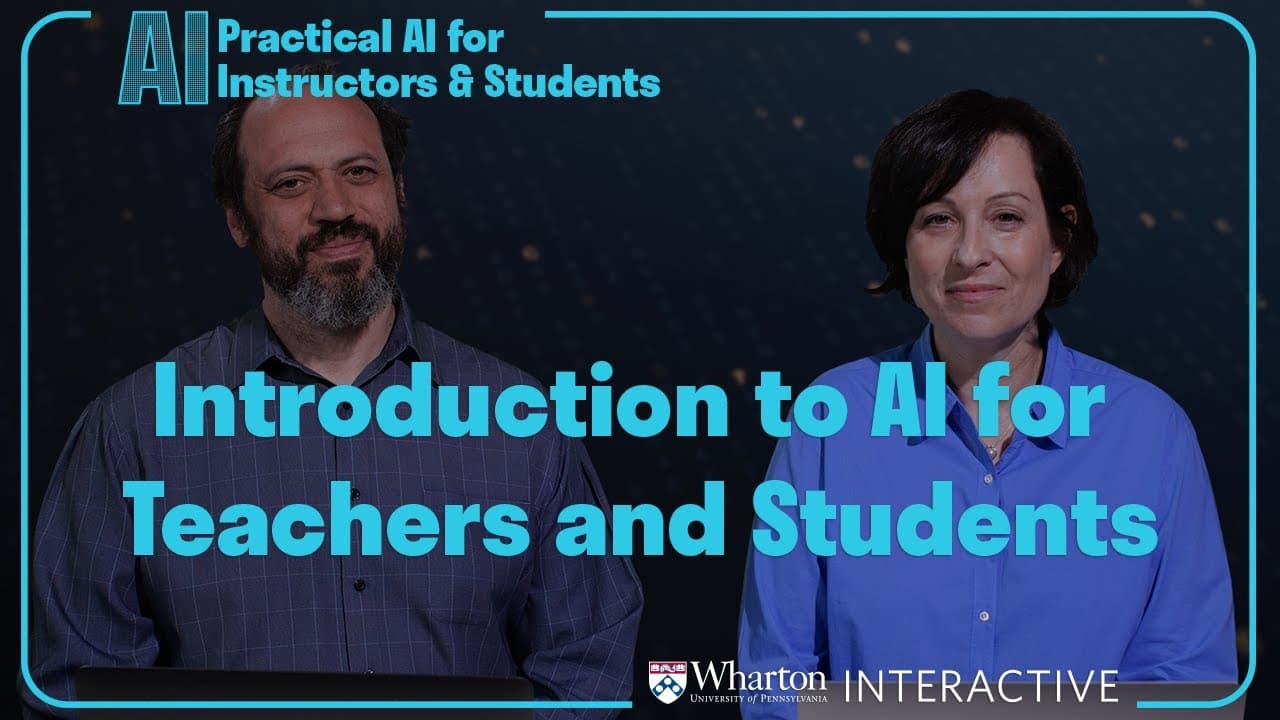
Practical AI for Instructors and Students Part 1: Introduction to AI for Teachers and Students
TL;DR
AI technology is transforming education by democratizing access to education through generative AI models, but it also raises ethical concerns.
Transcript
hi I'm Lita Malik and I've been working on interactive pedagogy and AI research at the Wharton School and I'm Ethan Malik a professor at Wharton and together along with Wharton interactive the organization that we help run we have been really passionate about how you can democratize access to education so how do we get everybody the kind of educati... Read More
Key Insights
- 🎓 AI technology, specifically generative AI models, is revolutionizing education by providing access to quality education worldwide.
- 💯 Large language models have demonstrated surprising capabilities, such as scoring well on tests and enhancing productivity in various tasks.
- ❓ Higher-paying, higher-educated, and more creative jobs are most affected by AI, including teaching and instructing.
- 😒 Ethical concerns surrounding AI in education encompass copyright, biases, plagiarism, and the ethical use and potential dependence on AI.
- ✊ The transformative power of AI in education must be approached with caution and careful consideration of its implications.
Install to Summarize YouTube Videos and Get Transcripts
Explore YouTube Video Summarizer or Get YouTube Transcript Extractor
Questions & Answers
Q: What are some practical ways AI is used in classrooms?
AI is used to assist students in tasks like test-taking, writing, and coding, improving their productivity and quality of work. It offers personalized learning experiences and access to vast amounts of educational resources.
Q: How are large language models trained?
Large language models are trained using a massive amount of data from the internet, learning language patterns and connections between words. This training process enables them to predict the next word or sentence fragment in any given text.
Q: What ethical concerns are associated with AI in education?
Ethical concerns include copyright issues with AI having access to copyrighted material, biases in AI models reflecting societal biases, plagiarism concerns with copying AI-generated content, and the potential replacement of human effort without transparency.
Q: What are the implications of AI surpassing human intelligence?
The advancement of AI raises questions about the role of human thinking and work in society and the potential for AI to be smarter than humans. These implications require thoughtful consideration and balance.
Summary & Key Takeaways
-
AI, specifically generative AI models, is being used extensively in classrooms, offering both benefits and challenges.
-
Large language models, such as chat CBT and GPT-4, have shown unprecedented capabilities in tasks like test-taking and creative tasks like writing and coding.
-
AI is most disruptive in higher-paying, higher-educated, and more creative jobs, such as teaching and instructing, necessitating preparation for the changing landscape in education.
Read in Other Languages (beta)
Share This Summary 📚
Summarize YouTube Videos and Get Video Transcripts with 1-Click
Try YouTube Summary with ChatGPT & Claude or YouTube Transcript Generator
Explore More Summaries from Wharton School 📚


Summarize YouTube Videos and Get Video Transcripts with 1-Click
Try YouTube Summary with ChatGPT & Claude or YouTube Transcript Generator