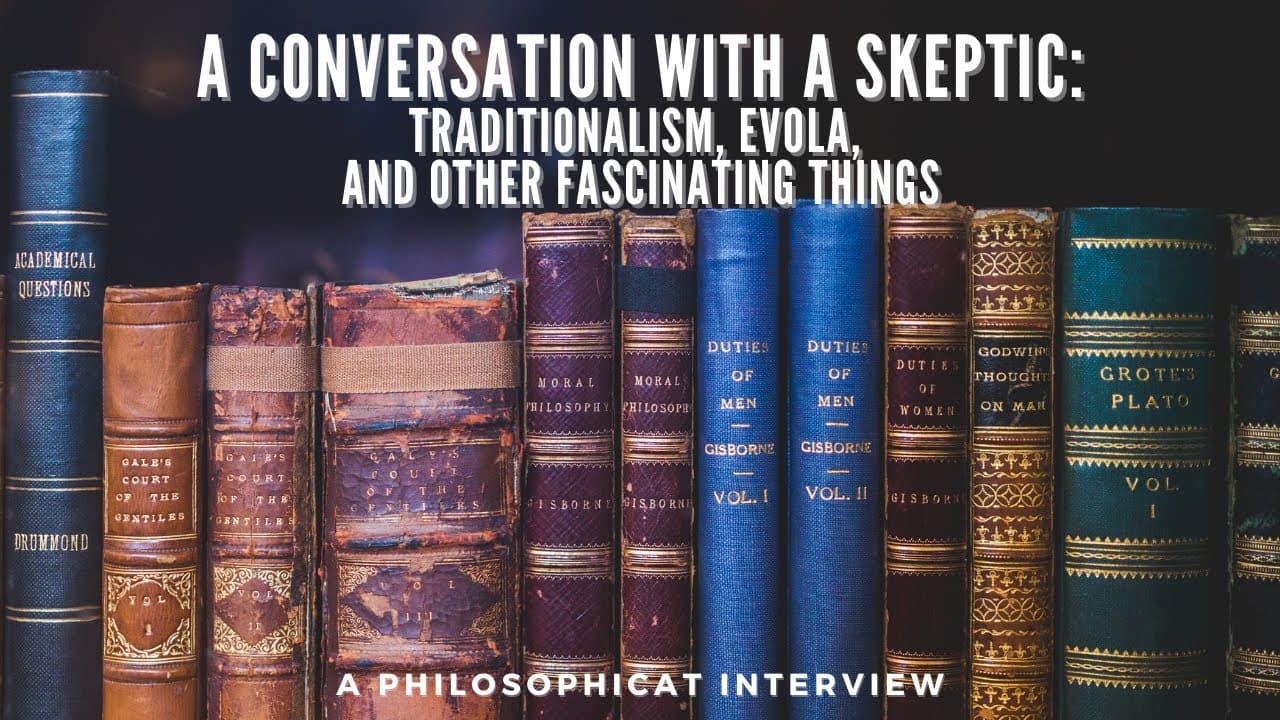
A Conversation with a Skeptic: Traditionalism, Evola, and Other Fascinating Things
TL;DR
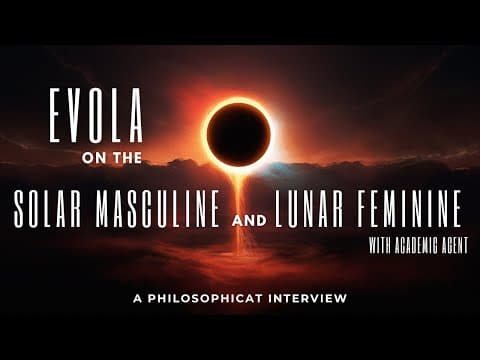
Philosophicat shares insights on Julius Evola's traditionalist philosophy and its implications.
Transcript
hello hello hello and welcome to this edition of the jolly heretic i have such a guest for you today and that is philosophic cat um with whom i wish to discuss the issue of traditionalist philosophy and while i signed into the old entropy i'm going to ask captain introduce yourself so cat over to you hey thanks for having me ed i'm very happy to be... Read More
Key Insights
- 🤕 Traditionalist philosophy emphasizes a decline from a so-called golden age, advocating a return to primordial truths as found in various religions.
- 🧘 Evola's traditionalism posits that modernity's progressive ideals foster chaos and degenerate society, as opposed to the stability offered by traditional structures.
- ❓ Philosophicat argues that authentic spirituality should not be entangled in dogma but rather encourage individual exploration and realization.
- 💭 The conversation critiques the linear perception of time prevalent in modern thought, suggesting a cyclical understanding is more aligned with spiritual traditions.
- 🫵 Both philosopher and guest acknowledge the challenges confronting traditionalists in articulating their views in a predominantly secular and rationalistic society.
- 👶 Discussing the role of women, the dialogue interprets hypergamy as a natural inclination to seek partners who can provide stability and resources for child-rearing.
- 🔬 Philosophicat defends the value of metaphysics, contending it addresses questions beyond the scope of empirical science and emphasizes spiritual intuition.
Install to Summarize YouTube Videos and Get Transcripts
Explore YouTube Video Summarizer or Get YouTube Transcript Extractor
Questions & Answers
Q: Who is Julius Evola, and what is his significance in traditionalist philosophy?
Julius Evola is an influential figure within traditionalist philosophy, advocating for a return to ancient spiritual traditions believed to embody a primordial truth. His works often critique modernity and emphasize the importance of hierarchical structures, spiritual awakening, and the cyclical nature of existence. Evola's perspective has attracted both critique and admiration, particularly within right-wing philosophical circles.
Q: Why does Philosopher Cat find Evola's writing challenging, and how does she suggest approaching it?
Philosopher Cat points out that Evola assumes a level of prior knowledge from his readers, making his complex ideas difficult to grasp without a solid understanding of traditionalist concepts. She recommends starting with her own series on "Revolt Against the Modern World" to build foundational knowledge before delving into Evola’s texts.
Q: What is the central idea of traditionalism as discussed in the content?
Traditionalism posits that there exists a primordial spiritual tradition, from which various religious practices have evolved. This philosophy views modernity as a departure from essential truths and seeks to reconnect with those enduring principles, often through an esoteric understanding of symbols across different cultures.
Q: How does the conversation differentiate between spirituality and religion?
The discussion highlights that spirituality transcends dogma and religious ideologies by focusing on individual experiential understanding and connection with the divine. In contrast, religion is often critiqued for its rigid belief systems that may lack personal spiritual experience.
Summary & Key Takeaways
-
The conversation centers on traditionalism as a philosophy, particularly the viewpoints of Julius Evola, known for his critique of modernity and advocacy for a return to primordial spiritual traditions.
-
Philosophicat discusses the challenges of understanding Evola's work, stating it often requires a prior knowledge of spiritual and metaphysical concepts to grasp his complex writings fully.
-
The dialogue touches on the dichotomy of traditionalism versus modern progressive thought, with an emphasis on understanding cyclical time and the spiritual dimensions of human existence.
Read in Other Languages (beta)
Share This Summary 📚
Summarize YouTube Videos and Get Video Transcripts with 1-Click
Try YouTube Summary with ChatGPT & Claude or YouTube Transcript Generator
Explore More Summaries from PhilosophiCat 📚
Summarize YouTube Videos and Get Video Transcripts with 1-Click
Try YouTube Summary with ChatGPT & Claude or YouTube Transcript Generator