EfficientNet! - Keras Code Examples
TL;DR
The tutorial covers EfficientNet models and transfer learning in Keras.
Transcript
welcome to the henry ai labs walkthrough of keras code examples keras has provided 56 code examples implementing popular ideas in deep learning this ranges from the basics such as simple mnist and imdb text classification all the way to cutting-edge research ideas such as knowledge distillation supervised contrastive learning and transformers we'll... Read More
Key Insights
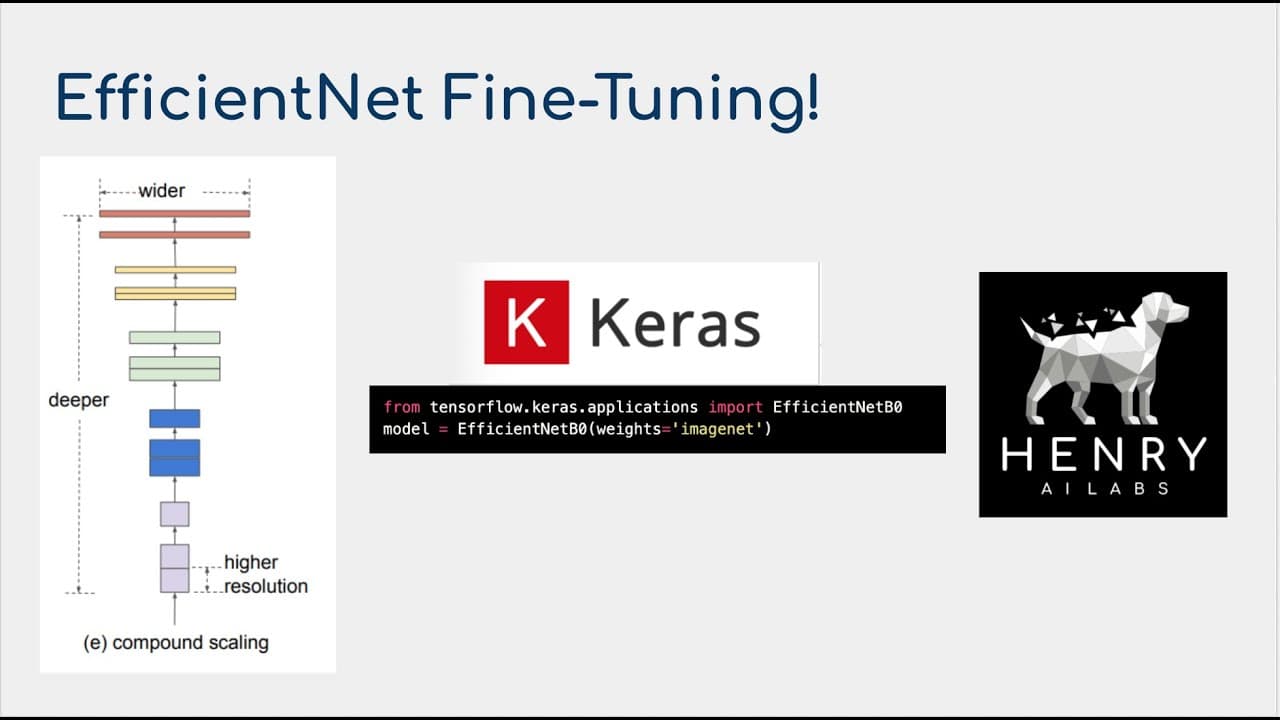
- ✋ EfficientNet leverages a unique compound scaling strategy across depth, width, and resolution, resulting in high efficiency for deep learning models.
- 🧡 The tutorial emphasizes the importance of choosing the right EfficientNet variant based on available computational resources and specific task requirements, ranging from B0 to B7.
- 🚂 Transfer learning allows practitioners with limited data to utilize powerful models pre-trained on extensive datasets, reducing the time and resources needed for training effective classifiers.
- 🛩️ Data augmentation is crucial for enhancing model robustness, addressing the overfitting issue typically encountered with smaller datasets by providing diverse training samples.
- 🥠 The significance of freezing certain layers, particularly batch normalization, optimizes the learning process during transfer learning by preserving previously fine-tuned parameters.
- 🧑🔬 EfficientNet's integration within the Keras ecosystem streamlines the deployment of advanced deep learning models, making it accessible for developers and data scientists alike.
- 👶 Exploring techniques like stochastic depth regularization can offer new avenues for improving deep network training, alongside traditional methods such as dropout and data augmentation.
Install to Summarize YouTube Videos and Get Transcripts
Explore YouTube Video Summarizer or Get YouTube Transcript Extractor
Questions & Answers
Q: What is EfficientNet and why is it significant in deep learning?
EfficientNet is a model family in deep learning that focuses on optimizing the scaling of convolutional neural networks. It employs a compound scaling method that systematically balances width, depth, and resolution, producing highly efficient architectures at various scales. The efficiency and performance of EfficientNet on benchmarks like ImageNet highlight its importance in image classification tasks.
Q: How do you implement transfer learning with Keras using EfficientNet?
To implement transfer learning with Keras, you can import the EfficientNet model, modify its output layer for your specific task, and utilize pre-trained weights, typically from ImageNet. By fine-tuning these weights on a smaller dataset, such as the Stanford Dogs dataset, while applying data augmentation techniques, you can enhance classification performance without extensive training data.
Q: What role does data augmentation play in improving model performance?
Data augmentation introduces variability into the training dataset by applying transformations like rotations, translations, and color adjustments. This prevents overfitting by allowing the model to generalize better and learn robust features, essential when working with smaller datasets. By enhancing the input data, augmentation improves the model's ability to recognize patterns in unseen data.
Q: Why is freezing batch normalization layers beneficial during transfer learning?
Freezing batch normalization layers retains learned scale and shift parameters from pre-training on large datasets like ImageNet. This stabilizes the learning process and speeds up convergence since these parameters have already been optimized for similar tasks, allowing the model to adapt more efficiently to new data without disturbance from retraining these critical components.
Q: How does EfficientNet's scaling from B0 to B7 affect input image resolution?
As the model scales from B0 to B7, the required input image resolution increases accordingly. EfficientNet B0 expects smaller images, while higher variants require larger images, emphasizing the need to match your data preprocessing steps with the specific model architecture to ensure compatibility and optimal performance.
Q: What performance improvements can be expected by using pre-trained weights versus training from scratch?
Using pre-trained weights significantly enhances initial validation accuracy and reduces training time. Models starting with these weights often achieve better performance faster compared to training from scratch, especially in scenarios with limited data, as they originate from mature feature representations learned from extensive datasets like ImageNet.
Q: How does stochastic depth regularization differ from traditional dropout?
Stochastic depth regularization involves dropping entire paths in a deep neural network during training instead of randomly dropping individual neurons as in traditional dropout. This technique promotes the utilization of the full architecture by forcing the network to learn more robust features, ultimately improving performance while preventing overfitting.
Q: What are some recent advancements in EfficientNet training methodologies?
Recent advancements include integrating advanced data augmentation strategies and semi-supervised learning techniques, such as the noisy student approach. These methodologies have led to improved performance benchmarks in tasks like image classification by leveraging both labeled and unlabeled data efficiently during the training phase.
Summary & Key Takeaways
-
The tutorial introduces EfficientNet and its scaling parameters, essential for fine-tuning models based on available computational resources, covering variants from B0 to B7.
-
It demonstrates using EfficientNet for classifying dog breeds from the Stanford Dogs dataset, emphasizing the importance of transfer learning and data augmentation in achieving better performance with limited data.
-
Key techniques such as freezing batch normalization layers, using pre-trained weights, and implementing various data augmentation strategies are discussed to enhance the model's training efficacy.
Read in Other Languages (beta)
Share This Summary 📚
Summarize YouTube Videos and Get Video Transcripts with 1-Click
Try YouTube Summary with ChatGPT & Claude or YouTube Transcript Generator
Explore More Summaries from Connor Shorten 📚
Summarize YouTube Videos and Get Video Transcripts with 1-Click
Try YouTube Summary with ChatGPT & Claude or YouTube Transcript Generator