How do random forests work?
TL;DR
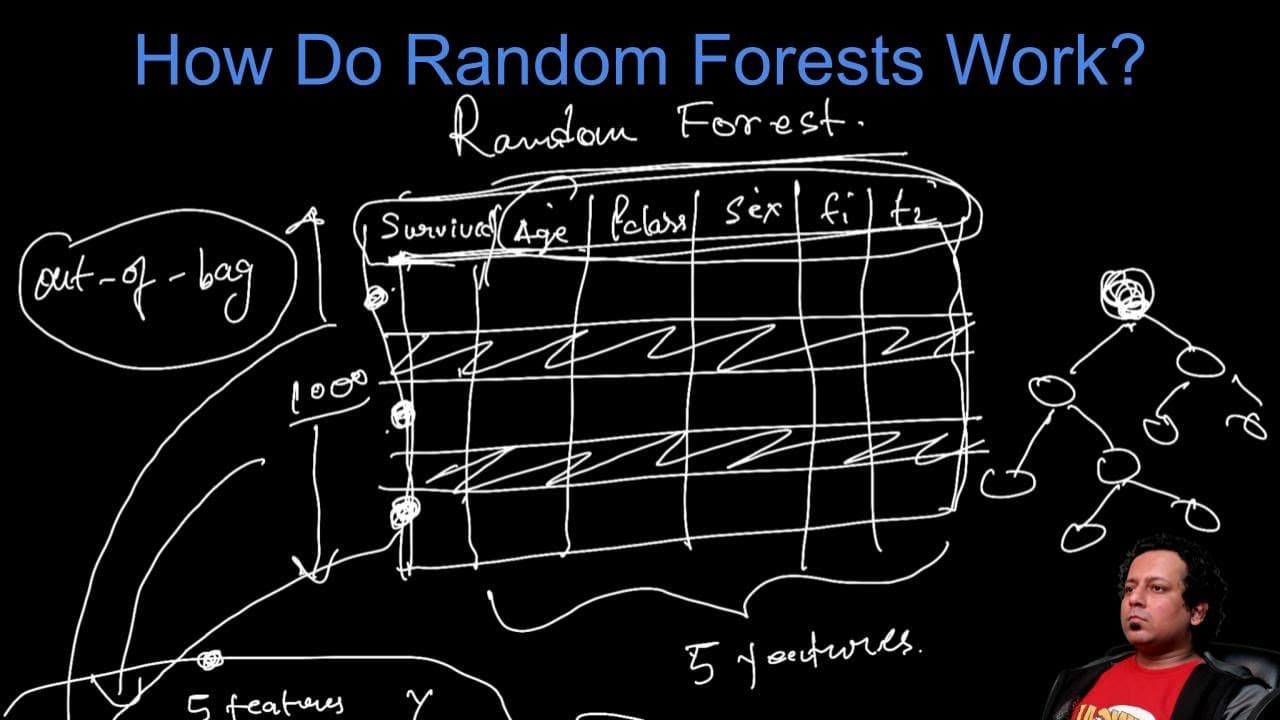
Random forests are an ensemble of decision trees that make predictions by combining multiple models, using a technique called bagging.
Transcript
hello everyone and welcome to my youtube channel today we are going to learn what random forests are and how they work random for us so this lecture has a prerequisite you should know what decision trees are and how they work then you can come to random forest so random forest uses something called bagging so backing is a technique in which you com... Read More
Key Insights
- 💦 Random forests are ensembles of decision trees that work together to make predictions.
- 💳 Bagging is a technique used to combine multiple models by creating sub-sampled datasets.
- 🌲 Random forests introduce randomness by selecting a subset of features for each decision tree.
- 🥖 Out-of-bag samples help evaluate the performance of the random forest model.
- ❓ Random forests can be used for both classification and regression problems.
- #️⃣ The number of decision trees and the choice of k, the number of features to choose at each node, are important parameters in random forests.
- 🥖 Combining multiple models through bagging generally improves accuracy compared to using a single model.
Install to Summarize YouTube Videos and Get Transcripts
Explore YouTube Video Summarizer or Get YouTube Transcript Extractor
Questions & Answers
Q: What is bagging in the context of random forests?
Bagging stands for Bootstrap Aggregating, which involves creating multiple sub-sampled datasets from the original dataset and training models on each of them. This technique helps improve accuracy by reducing the error that comes from a single model.
Q: How are decision trees built in random forests?
In random forests, each sub-sampled dataset is used to build a decision tree. The decision tree randomly selects a subset of features at each node to create the root node and continues this process as it progresses through the tree. This randomness adds diversity to the ensemble of decision trees.
Q: How do random forests make predictions?
Random forests make predictions by combining the predictions of multiple decision trees. For classification problems, the class with the majority vote from the decision trees is chosen. For regression problems, the average of the predicted values from the decision trees is taken.
Q: What are out-of-bag samples in random forests?
Out-of-bag samples are the data points that were not included in the sub-sampled dataset used to train a specific decision tree. These samples can be used to evaluate the performance of the random forest model by predicting their outcomes using the decision trees that did not see them during training.
Summary & Key Takeaways
-
Random forests use bagging to combine multiple models and improve accuracy in predicting outcomes.
-
Bagging involves creating sub-sampled datasets from the original dataset and training decision trees on each of them.
-
Random forests select a random subset of features for each decision tree, resulting in an ensemble of models that work together to provide predictions.
Read in Other Languages (beta)
Share This Summary 📚
Summarize YouTube Videos and Get Video Transcripts with 1-Click
Try YouTube Summary with ChatGPT & Claude or YouTube Transcript Generator
Explore More Summaries from Abhishek Thakur 📚


Summarize YouTube Videos and Get Video Transcripts with 1-Click
Try YouTube Summary with ChatGPT & Claude or YouTube Transcript Generator