Tabular DI | Data Interpretation | No of Students Courses | Reasoning | Part - 21 | Bharath Kumar
TL;DR
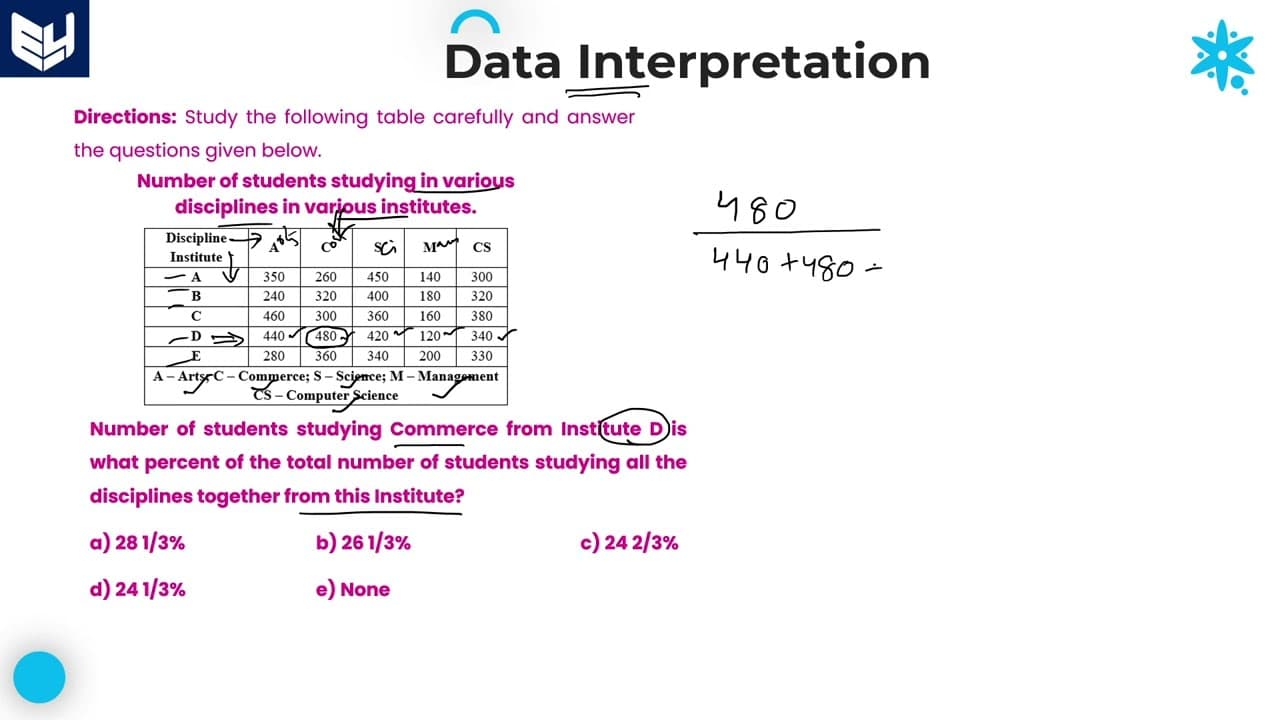
This content discusses student enrollment in various disciplines across different institutes and how to compute percentages and averages.
Transcript
hi everyone welcome to the session in this session I will continue the tablet data and operation problems first of all we need to read the information carefully based on that we need to solve the questions accordingly first of all in the information which is provided in this table is the number of students studying in various disciplines in various... Read More
Key Insights
- 🧑🎓 The table presents valuable data showing student enrollment in various disciplines across different institutes, illustrating diverse educational interest.
- 🏑 The calculated percentages and averages not only reveal participation levels in Commerce and other fields but also signal where institutions can improve enrollment strategies.
- ❓ The importance of careful calculation and avoidance of common approximation pitfalls is highlighted throughout the analysis, ensuring accuracy in educational assessments.
- 🥳 Understanding ratios between disciplines is crucial in analyzing student interests and trending educational pathways.
- 🧑🎓 The discussions provide a framework for effective problem-solving strategies for handling enrollment data, promoting critical numerical literacy among students.
- 😨 Emphasis on approximations can save time in exams, yet care should be taken to understand potential inaccuracies involved in this method.
- 🧑🎓 Percentages provide a clearer picture of student distributions, making it easier for educators to make informed decisions based on data interpretations.
Install to Summarize YouTube Videos and Get Transcripts
Explore YouTube Video Summarizer or Get YouTube Transcript Extractor
Questions & Answers
Q: What is the total number of students studying Commerce at Institute D, and how does it compare to the total students in the institute?
At Institute D, there are 480 students studying Commerce. To determine what percentage this represents of the total students, one would first need to sum the total enrollments from D, which is 2280. The calculation results in 26.67% for Commerce’s share of total students in D, indicating a notable participation in that discipline.
Q: How do you calculate the average number of students studying across all disciplines from Institute E?
To find the average of students in Institute E, you sum all enrollments across five disciplines (280 + 360 + 340 + 200 + 313 = 1493) and divide by the total number of disciplines, which is five. The result comes out to 298, reflecting the average distribution of students among the disciplines.
Q: What is the ratio of students studying Science combined from Institutes C and D to those studying Computer Science from the same institutes?
When we sum the Science students from Institutes C and D (360 + 420 = 780) and Computer Science students (380 + 340 = 720), the ratio of students in Science to Computer Science is 13:12. It effectively demonstrates how popular each discipline is among those two institutes.
Q: What is the methodology for calculating the overall average of students studying Commerce from all institutes?
First, you add the number of Commerce students across all institutes, which totals 2260 (adding 260, 320, 300, 480, and 360). Then, you divide this figure by the number of institutes (5) to get an average of 452, providing insights into the overall enrollment trends.
Summary & Key Takeaways
-
The video elaborates on a table showing the total number of students enrolled in five disciplines—Arts, Commerce, Science, Management, and Computer Science—across five institutes labeled A through E.
-
The speaker explains techniques for calculating the percentage of commerce students at Institute D relative to the total number of students in that institution and the average number of students in various disciplines.
-
Practical examples are provided along with calculations to find the ratio of science to computer science students as well as average enrollments accurately, highlighting common pitfalls in the process.
Read in Other Languages (beta)
Share This Summary 📚
Summarize YouTube Videos and Get Video Transcripts with 1-Click
Try YouTube Summary with ChatGPT & Claude or YouTube Transcript Generator