Conditional Probability With Venn Diagrams & Contingency Tables
TL;DR
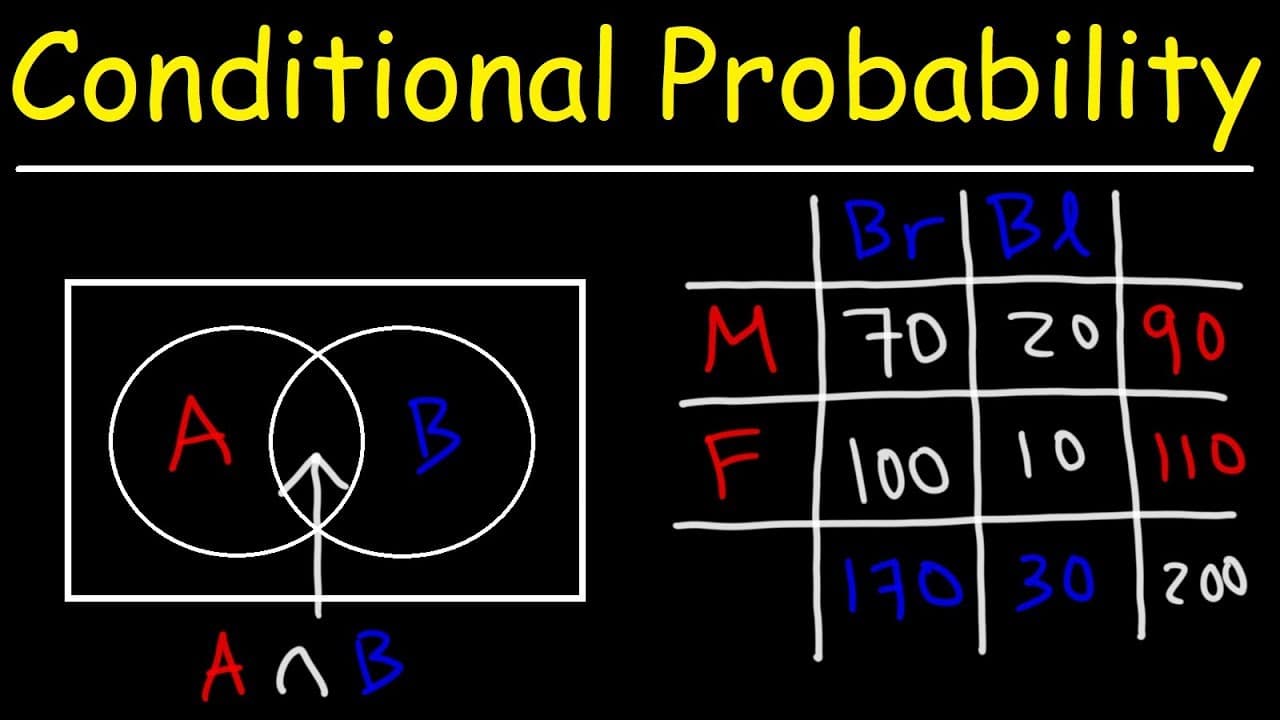
Conditional probability is the likelihood of one event occurring given that another event has already occurred, and it can be calculated using a formula or through simple counting methods.
Transcript
in this lesson we're going to focus on something called conditional probability perhaps you've seen something like this p of a with a bar next to it and then a b what does this mean this represents the probability that event a will occur given that event b has already occurred so let's say we have a six-sided die with a sample space of the numbers ... Read More
Key Insights
- ❓ Conditional probability represents the likelihood of one event occurring given that another event has already occurred.
- 🔙 Conditional probability can be calculated using counting methods or the formula P(A|B) = P(A and B) / P(B).
- ❓ It is important to consider the elements common to both events when calculating conditional probability.
Install to Summarize YouTube Videos and Get Transcripts
Explore YouTube Video Summarizer or Get YouTube Transcript Extractor
Questions & Answers
Q: What is conditional probability?
Conditional probability is the likelihood of one event occurring given that another event has already occurred. It can be represented as P(A|B) and can be calculated using counting methods or the formula P(A and B) / P(B).
Q: How do you calculate conditional probability using counting methods?
To calculate conditional probability using counting methods, you can count the number of elements in event A that are also in event B, and divide it by the total number of elements in event B.
Q: What is the formula for calculating conditional probability?
The formula for conditional probability is P(A|B) = P(A and B) / P(B), where P(A and B) is the probability of both events A and B occurring, and P(B) is the probability of event B occurring.
Q: Can you provide an example of calculating conditional probability using the formula?
Sure! Let's say there are 500 students in a school, 150 are enrolled in algebra, and 80 are enrolled in chemistry. If 30 students are taking both algebra and chemistry, the probability of a student taking algebra given that they are taking chemistry is 30/150 = 3/10 = 0.3 or 30%.
Summary & Key Takeaways
-
Conditional probability represents the probability of event A occurring given that event B has already occurred.
-
The conditional probability can be calculated by dividing the probability of both events occurring by the probability of event B occurring.
-
Examples are provided to demonstrate how to calculate conditional probability using both counting methods and the formula.
Read in Other Languages (beta)
Share This Summary 📚
Summarize YouTube Videos and Get Video Transcripts with 1-Click
Try YouTube Summary with ChatGPT & Claude or YouTube Transcript Generator
Explore More Summaries from The Organic Chemistry Tutor 📚



Summarize YouTube Videos and Get Video Transcripts with 1-Click
Try YouTube Summary with ChatGPT & Claude or YouTube Transcript Generator