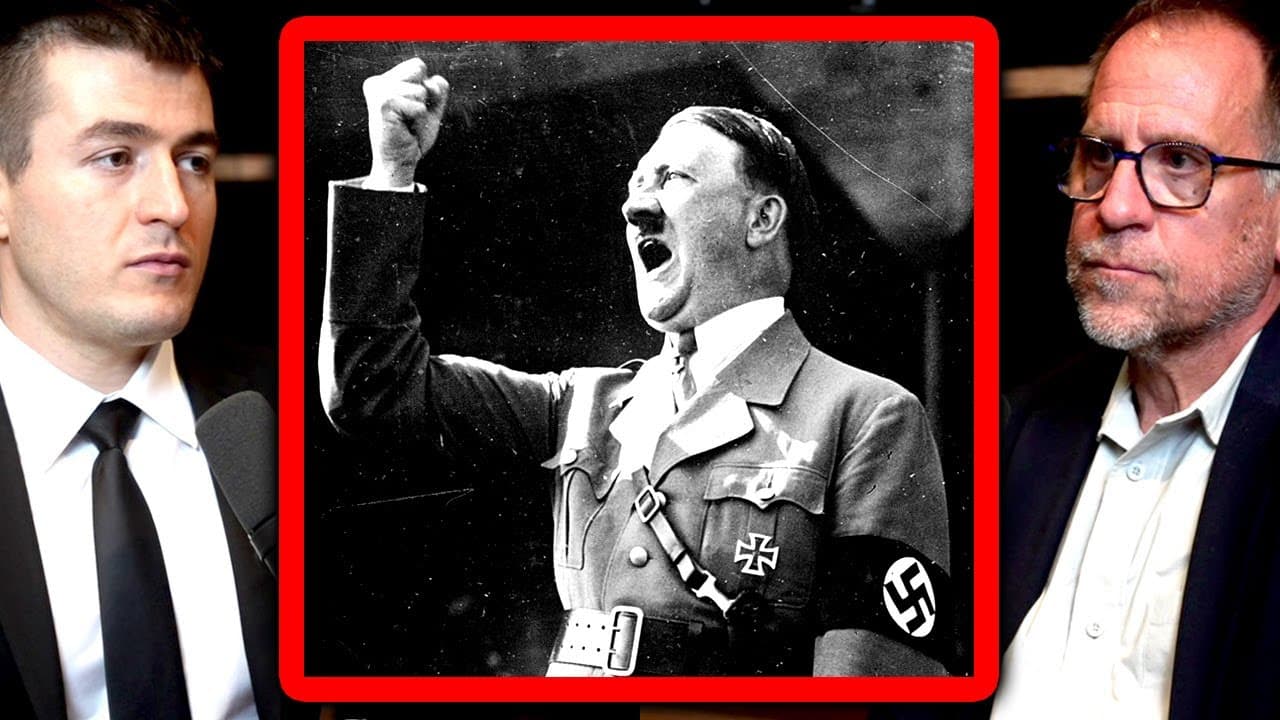
Hitler explained: Nazism is a religious ideology | John Vervaeke and Lex Fridman
TL;DR
Nazism emerged as a twisted form of Gnosticism during a period of deep meaning crisis in Germany, with Hitler playing a central religious role.
Transcript
you can only believe in an ends that can justify any means if you believe in a Utopia and you can only believe in the Utopia if you really buy into the Promethean spirit so is that what explains Nazism so Nazism is is part of that too the Promethean spirit that we can make ourselves into Superman ubermensch right and Nazism is fueled very much by a... Read More
Key Insights
- 🚨 Nazism emerged as a religious response to the meaning crisis in Germany during the Weimar Republic.
- 🖐️ The Promethean spirit and Gnostic themes played a significant role in fueling the beliefs and ideals of Nazism.
- 🤔 Hitler's charisma and symbolic role as a religious figure allowed him to exploit mythological thinking and rituals to provide meaning for the German people.
- 💯 Nazism should be understood as a complex interaction between political and religious factors, with a deep longing for meaning at its core.
- 😮 The Weimar Republic's societal breakdown and loss of identity created a fertile ground for the rise of Nazism.
- 🇨🇫 Mythologies and rituals were central to the Nazi ideology, providing a sense of belonging and purpose for individuals.
- ❓ Nazism's appropriation and distortion of Gnostic themes reflect the desire for a utopian society and the pursuit of superhuman ideals.
Install to Summarize YouTube Videos and Get Transcripts
Explore YouTube Video Summarizer or Get YouTube Transcript Extractor
Questions & Answers
Q: Was Nazism primarily a political or religious movement?
Nazism should be understood as a religious phenomenon beyond its political nature. It provided a distorted religious framework to address the deep meaning crisis in Germany during that time.
Q: Did the German people create Hitler or did Hitler create Nazi Germany?
It is a complex interaction. While the context of the meaning crisis in Germany allowed Hitler to rise, his charisma and ability to tap into mythological thinking made him the central figure in the creation of Nazi Germany.
Q: Can a charismatic leader be replaced by a collective group?
Ideally, a collective group can fulfill the role of a charismatic leader. However, in the case of Hitler and Nazi Germany, his charisma and symbolic role were essential in tapping into the collective mythological yearnings of the populace.
Q: How did Nazism incorporate mythologies and rituals?
Nazism created a Mythos around the master race and incorporated various rituals, such as the use of the swastika symbol. These mythologies and rituals provided a generative source of new meaning for individuals during a time of deep meaning scarcity.
Summary & Key Takeaways
-
Nazism, fueled by the Promethean spirit and Gnostic themes, offered a perverted sense of utopia and superhuman ideals during a time of deep meaning crisis in the Weimar Republic.
-
The loss of religion and identity, coupled with widespread suffering, created a vacuum that allowed Nazism to exploit mythologies and rituals to provide new meaning for people.
-
Hitler's charisma and symbolic role as a religious figure allowed him to tap into people's longing for meaning and lead them through mythological thinking.
Read in Other Languages (beta)
Share This Summary 📚
Summarize YouTube Videos and Get Video Transcripts with 1-Click
Try YouTube Summary with ChatGPT & Claude or YouTube Transcript Generator
Explore More Summaries from Lex Clips 📚




Summarize YouTube Videos and Get Video Transcripts with 1-Click
Try YouTube Summary with ChatGPT & Claude or YouTube Transcript Generator