This AI Captures Your Hair Geometry...From Just One Photo! 👩🦱
TL;DR
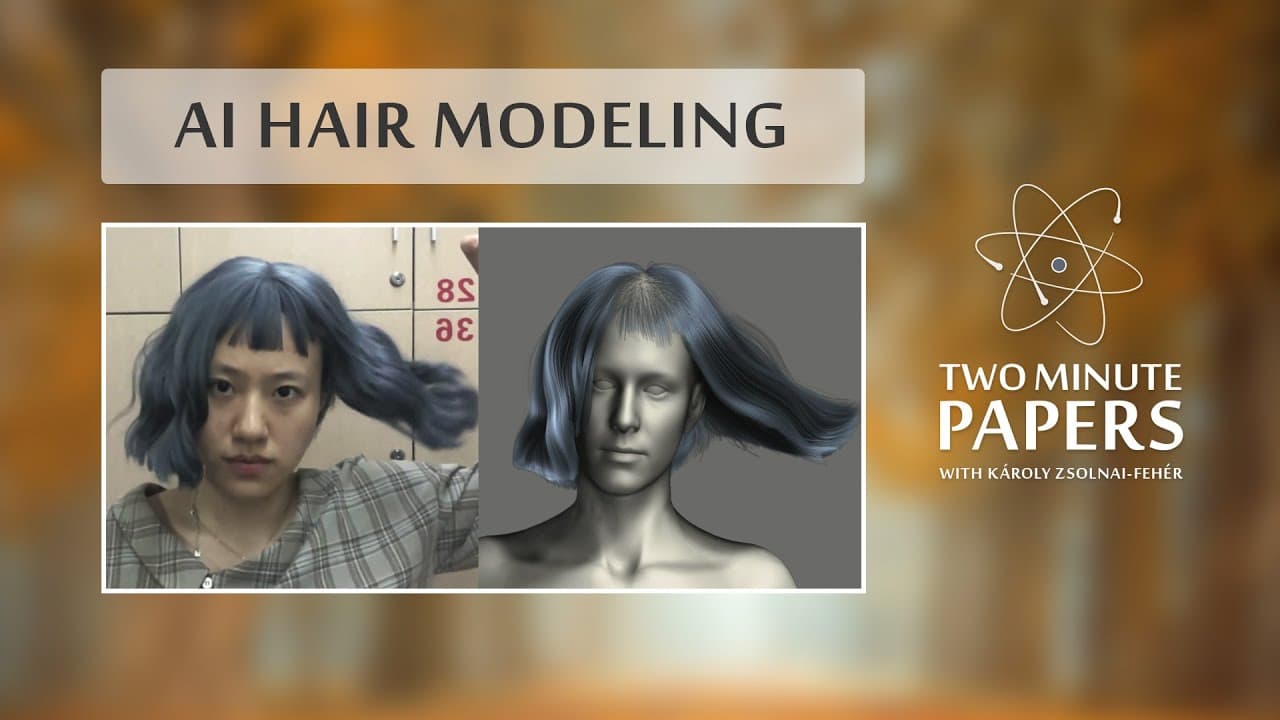
Advanced neural networks create realistic 3D hair simulations from 2D videos with motion and external forces.
Transcript
Dear Fellow Scholars, this is Two Minute Papers with Károly Zsolnai-Fehér. In this series, we talk about research on all kinds of physics simulations, including fluids, collision physics, and we have even ventured into hair simulations. If you look here at this beautiful footage, you may be surprised to know how many moving parts a researcher has t... Read More
Key Insights
- 👱 Neural networks create realistic 3D hair simulations from minimal 2D video data.
- 🥺 Predicting hair motion in 2D first leads to smoother and appealing results in 3D simulations.
- 🥶 Despite using less information than older methods, the new technique produces comparable outcomes.
- 👱 The research showcases advancements in computer graphics and realistic hair simulation.
- ✊ The learning-based framework emphasizes the power and efficiency of modern technologies in creating detailed simulations.
- 👱 The ability to generate full reconstructions of hair motion and shape without external data is a significant advancement.
- 👱 The study demonstrates the potential for creating realistic digital representations of hair using neural networks.
Install to Summarize YouTube Videos and Get Transcripts
Explore YouTube Video Summarizer or Get YouTube Transcript Extractor
Questions & Answers
Q: How do researchers create realistic 3D hair simulations from 2D videos?
Researchers use a learning-based framework with neural networks to predict hair geometry and motion from minimal data like two consecutive frames from a video.
Q: What is the significance of predicting hair motion in 2D first before extrapolating to 3D?
Predicting hair motion in 2D first allows the neural networks to generate smoother and more appealing results, enhancing the realism of the 3D hair simulations.
Q: How does the new technique compare to older methods that had access to multiple views of the model?
The new technique, despite having limited data from monocular 2D videos, produces comparable results to older methods with more information, showcasing its efficiency and power.
Q: What is the key contribution of the research in the field of computer graphics?
The research highlights the remarkable progress in computer graphics by demonstrating the ability to accurately simulate hair motion and shape, showcasing the potential for realistic digital representations.
Summary & Key Takeaways
-
Research explores creating accurate 3D models of hairstyles from 2D videos using neural networks.
-
The new technique generates full reconstructions of hair motion and shape without external data.
-
The study showcases advancements in computer graphics and realistic hair simulation.
Read in Other Languages (beta)
Share This Summary 📚
Summarize YouTube Videos and Get Video Transcripts with 1-Click
Try YouTube Summary with ChatGPT & Claude or YouTube Transcript Generator
Explore More Summaries from Two Minute Papers 📚



Summarize YouTube Videos and Get Video Transcripts with 1-Click
Try YouTube Summary with ChatGPT & Claude or YouTube Transcript Generator