LCM | 3 - Modals | Aptitude | Part- 03 | Bharath Kumar
TL;DR
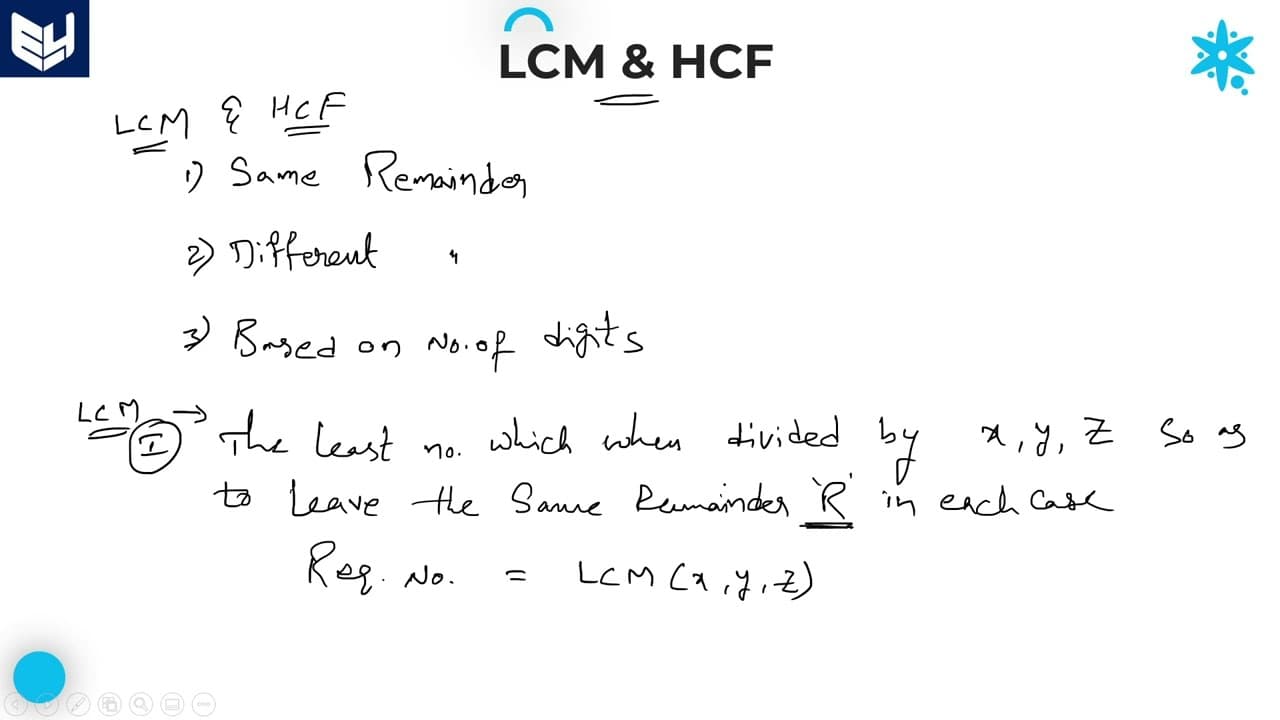
This session explains three problem models for LCM and HCF calculations.
Transcript
hi everyone welcome back in this session i'm continuing lcm and lcf in the last session i have explained a few methods of lcm and hcf that is long division method as well as factorization method now in this session i am going to discussing about what are the various models of problems in lcm as well as hcf first we'll start with the lcm see in lcm ... Read More
Key Insights
- ⚾ LCM models are categorized into three distinct problem-solving frameworks based on remainder uniformity, remainder variability, and digit specificity.
- #️⃣ The same remainder model emphasizes LCM augmentation with the given remainder to find the correct number.
- 📁 In the different remainders model, equal common differences are paramount to utilize direct calculation methods.
- 🍵 The digit-based model requires understanding how to handle significant figures in mathematical problems involving divisibility.
- 💯 Accurate computation of LCM is vital in all models, serving as the core principle for problem resolution.
- 🗯️ The values derived from various models can sometimes overlap, necessitating careful analysis of the problem type to select the right approach.
- 🛟 The integration of remainders in these models serves a critical function in determining not just divisibility but also the uniqueness of the solution.
Install to Summarize YouTube Videos and Get Transcripts
Explore YouTube Video Summarizer or Get YouTube Transcript Extractor
Questions & Answers
Q: What is the first model of LCM problems about?
The first model of LCM problems involves finding the least number that leaves the same remainder when divided by a set of numbers. The required solution is computed as the LCM of those numbers added to the specified remainder. This method is essential for uniformity in remainders across different divisors.
Q: How do you approach the second model with different remainders?
In the second model, the goal is to find the least number leaving different remainders when divided by a set of numbers. The solution requires calculating the LCM and subtracting the common difference from it. It's crucial to ensure that the common differences derived from the individual divisors and their remainders are equal for the method to hold.
Q: What does the third model focus on concerning number digits?
The third model concentrates on finding the least number with a specific number of digits that is divisible by given numbers. For instance, to find the least four-digit number divisible by certain divisors, you calculate LCM of those numbers and adjust using the least number's value and any relevant remainders for an accurate result.
Q: What should you do if common differences are not equal in the second model?
If the common differences for different remainders are found not to be equal, the recommended approach is to use the option verification method. This involves solving the problem by testing various options rather than relying solely on the theoretical common difference, ensuring the accuracy of the answer.
Summary & Key Takeaways
-
The session outlines three models for solving problems related to LCM (Least Common Multiple) and HCF (Highest Common Factor), including same remainder, different remainders, and digit-based problems.
-
The first model focuses on determining the least number that leaves the same remainder when divided by given numbers, and the solution involves LCM plus the specified remainder.
-
The second model examines cases with different remainders, emphasizing the importance of finding a common difference and whether it’s consistent across the numbers.
Read in Other Languages (beta)
Share This Summary 📚
Summarize YouTube Videos and Get Video Transcripts with 1-Click
Try YouTube Summary with ChatGPT & Claude or YouTube Transcript Generator