How to Calculate Inertia and Period of a Physical Pendulum
TL;DR
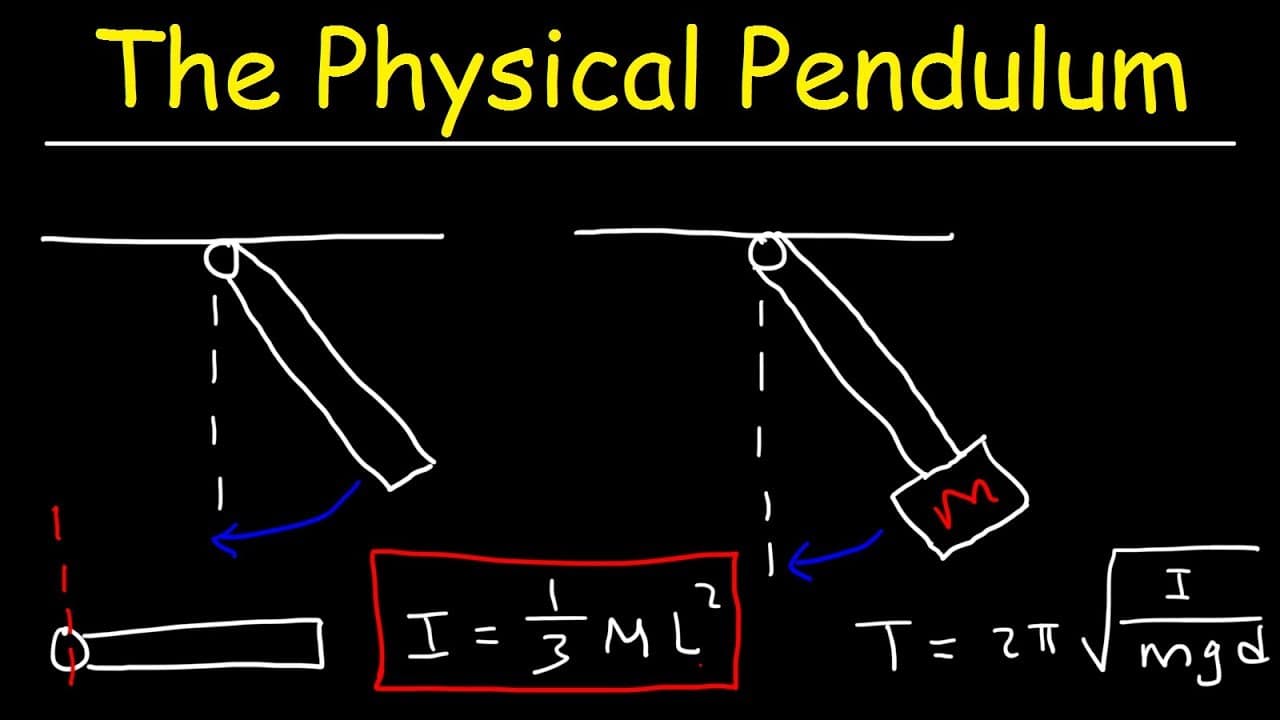
To calculate the inertia of a physical pendulum with a uniform rod, use the formula 1/3 * mass * length². The period can be found using 2π * √(inertia / (mass * gravity * distance to center of gravity). For systems with additional masses, adjust the total inertia and recalculate the center of mass accordingly.
Transcript
in this video we're going to talk about how to solve problems associated with the physical pendulum so in this example we have a 1.5 meter uniform rod with a mass of 0.6 kilograms and it's acting as a physical pendulum as you can see in the figure below what is the inertia of the rod about its axis of rotation so it rotates about this point l is th... Read More
Key Insights
- ❤️🩹 The inertia of a physical pendulum with a uniform rod rotating about its end is given by 1/3 * mass * length^2.
- 💆 The period of a physical pendulum depends on the inertia, mass, gravity, and the distance between the axis and the center of gravity.
- 💆 Adding a block to a physical pendulum changes the total inertia, and the center of mass needs to be calculated.
- 💆 The period of the pendulum can be calculated using the total inertia, total mass, gravity, and the distance between the axis and the center of mass.
- ❤️🩹 The formula for a simple pendulum can be derived from the formula for a physical pendulum by considering a massless string and concentrated mass at the end.
Install to Summarize YouTube Videos and Get Transcripts
Explore YouTube Video Summarizer or Get YouTube Transcript Extractor
Questions & Answers
Q: How do you calculate the inertia of a physical pendulum with a uniform rod?
The inertia for a uniform rod rotating about its end is given by the formula 1/3 * mass * length^2.
Q: What is the formula for calculating the period of a physical pendulum?
The period of a physical pendulum can be calculated using the formula 2π * √(inertia / (mass * gravity * distance between axis and center of gravity)).
Q: How do you calculate the total inertia of a physical pendulum with a rod attached to a block?
Calculate the inertia of the rod using the formula 1/3 * mass * length^2, and add it to the inertia of the block, which is equal to mass * length^2.
Q: How do you find the center of mass for a physical pendulum with a rod and a block?
Use the equation (mass1 * position1 + mass2 * position2) / total mass, where mass1 and position1 are the mass and position of the rod, and mass2 and position2 are the mass and position of the block.
Summary & Key Takeaways
-
To calculate the inertia of a physical pendulum with a uniform rod rotating about its end, use the formula 1/3 * mass * length^2.
-
The period of a physical pendulum can be calculated using the formula 2π * √(inertia / (mass * gravity * distance between axis and center of gravity)).
-
For a physical pendulum with a rod attached to a block, calculate the total inertia by adding the inertia of the rod and the block.
-
Determine the center of mass of the pendulum system using the equation (mass1 * position1 + mass2 * position2) / total mass.
-
Calculate the period of the pendulum with the formula 2π * √(inertia / (total mass * gravity * distance between axis and center of mass)).
Read in Other Languages (beta)
Share This Summary 📚
Summarize YouTube Videos and Get Video Transcripts with 1-Click
Try YouTube Summary with ChatGPT & Claude or YouTube Transcript Generator
Explore More Summaries from The Organic Chemistry Tutor 📚




Summarize YouTube Videos and Get Video Transcripts with 1-Click
Try YouTube Summary with ChatGPT & Claude or YouTube Transcript Generator