How Words Get Stuck on the Tip of Your Tongue
TL;DR
Researchers delve into tip-of-the-tongue states, exploring how our brains struggle to recall words, offering solutions.
Transcript
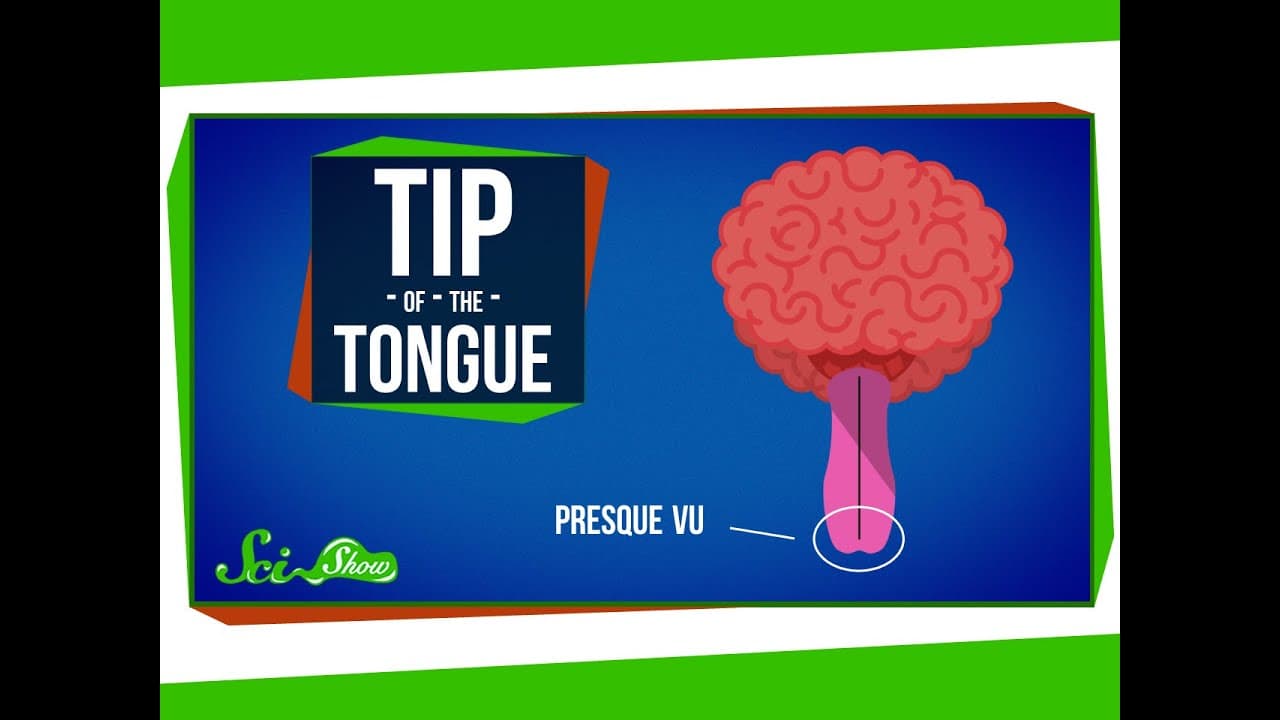
We all know it, the intense frustration, the deep self loathing when a word is stuck right on the tip of your tongue. Researchers have been studying this phenomenon since the 1960's, hoping for some relief, and finally, thanks to science, we have salvation! The words "presque vu," meaning "almost seen," describe that thing where you can almost say ... Read More
Key Insights
- 😋 Tip-of-the-tongue states are common occurrences when we struggle to recall familiar words, becoming more frequent with age.
- 🧠 Connectionist models combine neuroscience and computer science to understand how our brains handle language.
- 🦻 Providing hints rather than directly giving the word aids in better recall and reinforces the correct pathways in the brain.
- 😋 Understanding the science behind tip-of-the-tongue states can help improve cognitive functioning and linguistic abilities.
- 🧠 Activation spreads through clusters of neurons in the brain during word retrieval, with pathways changing and reinforcing with each recall instance.
- 🔑 The resolution effect suggests that self-retrieval of a word is more beneficial than being told the word directly.
- 😒 The more we use certain neural pathways for recalling a word, the stronger and more defined those pathways become.
Install to Summarize YouTube Videos and Get Transcripts
Explore YouTube Video Summarizer or Get YouTube Transcript Extractor
Questions & Answers
Q: What are tip-of-the-tongue states, and why do they occur?
Tip-of-the-tongue states are moments where we struggle to recall a known word, often happening more as we age due to a combination of factors like semantic and phonological information becoming temporarily disconnected.
Q: How do connectionist models help explain tip-of-the-tongue states?
Connectionist models combine neuroscience and computer science to simulate how neurons in our brains process language, showing how activation spreads through clusters of neurons during word retrieval.
Q: Why is it better to provide hints rather than directly tell someone the word they are struggling to recall?
Providing hints helps the individual establish the correct connections in their brain, reinforcing the pathway for future retrieval, making it easier for them to recall the word on their own next time.
Q: How can understanding the science of tip-of-the-tongue states benefit us in day-to-day situations?
Understanding the processes behind tip-of-the-tongue states can help us develop strategies to aid in word retrieval, improving our linguistic abilities and cognitive functioning.
Summary & Key Takeaways
-
Tip-of-the-tongue states occur when we struggle to recall a word we know, becoming more frequent with age.
-
Connectionist models blend neuroscience and computer science to understand how our brains handle language.
-
Providing hints rather than directly revealing the word aids in better recall.
Read in Other Languages (beta)
Share This Summary 📚
Summarize YouTube Videos and Get Video Transcripts with 1-Click
Try YouTube Summary with ChatGPT & Claude or YouTube Transcript Generator
Explore More Summaries from SciShow 📚

Summarize YouTube Videos and Get Video Transcripts with 1-Click
Try YouTube Summary with ChatGPT & Claude or YouTube Transcript Generator