What Was Pax Romana and Who Were Its Emperors?
TL;DR
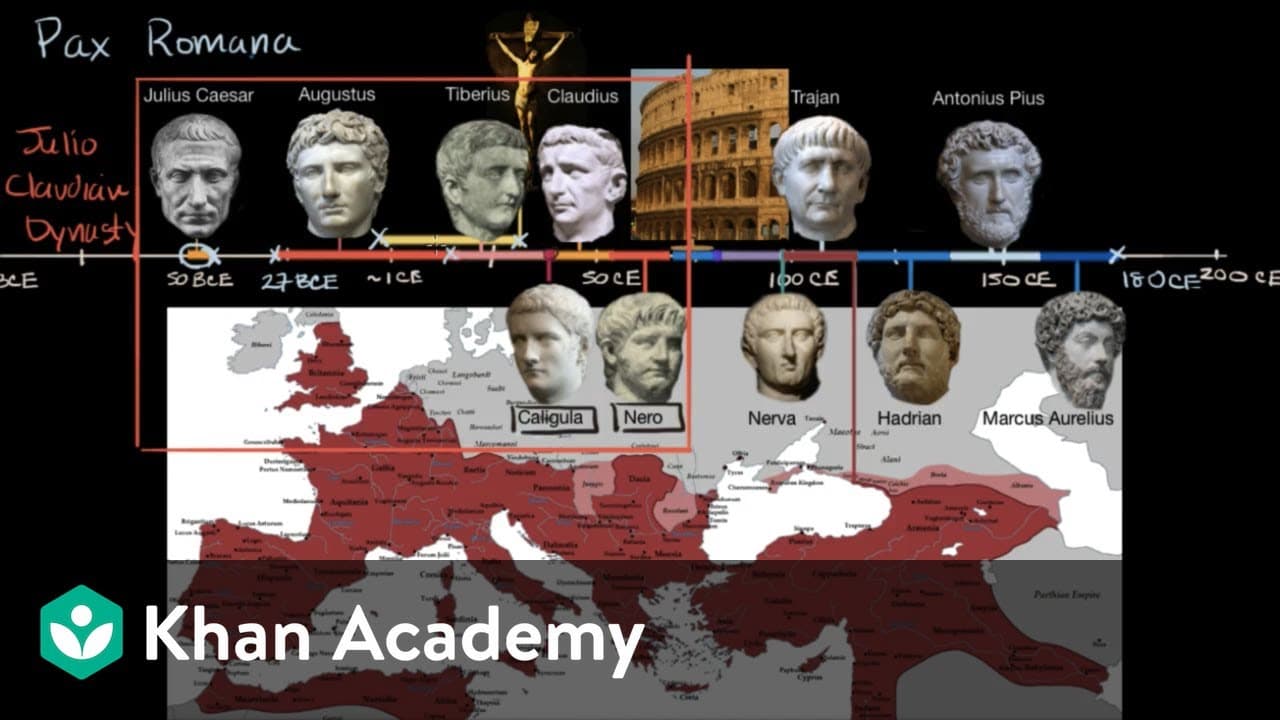
Pax Romana, meaning 'Roman Peace', was a 200-year period of relative stability in the Roman Empire, beginning with Augustus in 27 BCE. This era featured capable rulers, such as Augustus and Tiberius, alongside infamous emperors like Caligula and Nero, who contributed to its complexity through conflicts and cruelty. The period ultimately ended with Marcus Aurelius.
Transcript
- [Instructor] As we saw in the last several videos, the Roman Republic that was established in 509 BCE, it finally met its end with the rule of Julius Caesar. We talk about Julius Caesar crossing the Rubicon, becoming dictator for life, and then he's assassinated because of the power he was able to accumulate in 44 BCE, on March 15th, the Ides of ... Read More
Key Insights
- 📏 The Roman Empire experienced a relatively stable period known as Pax Romana under the rule of Augustus and his successors.
- ❓ Infamous emperors like Caligula and Nero brought cruelty, paranoia, and persecution to Rome.
- 🙈 The Julio-Claudian dynasty saw both capable rulers and tyrannical figures.
- 👷 The Flavian dynasty left a lasting legacy with the construction of the Colosseum and the destruction of the Second Temple in Jerusalem.
- ❓ The Good Emperors, including Trajan and Marcus Aurelius, expanded the empire and were known for their administrative skills and philosophical pursuits.
- 😀 The Roman Empire faced constant conflicts, bloodshed, and the enslavement of people throughout its existence.
Install to Summarize YouTube Videos and Get Transcripts
Explore YouTube Video Summarizer or Get YouTube Transcript Extractor
Questions & Answers
Q: How did Julius Caesar's rule lead to the end of the Roman Republic?
Julius Caesar crossed the Rubicon, became dictator for life, and was assassinated due to his accumulating power, sparking a civil war that eventually led to the collapse of the Republic.
Q: Who were the most infamous emperors of Rome and why?
Caligula and Nero were notorious for their sadistic and perverted behavior. Caligula killed people for fun, while Nero intentionally caused a significant fire, persecuted Christians, and even killed his own mother.
Q: What was the significance of the Julio-Claudian dynasty?
The Julio-Claudian dynasty comprised emperors descended from the Julian line (related to Julius Caesar) and the Claudian family. This dynasty saw both capable rulers like Augustus and Tiberius, as well as cruel leaders like Caligula and Nero.
Q: Who were the Good Emperors of Rome, and why were they called "good"?
The Good Emperors included Trajan, Hadrian, and Marcus Aurelius. They were considered good because they were viewed as able administrators who expanded the empire and brought relative peace and stability during the Pax Romana.
Summary & Key Takeaways
-
The Roman Republic ends with Julius Caesar's rule, leading to a civil war between Augustus and Mark Antony and Cleopatra. Augustus emerges victorious, starting a 200-year period of relative stability known as Pax Romana.
-
Augustus and Tiberius were capable emperors who set the foundation for the Roman Empire. Jesus was born and crucified during their rule.
-
Caligula and Nero, infamous figures, ruled after Tiberius and were known for their cruelty and persecution of Christians. Nero's reign marked the end of the Julio-Claudian dynasty.
-
Vespasian, Titus, and Domitian of the Flavian dynasty were known for building the Colosseum and destroying the Second Temple in Jerusalem.
-
The Good Emperors, including Trajan, Hadrian, and Marcus Aurelius, expanded the empire and were viewed as able administrators. The Pax Romana ended with Marcus Aurelius.
Read in Other Languages (beta)
Share This Summary 📚
Summarize YouTube Videos and Get Video Transcripts with 1-Click
Try YouTube Summary with ChatGPT & Claude or YouTube Transcript Generator
Explore More Summaries from Khan Academy 📚





Summarize YouTube Videos and Get Video Transcripts with 1-Click
Try YouTube Summary with ChatGPT & Claude or YouTube Transcript Generator