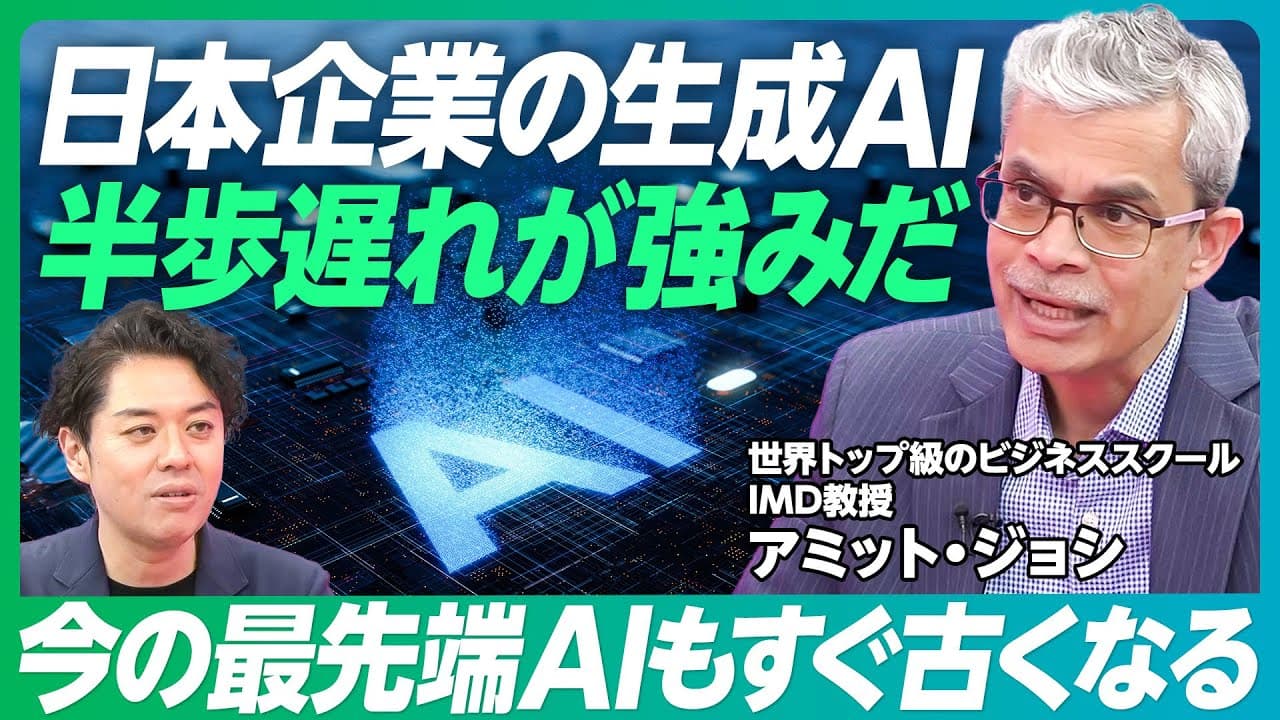
【日本の生成AI 半歩遅れが強み】名門ビジネススクール・IMD アミット・ジョシ教授/独自AI開発はOpenAIやGoogleに任せる/普通の企業がやるべき生成AI活用法【PIVOT GLOBAL】
TL;DR
Japanese companies are cautiously adopting AI, allowing others to make initial mistakes.
Transcript
how do you think the Japanese companies are adapting I do you think they're adapting it well or what's your impression what I really like is Japanese companies are not blindly rushing into implementing this they're not uh falling for the oh my God everybody else is doing it we should quickly do something with it I would say Japan is perhaps half a ... Read More
Key Insights
- Japanese companies are taking a cautious approach to AI implementation, which allows them to learn from others' mistakes and adapt more effectively.
- Generative AI is currently overhyped, with discussions often focusing on extreme scenarios rather than practical applications.
- The two primary use cases for generative AI are knowledge management and programming assistance, accounting for 90% of applications.
- For effective AI utilization, companies need to focus on organizing and cleaning their data, as messy data can hinder AI's potential.
- Creating a clear problem statement is crucial for identifying valuable data and determining how AI can address specific business challenges.
- Traditional companies may have an advantage due to their extensive data histories, provided they manage and clean their data effectively.
- Regulation of AI remains a complex issue, requiring a balance between preventing misuse and fostering innovation.
- The future of AI lies in practical applications that add value and improve lives, beyond the initial hype and theoretical discussions.
Install to Summarize YouTube Videos and Get Transcripts
Explore YouTube Video Summarizer or Get YouTube Transcript Extractor
Questions & Answers
Q: How are Japanese companies approaching AI adoption?
Japanese companies are taking a cautious approach to AI adoption, which allows them to observe and learn from the mistakes of other companies that have rushed into implementation. This strategy is seen as beneficial because it enables Japanese firms to adapt more effectively and avoid potential pitfalls associated with premature adoption.
Q: What are the main use cases for generative AI?
The main use cases for generative AI are knowledge management and programming assistance. Knowledge management involves using AI to organize and make sense of large amounts of internal data, while programming assistance helps software engineers by acting as a co-pilot to improve coding efficiency. These two applications account for approximately 90% of current AI use cases.
Q: Why is data management important for AI implementation?
Data management is crucial for AI implementation because the effectiveness of AI depends on the quality and organization of the data it processes. Companies need to clean and structure their data to ensure it is accessible and usable. Without proper data management, AI tools cannot perform optimally, limiting their potential to solve business problems.
Q: What challenges do traditional companies face with AI?
Traditional companies often have a wealth of historical data, which can be an advantage for AI implementation. However, they face challenges related to data management, such as cleaning and organizing data, ensuring data governance, and integrating disparate data systems. Addressing these challenges is essential for leveraging AI effectively and gaining a competitive edge.
Q: How should companies identify valuable data for AI projects?
Companies should start by clearly defining the problem they aim to solve with AI. Once the problem is defined, they can determine the minimum necessary data required to address it. This approach helps focus efforts on obtaining and cleaning only the most relevant data, rather than getting overwhelmed by the sheer volume of available information.
Q: What is the role of regulation in AI development?
Regulation plays a critical role in AI development by ensuring that AI technologies are used responsibly and ethically. However, finding the right balance is challenging, as overly strict regulations can stifle innovation, while too lenient an approach can lead to misuse. Effective regulation should aim to protect users while encouraging technological advancement.
Q: What is the future potential of generative AI?
The future potential of generative AI lies in its ability to move beyond the current hype and be applied in ways that add real value to businesses and society. As the technology matures, companies will likely discover innovative applications that improve efficiency, enhance customer experiences, and create new business opportunities, much like past technological revolutions.
Q: How can companies ensure successful AI integration?
Successful AI integration requires companies to focus on the 'boring' foundational tasks, such as data cleaning, governance, and infrastructure. By ensuring that these elements are in place, companies can better leverage AI technologies to solve specific business problems. Additionally, starting with a clear problem statement helps guide AI projects and align them with business objectives.
Summary & Key Takeaways
-
Japanese companies are not rushing into AI adoption, allowing them to learn from others' mistakes and adapt their strategies effectively. This cautious approach is seen as beneficial in the rapidly evolving AI landscape.
-
Generative AI, while overhyped, offers significant potential in knowledge management and programming assistance. Companies can leverage these applications to improve efficiency and productivity, provided they have clean and organized data.
-
Effective AI implementation requires a focus on data management and problem definition. Traditional companies with rich data histories can benefit, but they must invest in data cleaning and governance to fully leverage AI's potential.
Read in Other Languages (beta)
Share This Summary 📚
Summarize YouTube Videos and Get Video Transcripts with 1-Click
Try YouTube Summary with ChatGPT & Claude or YouTube Transcript Generator
Explore More Summaries from PIVOT 公式チャンネル 📚





Summarize YouTube Videos and Get Video Transcripts with 1-Click
Try YouTube Summary with ChatGPT & Claude or YouTube Transcript Generator